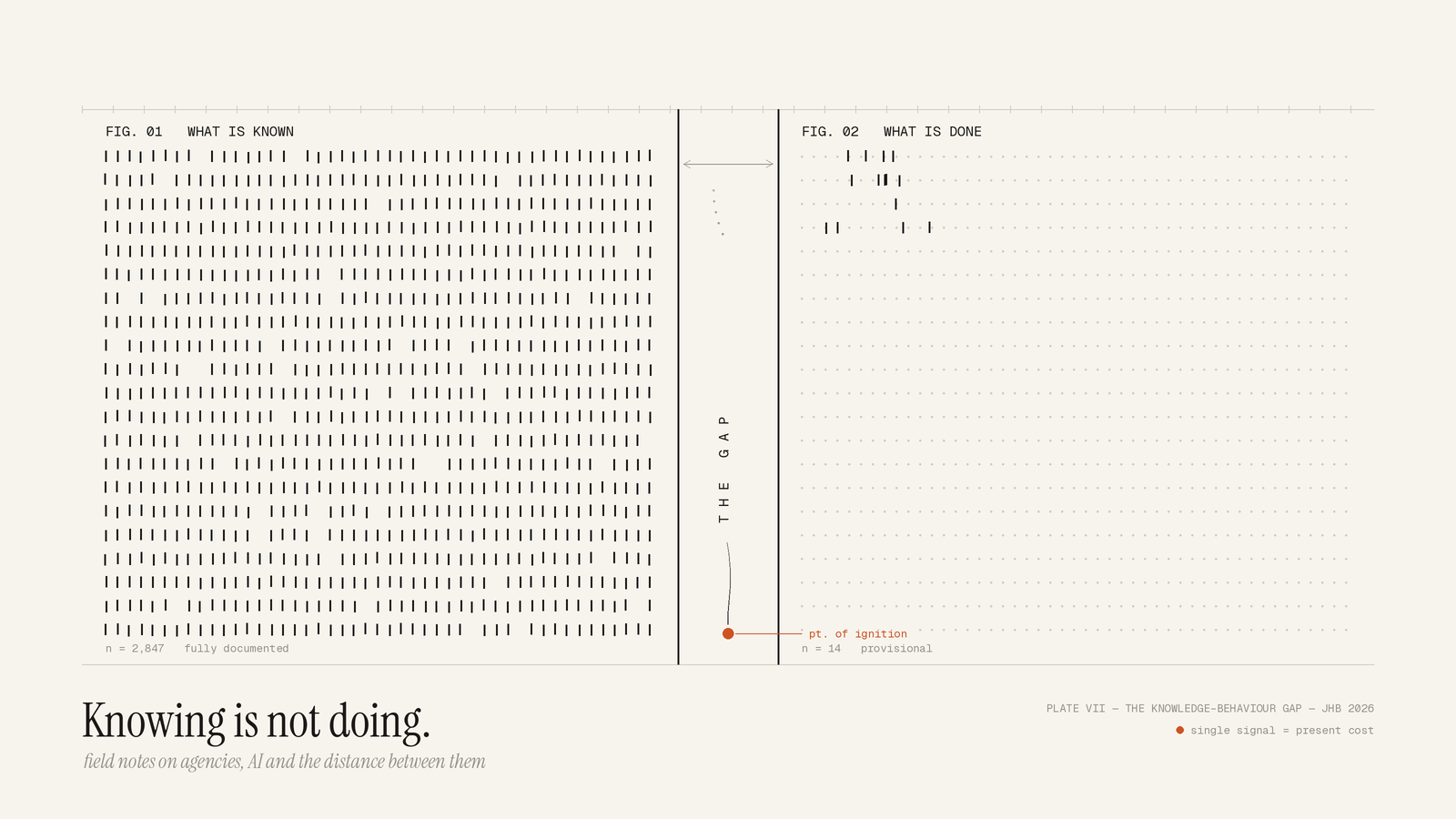
There is a well-worn puzzle in behavioural science that goes something like this: if information changed behaviour, no doctor would smoke. Yet plenty do. They can recite the epidemiology of lung cancer better than anyone, they have watched patients die of it, and still the habit persists. Knowledge, it turns out, is one of the weakest levers we have for changing what people actually do.
The advertising and marketing agency world is currently living out its own version of the smoking doctor. Walk into any agency boardroom in Johannesburg, Cape Town or Durban and you will find leadership teams who are remarkably well informed about artificial intelligence. They have attended the conferences, read the McKinsey reports, run the pilot projects and posted the obligatory LinkedIn think pieces. Ask them whether AI will fundamentally reshape their industry and they will say yes without hesitation. Then look at how the agency actually operates, how it prices, how it staffs, how it produces work, and you will often find that very little has changed.
This is not ignorance. It is the knowledge-behaviour gap, and understanding why it exists is far more useful than another round of AI education.
The habit is load-bearing
The first thing to understand about the smoking doctor is that the cigarette is rarely just a cigarette. It is woven into stress management, social rituals and daily routine. Removing it means unpicking a whole system, not just dropping a single behaviour.
Agencies face the same structural entanglement, except the habit in question is the billable hour and the headcount-based retainer. Most agency revenue models are built on selling time. AI collapses time. A campaign concept that took a strategist and two creatives three weeks can now be developed, tested and iterated in days. Every agency leader knows this. But acting on it means deliberately shrinking the very thing you invoice for, before any client has forced your hand.
So the knowledge sits in one part of the organisation while the incentives sit in another, pulling in the opposite direction. Finance directors are not rewarded for cannibalising margin. Client service directors are not rewarded for reopening pricing conversations that might invite scrutiny. The status quo pays everyone's salary this month, and transformation only pays off in some hazy future. In behavioural terms, the habit is load-bearing. You cannot simply remove it without redesigning the structure around it.
Present pain beats future harm
Behavioural scientists call it temporal discounting: humans systematically undervalue consequences that are distant and probabilistic, and overvalue costs and comforts that are immediate and certain. The smoker knows the cancer risk is real, but it is twenty years away and might not happen. The craving is here now.
For agencies, the future harm is losing relevance, losing clients to leaner competitors, or being disintermediated entirely as brands take AI-assisted work in-house. All real, all serious, all comfortably vague. The present pain of transformation, by contrast, is concrete and immediate: retraining teams, restructuring departments, having awkward conversations with clients about what things should now cost, and possibly telling long-serving people that their roles are changing or disappearing. Faced with certain discomfort today versus probable decline in three to five years, most organisations choose the same thing the smoker chooses. One more year. One more financial cycle. We will deal with it after the big pitch.
The rationalisations are half true, which is what makes them dangerous
The smoking doctor has a repertoire of comforting stories. My grandfather smoked until ninety. I only smoke socially. I will quit before it matters. The stories work because each contains a grain of truth.
Agencies have their own repertoire. Clients still value the human touch. AI output is generic and off-brand. Our work is too strategic to automate. South African audiences need local nuance that a model trained overseas cannot capture. Every one of these statements is partly true, and that partial truth is exactly what makes them effective sedatives. They allow leadership to acknowledge AI in general while exempting their own agency in particular. The doctor knows smoking kills, just not him. The agency knows AI disrupts, just not them.
Performative adoption is the organisational version of social smoking
One of the more interesting patterns is what might be called performative adoption. The agency launches an AI task force. It runs a hackathon. It produces a polished credentials deck about its AI capabilities for new business pitches. Meanwhile the actual production floor works much as it did in 2019, with AI tools used informally around the edges by individuals rather than embedded in workflow, pricing and quality control.
This is not cynicism, mostly. It is identity protection. Creative careers are built on craft, and craft is precisely what generative AI appears to encroach on. Fully absorbing that reality is not a process change, it is an ego injury, and organisations flinch from ego injuries just as individuals do. So the industry ends up with a great deal of AI theatre: visible enough to reassure clients and staff that the agency is modern, shallow enough that nobody's actual job or margin is disturbed.
What actually shifts behaviour
If knowledge were sufficient, the industry would already have transformed, because the knowledge is abundant. The behavioural science literature is blunt about this: information is necessary but nowhere near sufficient. Models like COM-B point out that behaviour requires capability, opportunity and motivation together. Agencies largely have the capability, since the tools are accessible and the talent can learn. They have the opportunity, since the technology is cheap and improving monthly. What is compromised is motivation, because the existing business model rewards inertia right up until the moment it collapses.
That means real change in this industry is unlikely to come from more education, more inspiration keynotes or more internal evangelism. It will come from environmental shifts that change the incentives themselves. Clients and procurement teams asking pointed questions about AI-adjusted pricing. Marketing budgets that assume compressed timelines. A competitor visibly winning accounts with a restructured, output-based model. In-house teams demonstrating that they can do eighty percent of the work at thirty percent of the cost. When the environment changes, behaviour follows with remarkable speed, in the same way that smoking rates only fell meaningfully when the environment changed: taxation, bans in public spaces, social stigma. The doctors did not quit because they finally read the research. They quit when the world around the habit stopped supporting it.
The uncomfortable implication for agency leaders
The honest conclusion is uncomfortable. If you lead an agency and you are waiting for the moment when the case for change feels emotionally compelling rather than merely intellectually obvious, you are waiting for a feeling that will only arrive alongside the crisis. The smoking doctor rarely quits after reading another study. He quits after the health scare, when the cost has already been paid.
The agencies that navigate this well will be the ones that treat the problem as a behavioural and structural one rather than an informational one. That means changing the incentives before the market does it for them: piloting output-based or value-based pricing on real accounts, not slideware. Rebuilding workflows so that AI is embedded in production rather than tolerated at the margins. Being honest internally about which roles change and investing properly in moving people into them. And retiring the comforting half-truths, not because they are entirely false, but because they are doing the same job for the agency that "my grandfather smoked until ninety" does for the smoker.
Everyone in this industry already knows what is coming. That was never the question. The question is whether knowing will be enough, and the whole history of human behaviour suggests it will not be. The gap between knowing and doing is where agencies will be won and lost over the next few years, and it will be closed by structure and incentive, not by another article. Including, in fairness, this one.





