Once upon a time, knowledge behaved like land. Scarce. Guarded. Powerful because few possessed it. A book meant access. A degree meant leverage. A library meant advantage.
That world is over.
AI changed the physics of knowledge.
Not the politics. The physics.
What a Commodity Actually Is
A commodity has four properties:
- It is abundant.
- It is standardised.
- It is easy to copy.
- Its price trends to zero.
Coal, wheat, electricity, bandwidth. None of these are valuable because of what they are. They are valuable only because of what they enable.
Knowledge now fits this definition exactly.
Why Knowledge Lost Its Scarcity
Before AI:
To get knowledge, someone had to:
- Discover it.
- Write it.
- Edit it.
- Print it.
- Teach it.
Each step added cost and friction. Scarcity was artificial but real.
After AI:
- Discovery is accelerated.
- Writing is automated.
- Teaching is instant.
- Translation is free.
- Summarisation is trivial.
The marginal cost of producing one more explanation is almost zero. When cost collapses, price follows.
Not because of greed. Because of maths.
Why “Knowing” No Longer Confers Power
If two people have access to the same facts, the same research, the same tutorials, the same strategies, then knowledge no longer separates them.
What separates them is:
- Who understands what actually causes what.
- Who acts first.
- Who compounds execution.
Knowledge used to be a barrier. Now it is just input material.
Owning facts is like owning sand on a beach.
The Critical Mistake Most People Are Making
They are still trying to:
- Sell information.
- Protect content.
- Monetise explanations.
- Gate PDFs, courses, and prompts.
That is like trying to sell bottled air after oxygen becomes free.
You can do it for a while.
You cannot build a durable business on it.
What Became Scarce Instead
When one thing becomes abundant, something else quietly becomes rare.
Five things are now scarce:
- Context - Knowing which knowledge applies in this specific situation.
- Causality - Knowing what actually produces the outcome, not what merely correlates.
- Timing - Knowing when to act and when not to.
- Trust - Knowing whose outputs do not collapse under real-world pressure.
- Integration - Embedding knowledge into systems that operate without constant human babysitting.
These cannot be copied at zero cost. They require exposure to reality.
The New Economic Unit Is Not “Knowledge”
The old unit of value was:
- Information
- Expertise
- Credentials
The new unit of value is:
- Decision advantage
- Execution leverage
- Speed to impact
- Risk reduction
- Cashflow ownership
People no longer pay for knowing.
They pay for outcomes that happen because someone knew what to do and built it into a system.
The Factory Metaphor
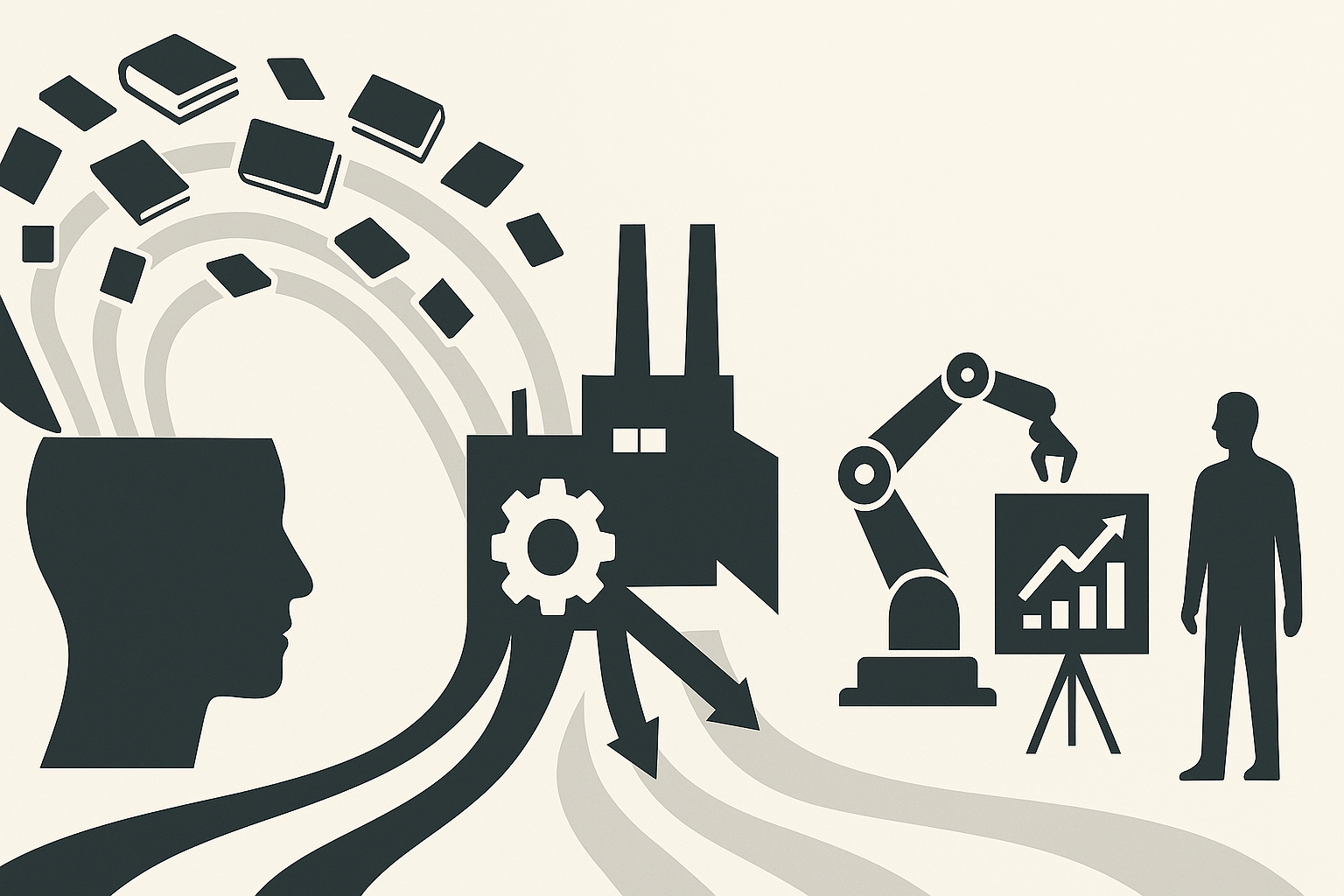
Knowledge is now raw material.
Raw material is not where profit lives.
Profit lives in:
- The factory that transforms it
- The logistics that deploy it
- The product that captures outcomes
If knowledge is iron ore, intelligence is the smelter.
Execution is the machine shop.
Outcomes are the finished product.
Selling ore is low-margin.
Owning the factory compounds.
Why This Change Feels Unsettling
Because entire identities were built on being “the one who knows”.
- The expert
- The consultant
- The teacher
- The strategist
When everyone can access the same explanations, identity collapses before the business model does. That is why the resistance feels emotional, not technical.
The Real Divide Going Forward
Not human vs AI.
Not creators vs machines.
Not experts vs amateurs.
The real divide is:
- Those who turn knowledge into operating systems
- Those who keep trying to sell answers
One group compounds.
The other group competes with a machine that charges nothing.
Final Reduction
Knowledge is no longer power.
It is fuel.
Power now lives in:
- Systems that decide
- Infrastructure that executes
- Ownership of outcomes
In the AI age, knowledge is a commodity.
Execution is capital.