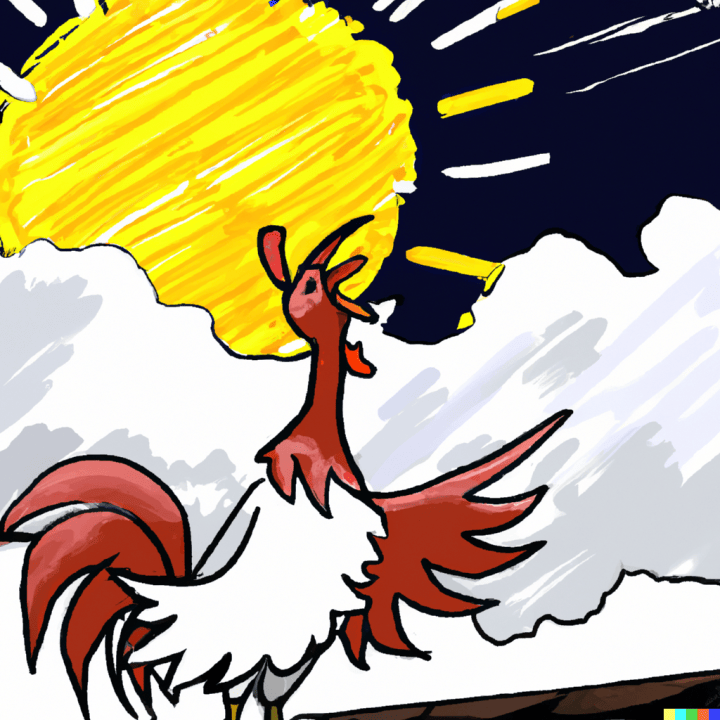
What “cause” actually means
A cause is not an event that merely appears before another.
A cause is something that, when changed, reliably changes the outcome.
Formally:
- If X causes Y, then intervening on X must change Y.
- If removing X leaves Y untouched, X was never the cause.
This is the entire logic behind the rooster test.
Kill the rooster.
The sun still rises.
Therefore the rooster never had causal power.
Timing alone proves nothing.
Why the brain gets this wrong
The human brain evolved to detect patterns fast, not truth accurately.
It uses three shortcuts:
- Sequence bias: If A happens before B, assume A caused B.
- Repetition bias: If A and B repeat together, assume a link.
- Agency bias: If something looks intentional, assume control.
Rooster → sunrise fits all three.
So does:
- Ice cream sales → drownings
- Church attendance → economic growth
- Ad spend → revenue spikes
The brain sees rhythm and assigns control.
Nature does not care about that instinct.
Correlation is just shared movement
Correlation means two variables move together. Nothing more.
They may move together for three completely different reasons:
Direct cause
- X → Y
- Smoking → lung cancer
Reverse cause
- Y → X
- Illness → higher medical spending
Hidden cause
- Z → X and Z → Y
- Heat → ice cream sales and heat → drownings
The rooster case is type 3:
- The hidden cause is Earth’s rotation and changing light.
- Both sunrise and crowing respond to the same driver.
No control. Just coincidence driven by a third force.
The only test that matters: intervention
You do not prove causation by observing more data.
You prove causation by breaking the system on purpose.
Valid causal test:
- Change X deliberately.
- Hold everything else constant.
- Observe whether Y changes.
Applied to the rooster:
- Remove rooster.
- Do not alter Earth’s rotation.
- Observe sunrise.
Sunrise remains invariant.
Causal claim collapses.
This is why:
- Randomised trials work.
- A/B tests work.
- Natural experiments work.
And why dashboards without intervention lie quietly.
Why correlation destroys businesses
Most business failure is misidentified causation:
- “When we post more, sales rise.”
- Seasonality did it.
- “This influencer converted.”
- Brand demand already existed.
- “This feature increased retention.”
- Power users were already loyal.
Optimising on correlation makes teams double down on noise.
They feed the rooster harder and expect earlier sunrise.
The invariant rule
This rule never fails:
If removing X does not stop Y, X was never the cause of Y.
Not sometimes. Always.
- Remove the rooster. The sun rises.
- Remove the ad. The brand still grows.
- Remove the ritual. The outcome persists.
The universe is merciless with fake causes.
Why superstition survives
Superstition persists because:
- Doing nothing feels like risk.
- Doing the wrong thing feels like control.
- Correlation gives emotional reinforcement without physical proof.
People prefer agency over accuracy.
The sun keeps rising either way, so the lie survives.
Final compression
Correlation is shared motion.
Causation is control under intervention.
Only one lets you shape reality.
If removing the rooster does not stop the sun, the rooster was never the cause.





