Whether you are raising funds for a medical bill, a school project, an animal shelter, a community drive or your own creative work, the question is the same: how do you get money from people who care about your cause into your bank account, without losing donors to friction and doubt along the way?
South Africans are generous. The country's crowdfunding platforms move hundreds of millions of Rands a year, and beyond the platforms, an enormous informal layer of giving runs through stokvels, WhatsApp groups, church collections and Facebook posts. The money is there. What decides whether your fundraiser works is trust, ease of giving, and how well you tell the story. This guide covers all three, plus an honest look at where the established platforms fit and where a different approach serves you better.
The three things every successful fundraiser gets right
Trust. Donors give when they believe the money will reach the cause. That belief is built by small signals: a named page rather than a bare bank account number, a visible goal and running total, a clear statement of what the funds are for, and updates as the campaign progresses. The single biggest killer of informal fundraising is scam anxiety, and the fix is visibility.
Ease. Every step between the moment someone feels moved and the moment they have paid loses donors. If giving means finding banking details, opening a banking app, typing a reference and doing a manual EFT, many people who genuinely intended to give simply never do. Card, instant EFT and Capitec Pay in a checkout that opens in seconds is not a nice-to-have, it is the difference between intention and donation.
Story. People give to people, not to abstractions. A fundraiser that says "Help Thandi finish her final year of nursing school" with a photo and three honest sentences outperforms "Education fund contribution drive" every time. Specific beneficiary, specific goal, specific outcome.
The established platforms, honestly
BackaBuddy is South Africa's best-known donations-based crowdfunding platform, and credit where it is due: it has channelled hundreds of millions of Rands to causes since 2015, and since June 2025 it charges no platform fee on campaigns at all, with donors given the option to leave a voluntary tip and only payment gateway fees applying. For once-off, high-stakes campaigns, especially medical crises where a recognised, vetted platform reassures strangers who have never heard of you, it is a strong choice, and this guide will not pretend otherwise.
Where the platform model fits less well is a different set of situations:
When your donors already know you. The vetting and familiar brand of a big platform matter most when you are asking strangers. If your donors are your followers, your community, your congregation or your customers, the trust already exists, and what you need is the smoothest possible path from your bio to a completed donation.
When fundraising is ongoing, not a campaign. Platforms are built around campaigns with a start and an end. An animal shelter that needs support every month, a creator funding their practice, or a school with a rolling needs list wants a permanent home for giving, not a campaign page that expires.
When you want the page to be yours. A platform campaign lives on the platform's domain, in the platform's layout, surrounded by other campaigns. Your own branded page keeps the relationship, the analytics and the audience with you.
When you want to give something back. Traditional donation pages take; they cannot also give. If you want to thank donors with a digital gift, or let supporters choose between donating and buying something you have made, you need a page that can do both.
The Acalytica way: your own fundraising page
On Acalytica, your fundraiser is a block on your own bio link page. Here is what that looks like in practice.
Your page, your brand. You create a mobile-first page at acalytica.com/yourname (or your own domain), with your photos, your colours and your story. It looks like you, not like a form.
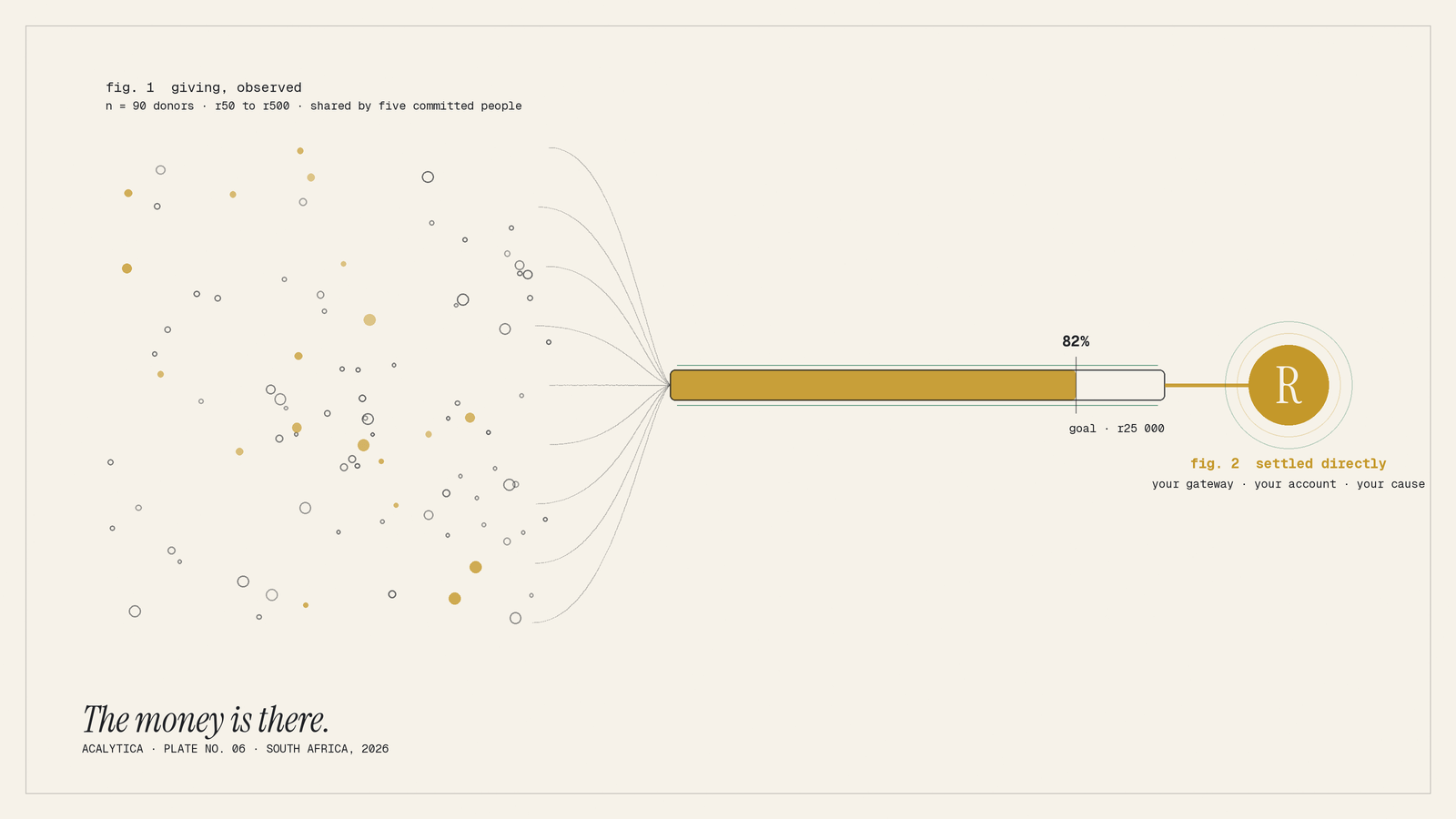
A live goal and progress bar. Set your target, say R25,000 for shelter blankets, and the page shows a running total as donations come in. Progress bars do quiet, powerful work: they prove the campaign is real and moving, they create momentum ("we're at 80%!"), and they give you a reason to post updates that are actually news.
Local payment, instant settlement. Donors give through your connected South African payment gateway with card, instant EFT or Capitec Pay, in Rands, in a checkout that takes seconds. The money settles directly into your own bank account through your gateway. Acalytica never holds your funds, so there is no waiting on a platform payout process.
Thank-you gifts, built in. Because the same page sells digital downloads, you can attach a gift to giving: a recipe ebook from your volunteers, a children's activity pack, a digital certificate, donor-only artwork. It costs you nothing per donor and it measurably changes how giving feels.
Everything else on the same link. Your socials, your updates, your other work, and if you are a creator, the things you sell, all live on the same page. One link in every bio does the whole job.
Setting up your fundraiser: a practical walkthrough
Name the goal precisely. "R15,000 to cover Grade 12 exam fees for 20 learners" beats "Support our education programme". A number plus a concrete outcome is what donors repeat when they share your link.
Write the story in three parts. Who this is for, what the money does, and what happens when the goal is reached. Keep it under 150 words on the page; the long version can live in your posts.
Choose a realistic target. A goal you can hit creates a completed, shareable success. It is far better to smash a R10,000 target and raise it than to sit visibly stuck at 12% of R100,000. You can always run a second phase.
Connect your gateway. Paystack, Payfast, Yoco or your preferred processor. If your organisation does not have one, entry-level signup is free, though allow a day or two for verification, so do this first, not last.
Launch to your warmest circle first. Your WhatsApp status, your existing supporters, your committee, your family. Early donations matter beyond their amount, because a progress bar at 15% within hours signals a living campaign to everyone who arrives after.
Post updates tied to the bar. "We've passed halfway" is a post. "R4,000 to go" is a post. "Goal reached, here's what happens next" is the most shareable post of all. The progress bar turns one ask into a series of stories.
Report back when it is done. Photos of the blankets, the fees paid, the project delivered. This is not just decency, it is the foundation of your next fundraiser, because donors who saw the outcome give again.
What to expect
Be realistic: most community fundraisers are powered by 20 to 100 donors giving R50 to R500 each, clustered around paydays and weekends, driven almost entirely by how often and how personally the link is shared. Virality is rare and unnecessary. A modest, well-run page shared consistently by five committed people will outperform a beautiful page shared once.
Start before you feel ready
The causes that raise money are not the most polished ones, they are the ones that exist. Set up the page, set the goal, connect the gateway and share the link with ten people today.
Create your free page on Acalytica, add a fundraising block, and give your cause a home that is open all year round.