Somewhere on your Instagram right now is a follower who was genuinely moved by your last post. They watched the video of the feeding scheme, the rescued dog, the learners with their new books, and for a moment they wanted to help. Then they kept scrolling.
That moment is the most valuable asset a small NPO has, and most organisations lose it, not because people do not care, but because caring has nowhere to go. The post says "visit our website to donate" and the website asks them to find the donate page, fill in a form, and complete a payment flow built years ago. Or worse, the post says "DM us for banking details." Every step between the feeling and the payment sheds donors, and small organisations, with no dev budget and a comms team of one, usually have the most steps of all.
The fix is not a bigger website. It is a shorter path. Your Instagram bio holds one link, and that link can be a donation page that works in seconds.
The maths of the moved follower
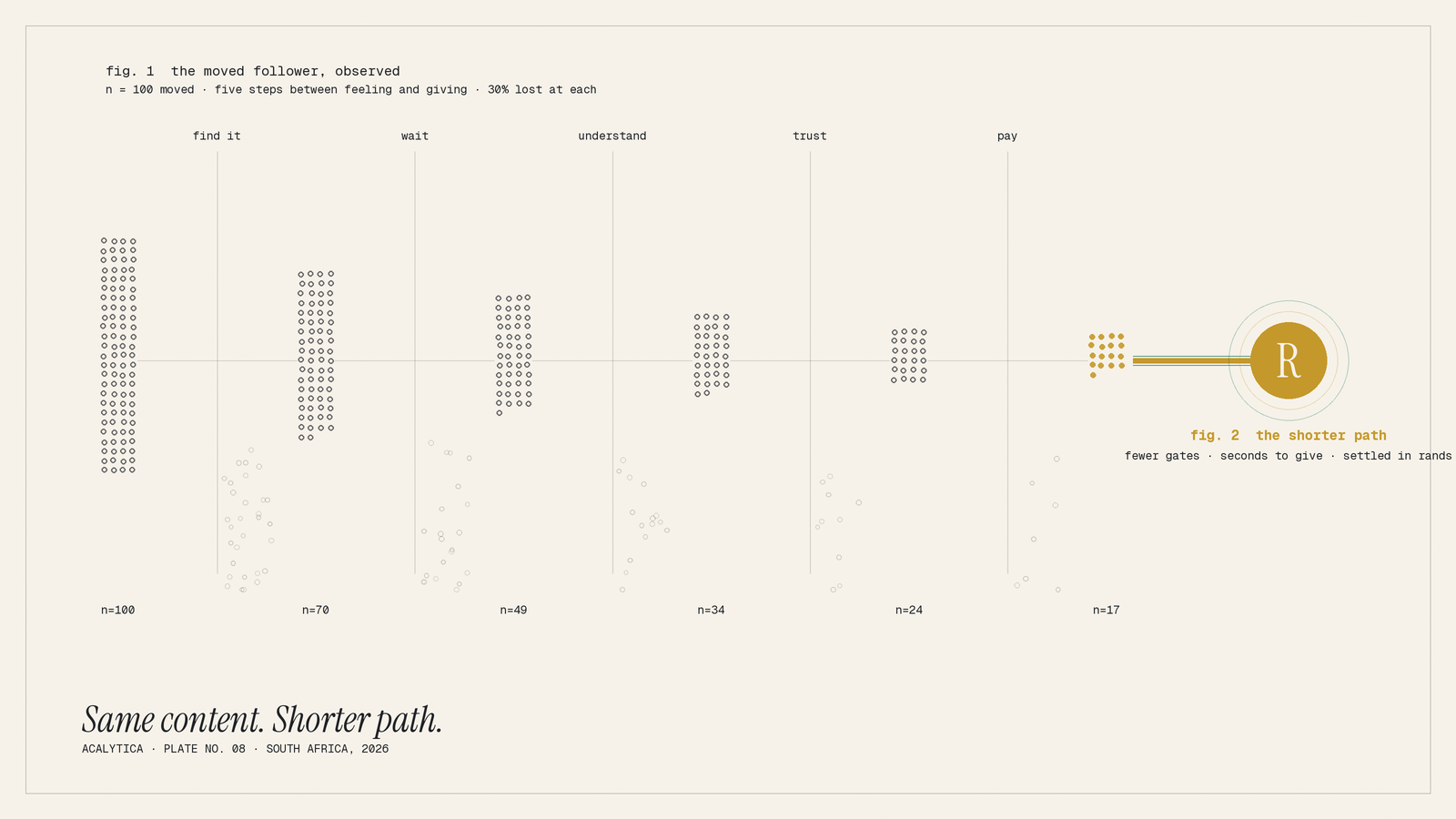
Think about what has to survive for a donation to happen from social media. The follower must feel moved (your content already does this), find the path (the bio link), stay through the loading (on mobile data), understand the ask (a clear goal), trust the destination (a page that looks like you), and complete payment (with a method they actually use). Lose 30 percent of people at each of five steps and only 17 of every 100 moved followers actually give. Cut two steps and make the rest instant, and the same content produces two to three times the donations without a single extra post.
That is the entire strategy: same content, shorter path.
What the bio link should open
On Acalytica, your bio link opens a mobile-first page that is your organisation in miniature: your name, your logo, your photos, and a fundraising block front and centre. The block shows the current drive ("R40,000 for 300 school shoes by 1 March"), a live progress bar, and a donate button. A supporter taps it, picks an amount, and pays by card, instant EFT or Capitec Pay in a secure checkout without leaving the page. The money settles through your own payment gateway directly into your organisation's bank account, and the progress bar ticks up for the next visitor to see.
Below the fundraising block, the rest of your page does the supporting work: your other links, your WhatsApp contact, your newsletter signup, and, if you use them, the digital thank-you gifts we will get to shortly.
Two properties of this setup matter especially for NPOs. First, the page is permanent. Unlike a campaign on a crowdfunding platform, it does not expire when a drive ends; you simply update the goal, and the same link in your bio serves every campaign you will ever run, which means every follower who ever saved or shared it stays connected. Second, the page is yours: your branding, your analytics, your donor relationship, on your link.
Setting it up in an afternoon
Claim a link that says who you are. acalytica.com/hopehousedbn beats a shortened mystery URL, because people forward what they can read.
Lead with one specific drive, not general support. "Support our work" is everything and therefore nothing. "R40,000 for 300 pairs of school shoes" gives the moved follower a concrete thing their R200 becomes. Run one featured drive at a time and let general donations be the quiet second option.
Connect your gateway before you announce. Paystack, Payfast, Yoco or your existing processor. If the organisation does not yet have one, entry-level signup is free, but verification can take a day or two, so this is step one, not step five.
Seed the bar from your inner circle. Board members, volunteers, staff, the founder's family. A drive that goes public at 12% within its first hours reads as alive; one sitting at 0% reads as abandoned, no matter how new it is.
The Instagram playbook once the page is live
Rewrite the bio's last line. The line above your link should tell people why to tap it, and it should change with the campaign: "🎯 300 school shoes by 1 March — help below". The link stays the same forever; the line above it is your billboard.
Make the progress bar your content calendar. This is the single biggest unlock. "We've hit 50%" is a story. "R6,000 to go" is a story. "Meet the learner your donations just helped" is a story. A visible total turns one campaign into eight or ten posts, each with a natural reason to exist and each pointing to the same link. Without a progress bar, all you can post is the same ask again, and audiences tune out repeated asks fast.
Use the link sticker in Stories relentlessly. Stories with a link sticker are the shortest path on all of Instagram: one tap from the emotional moment to the donate button. Post the drive to Stories two or three times a week with different framings (the need, the progress, the faces), and always with the sticker, because "link in bio" costs you a step that Stories can skip.
Pin the campaign. Pin the drive announcement to the top of your grid so the moved follower who visits your profile tomorrow, or next month, lands on the ask and not on whatever you happened to post last.
Close the loop publicly. When the goal is reached, the report-back post, with photos of the shoes on actual feet, is your most shareable content of the entire campaign and the foundation of the next one. Donors who see the outcome give again, and their comments are your social proof.
Give something back
Here is the mechanic traditional donation platforms cannot offer: because your Acalytica page can also deliver digital downloads, you can thank donors with a gift. A recipe collection from your soup kitchen's volunteers. A colouring book drawn by the kids in your programme. A digital certificate. Donor-only photos from the project. It costs the organisation nothing per donor, it makes giving feel like an exchange rather than a transaction, and it gives your supporters something to post, which markets the drive for you. We cover this fully in its own guide, but even one simple gift measurably changes how an ask lands.
This costs nothing to try
The free plan covers a page, a payment processor connection and everything a first drive needs, so the only investment is the afternoon of setup and the discipline of the playbook. Your content is already doing the hard part every single day; give the feeling it creates somewhere to land.
Create your organisation's free page on Acalytica, add a fundraising block, and put the link in your bio before your next post. For the full campaign playbook, read our complete guide to crowdfunding in South Africa, and if your collections currently run on banking details posted to Facebook, read why there is a safer way.





