Ask any creator what stopped them from launching their first digital product and you will hear the same answer over and over: "I did not know what to charge." Not the design, not the writing, not the marketing. The price.
It makes sense. Almost every pricing guide online is written for American audiences, throwing around figures like $27 and $97 as if those numbers mean anything to a buyer in Johannesburg or Polokwane. Convert them directly to Rands and you get prices that feel wrong for the local market. So creators freeze, or worse, they pick a number out of thin air, usually far too low, and then resent every sale.
This guide gives you actual Rand figures for the South African market, the reasoning behind them, and a simple way to test your way to the right price.
The golden rule: price the transformation, not the file
Buyers do not pay for a PDF. They pay for what changes after they use it. A 15-page meal plan that helps someone finally lose weight is not competing with the cost of paper and ink, it is competing with a dietician consultation at R800 or a diet app subscription at R150 a month. A CV template that helps someone land an interview is worth a great deal more than the twenty minutes it saves them in Word.
So before you look at any benchmark, answer one question honestly: what does my product help someone do, and what would it cost them to get that result another way? Your price should sit comfortably below the alternative and comfortably above "so cheap it looks worthless."
Benchmark prices for the South African market
These ranges reflect what sells in the local market right now. They are starting points, not rules.
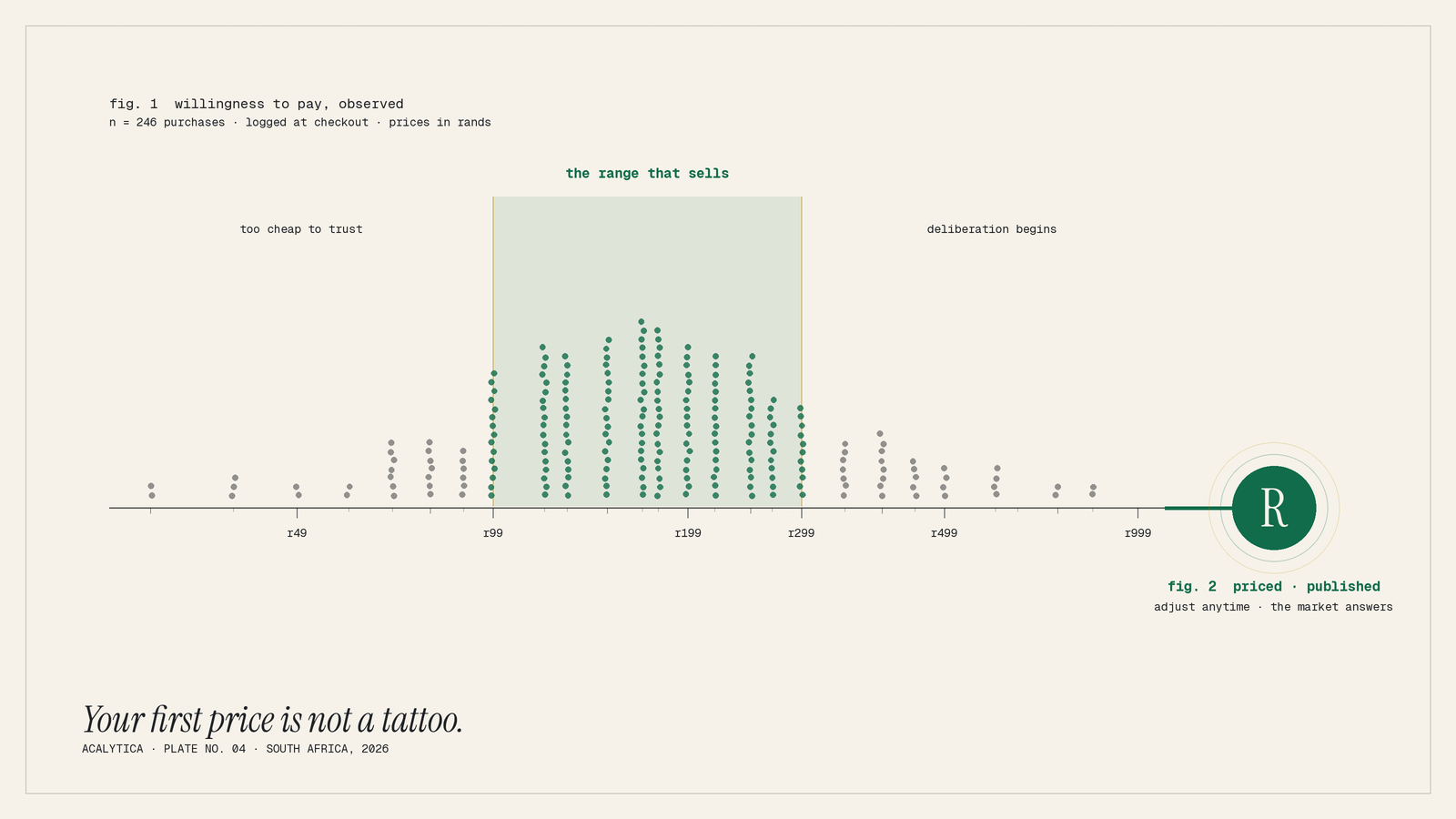
Ebooks and guides (R79 to R299). A focused, practical guide sits happily between R99 and R199. Go toward R249 to R299 when the topic saves the buyer real money or earns them money, like a guide to registering a small business or landing freelance clients. Below R79, buyers start wondering what is wrong with it.
Meal plans and training programmes (R99 to R349). A standard 4-week meal plan sells well at R149 to R199. Bundle meal plan plus training programme plus a grocery list and you can confidently ask R249 to R349, because the bundle replaces multiple purchases.
Study notes and exam packs (R49 to R199). Students are price-sensitive, but they are also desperate the week before an exam. Single-subject notes work at R49 to R99. A full exam pack with past paper solutions justifies R149 to R199. Volume is your friend here: fifty students at R79 beats five students at R199.
CV templates and career documents (R49 to R199). A single template sells at R49 to R99. A pack with a CV, cover letter and LinkedIn guide moves up to R149 to R199, because you have turned a file into a job-hunting kit.
Design assets, presets and templates (R79 to R499). A single Lightroom preset pack or social media template set sits around R99 to R199. Assets sold to businesses rather than individuals, like brand templates or pitch deck designs, can go from R299 to R499 and beyond, because a business measures the price against paying a designer.
Mini-courses and video workshops (R299 to R999). The moment your product includes video teaching or a structured curriculum, you leave PDF pricing behind. R399 to R599 is a comfortable zone for a self-paced mini-course. Push toward R999 when the outcome is income-related, like a course on starting a side hustle or getting freelance clients.
Local pricing psychology that actually matters
Charm pricing works here too, but round numbers are fine. R199 feels meaningfully cheaper than R200, and R99 remains the single most powerful price point in the local digital market. That said, South Africans do not distrust round numbers the way some markets do. R150 reads as honest and clean.
Mind the airtime test. For a big chunk of the market, an impulse buy is anything that costs about the same as a weekly data bundle or a takeaway meal, roughly R50 to R150. Products in this band sell on impulse from a TikTok. Above R300, buyers deliberate, compare and sleep on it, so your content needs to do more convincing before they reach the checkout.
Payday matters. Sales in South Africa cluster around the 25th to the 1st of the month. If you are launching or running a promotion, time it for the payday window. A R249 product that stalls mid-month can move briskly on the 26th.
Do not price for load shedding-level pessimism. The most common mistake local creators make is assuming nobody has money and pricing at R29 or R39. Underpricing does not just cost you income, it signals low quality and attracts the most demanding customers. There is almost always more room above your instinct than below it.
The three-tier trick
If you genuinely cannot decide between two prices, offer both. A simple two- or three-tier structure lets the market decide:
Basic (the file): your ebook or template at, say, R99. Plus (the file and extras): add a bonus like a checklist, a second template or a worksheet at R179. Premium (everything plus access): include a 20-minute call, a WhatsApp community or a personalised review at R399.
Something interesting happens with tiers: the middle option usually outsells the rest, and its price reads as reasonable purely because the premium tier exists next to it. You also learn quickly which buyers you have, and a surprising number pick premium.
Test, do not guess
Here is the liberating part: your first price is not a tattoo. On your Acalytica page you can change a price in seconds, so treat pricing as an experiment. Launch at your best guess. If the product sells briskly for two or three weeks, raise the price by 20 to 30 percent and watch what happens. If nothing sells despite good traffic (your page analytics will tell you whether people are visiting), the price is usually not the problem; the offer or the audience is.
A simple rule of thumb: if nobody ever complains about your price, you are too cheap. If everybody complains, you are too expensive. A grumble here and there means you are exactly right.
Stop deliberating, start selling
Pick a number from the ranges above, put it on your page, and let real buyers give you the answer no guide ever can. You can adjust tomorrow. What you cannot do is earn anything from a product that stays unpriced and unpublished.
Create your free page on Acalytica, set your price in Rands, and change it as many times as the market tells you to.





