Outcome-based pricing is one of those topics where the industry consensus and the actual practice are very far apart. Almost everyone agrees the hourly billing model is broken, almost everyone says they want to move toward pricing that ties agency compensation to client outcomes, and almost no one has actually figured out how to make it work at scale without taking on risks that eventually blow up the relationship. The agencies that have made real progress have done so by being a lot more careful about the how than the marketing literature suggests, and by accepting that outcome pricing isn't one model, it's a family of models, each with very different mechanics, risk profiles, and applicability.
The starting point is understanding why the existing models stopped working, because outcome pricing only makes sense as an answer to a specific problem the alternatives can't solve.
The traditional time-and-materials retainer, agency staffs a team, client pays for the hours, work happens, was designed for a world where output was roughly proportional to effort and effort was roughly proportional to people. AI broke the second link: a senior creative with the right tools now produces in two hours what used to take a team two weeks, which means the hours-billed model literally penalises the agency for getting more efficient. The harder the agency works to use technology well, the less it earns. This is unsustainable, and every senior agency leader knows it, but most agencies are still trapped in it because the alternative requires renegotiating with procurement teams whose entire job is to push hourly rates down.
The fixed-fee project model, agree the deliverable upfront, agree the price, scope creep gets billed separately, works for discrete artifacts but breaks down for the kind of always-on, iterative work that modern marketing actually requires. There's no clean "deliverable" for an always-on personalisation program or a creator partnership that runs for a year. Trying to force that work into project containers produces endless scoping arguments and unhappy clients.
The commission model, agency earns a percentage of media spent, is the original outcome-adjacent pricing, and the part of the industry it created (media buying) has been slowly dying for fifteen years. The fundamental problem is that media commission incentivises the agency to recommend more spending, regardless of whether more spending is the right answer for the client. This was tolerated for decades because the misalignment was hidden, but the ANA transparency report and the broader push for accountability made it untenable.
So outcome pricing has emerged as the conceptual answer: tie what the agency earns to what the client gets, align incentives, escape the hours-vs-output trap, and reposition the agency as a partner in the business rather than a vendor of work. The trouble is that doing this in practice is much harder than saying it.
The first hard problem is defining the outcome the agency is being paid against. The cleaner the metric, the easier the contract, and the harder it is to make the metric actually represent what the client cares about. If you pay an agency on revenue, you incentivise them to chase short-term sales spikes that may damage long-term brand health. If you pay on brand metrics like awareness or consideration, you get into endless arguments about measurement methodology. If you pay on conversions, you have to define what counts as a conversion, how to attribute it, what the time window is, and what to do about traffic the client would have gotten anyway. If you pay on a composite score, you need to negotiate the weights, and every weight is a fight. Most outcome contracts that fail in practice fail at this layer: the metric the agency is paid on turns out to be measuring something subtly different from what the client actually wanted, and within a year both sides feel cheated.
The agencies that have made this work tend to do a few things differently. They invest serious effort in the metric design phase, sometimes weeks of analysis before the contract is signed to make sure the metric is genuinely representative, hard to game, and stable enough to hold up over the contract term. They build in safety mechanisms: floors so the agency doesn't lose money on bad luck, ceilings so the client doesn't pay windfalls on good luck, exclusions for factors outside the agency's control (a competitor recall, a category-wide downturn, a stockout). They use incrementality testing to separate what the agency contributed from what would have happened anyway, which is the single most important and most underused practice in this entire space. And they build in renegotiation triggers: if the underlying business changes materially, the deal gets reopened rather than enforced rigidly into a context it wasn't designed for. The contracts that work look more like shareholder agreements than like procurement documents, and the lawyers on both sides hate how much judgment they require. That's a feature, not a bug.
The second hard problem is attribution, which is the central technical challenge of outcome pricing in a world where deterministic tracking is broken. If you can't reliably tell which sales were caused by which marketing activity, you can't pay the agency on the sales it caused. The honest answer is that nobody can do this perfectly, and the agencies that pretend they can are the ones most likely to either overcharge or under-deliver. The agencies doing it well combine multiple methods: marketing mix modelling for the long-run portfolio view, geo-incrementality experiments for specific campaigns, holdout tests where they can be run, brand tracking for the harder-to-attribute upper funnel, and explicit baselines that everyone agrees on before the work starts. The combination is messier than a single dashboard, but it's defensible — both sides understand how the number was produced and trust the process even when they don't love the result. The agencies that try to use last-click attribution as the basis for outcome pricing are setting themselves up for systematic disagreement with the client about what really happened.
The third hard problem is the agency's working capital. Outcome pricing means the agency does the work first and gets paid based on results that materialise months later, sometimes much later for upper-funnel work. Most agencies are not capitalised for this. They're operating on monthly retainer cash flow with thin margins, paying salaries every two weeks, and they can't afford to wait six months to find out whether a campaign earned them anything. The honest version of outcome pricing requires either a significant base fee that covers the agency's operating costs (with the outcome component as upside) or some kind of milestone payment structure that releases cash as the work progresses. Pure pay-on-results contracts only work for agencies large and well-capitalised enough to absorb the cash flow exposure, which is a small fraction of the industry. The contracts that look most like "we only get paid if it works" usually have a hidden base that makes them economically viable; the agencies that took those contracts at face value mostly went bankrupt.
The fourth hard problem is scope and control. If the agency is being paid on results, it needs the authority to make the decisions that affect those results. This sounds obvious and is almost never honoured in practice. The client wants the agency to be accountable for outcomes but also wants approval rights over the creative, the media plan, the targeting, the messaging, the budget allocation, and the launch timing. When the agency has accountability without authority, the inevitable outcome is that the client overrules the agency's recommendation, the results are worse than they would have been, and the agency is held accountable anyway. The contracts that work explicitly carve out which decisions belong to which side: the client owns brand strategy, budget total, and major creative direction; the agency owns tactical execution, optimisation decisions, and channel mix within the agreed budget. Without this clarity, outcome pricing produces a perverse dynamic where the agency is fighting for the authority to do what it's already on the hook for.
The fifth hard problem is the trust and verification layer that has to sit underneath the whole arrangement. Outcome pricing only works when both sides trust the numbers. That requires shared access to data, jointly chosen measurement vendors, transparent methodology, and the ability for either side to audit the results. It also requires personal trust between the senior people on both sides — because no contract can fully specify what to do when an unexpected situation arises, and the difference between "we'll figure it out together" and "let's see what the lawyers say" is the difference between a pricing model that survives and one that ends in a relationship blowup. Agencies that have built this kind of trust with specific clients can run outcome contracts that look reckless on paper. Agencies that haven't shouldn't try.
With all of those caveats, the actual mechanical models being used in practice fall into a few recognisable shapes.
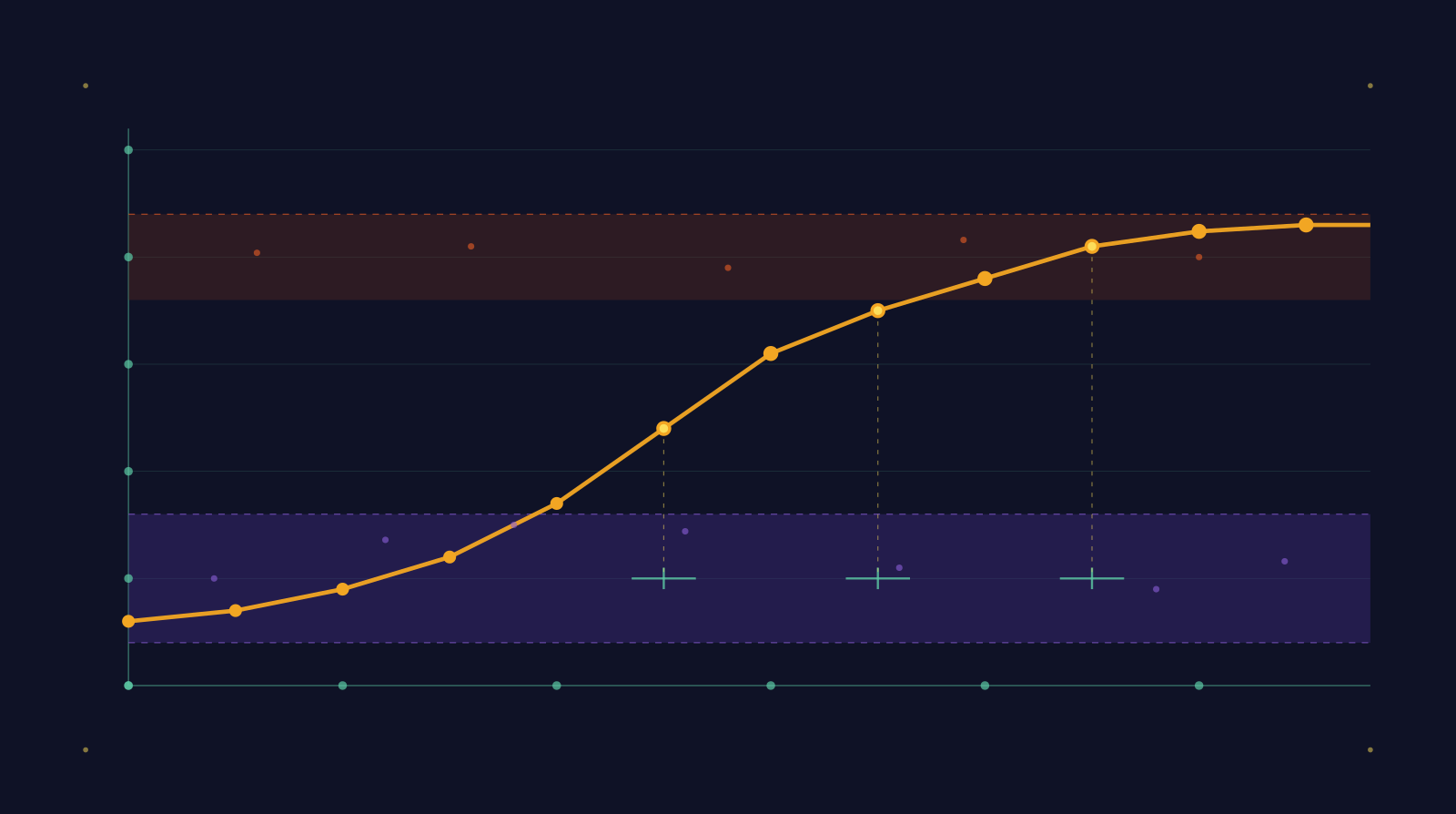
The base-plus-bonus model is the most common and the most workable. The agency gets a base fee that covers its operating costs and a fair margin on the work, typically 60-80% of what a traditional retainer would have been. On top of that, there's a performance component that pays out based on agreed metrics, and that can take the total compensation significantly above what the retainer would have been if things go well. The key design decision is how big the bonus pool is relative to the base, and how steeply the payout curve is structured. Most working examples have the bonus topping out at 30-50% of the base, enough to be motivating, not so much that the agency's survival depends on it. The metrics are usually a small number (two to four), each with clear measurement methodology, each with floors and ceilings.
The shared-risk-shared-upside model goes further: the agency takes a meaningful discount on its base fee (sometimes 30-50% off) in exchange for a much larger upside if outcomes are met. This is closer to a partnership than a vendor contract, and it's only viable when the agency genuinely believes it can move the numbers and has the capital to absorb the risk. The agencies that do this well usually pick their spots, they might run on this model for one or two large clients where they have the data and the team to be confident, while keeping the rest of their book on more conservative pricing. Treating it as a default pricing model would be reckless for almost any agency.
The pay-for-performance model, where the agency only earns when specific outcomes are achieved, is what people usually mean when they say "outcome pricing", and it's the rarest in practice. It works in a few specific situations: lower-funnel performance work where attribution is relatively clean, lead generation where the unit economics are well-understood, e-commerce work where conversion data is reliable and the agency has enough control over the funnel to actually move the numbers. Outside those situations, pure pay-for-performance tends to produce one of two failure modes: the agency takes on work it can't profitably deliver (and either burns out or cuts corners) or the agency only takes on safe work (and the model selects for risk-averse, undifferentiated execution).
The licensed IP or productised model is a different shape entirely: the agency builds something, a tool, a methodology, a creative system, a measurement framework, and licenses it to clients as a product, with the agency's compensation tied to usage and outcomes. This isn't outcome pricing in the traditional sense, but it solves the same underlying problem (decoupling agency revenue from agency hours) and is one of the most promising directions for agencies that want to escape the labor-arbitrage trap. The challenge is that productising an agency capability is hard, requires real R&D investment, and usually fails the first few tries. The agencies that have done it well, Mother Design's licensing model, certain BBH product spinouts, R/GA's various platform plays over the years, plenty of others at smaller scale, generally treat it as a multi-year investment with explicit budget and patience from leadership, not as a side project an account team is supposed to run in addition to client work.
The equity or value-share model is the most ambitious version: the agency takes a stake in the client's business (literal equity for startups, a percentage of incremental revenue for larger companies) in exchange for doing the work. This shows up most often in early-stage and challenger brand work, where the agency can credibly believe they'll move the business meaningfully and the client doesn't have the cash to pay full freight. It produces enormous wins occasionally and enormous losses regularly; the agencies that run it well treat it as venture investing, with a portfolio mindset, and accept that most bets won't pay off but the ones that do will subsidize the rest. The agencies that drift into it accidentally — taking equity from one client because cash is tight, usually end up with neither the cash nor the upside.
A few honest observations about what actually determines whether outcome pricing works.
The relationship matters more than the contract. Every working outcome-pricing arrangement I've seen up close depends on a layer of personal trust between specific senior people on each side that allows the contract to be the floor rather than the ceiling. When something unexpected happens, and something always does, the question isn't what the contract says, it's whether both sides want to keep the relationship working. Agencies that try to use outcome pricing as a way to win business from clients they don't have a deep relationship with are usually setting themselves up for trouble. The model works as a deepening of an already trusting relationship, not as a way to bootstrap one.
Procurement is often the obstacle, not the marketing team. The CMO and the senior marketers usually understand why outcome pricing makes sense and want to move toward it. The procurement team's incentives are different: they're measured on cost reduction, not value creation, and they understand traditional pricing models better than novel ones. Outcome contracts often die in procurement, not in marketing. The agencies that have made progress here have usually had to bring procurement into the conversation early, explain the model in language they can defend internally, and accept some compromises that make the contract more procurement-friendly even at the cost of some elegance. The agencies that try to negotiate around procurement usually lose.
Most clients don't actually want outcome pricing — they want lower prices dressed up as outcome pricing. The version of outcome pricing the client often proposes is "we'll pay you less, and if you hit aggressive targets you'll get back to roughly what you were earning before." This isn't outcome pricing; it's a price cut with a fig leaf. The agencies that accept it under the banner of "innovation" end up doing the same work for less money. Real outcome pricing requires the client to accept that they will sometimes pay the agency more than they would have under the old model, significantly more, in good years, and the agencies that aren't willing to walk away when the upside is capped but the downside isn't are setting themselves up to lose money on the model. The willingness to walk away from bad outcome contracts is the single most important discipline in this whole area.
The agencies that have made this work usually started small. They didn't reorganise their entire pricing model in one move. They picked one or two clients where the relationship was deep, the data was good, and the work was the right shape, and ran outcome contracts as pilots for a year or two before generalizing. They learned what worked and what didn't on relationships they could afford to risk. They built internal muscle around metric design, measurement, contract negotiation, and partnership management before scaling. The agencies that announced a strategic pivot to outcome pricing across the whole business in one quarter are almost all the agencies that quietly walked it back the next year.
Internal incentives have to change too. If the agency's account teams are still measured on billable hours and revenue per FTE, no amount of contract innovation on the outside will make outcome pricing work on the inside. The agencies that have actually shifted to outcome thinking have rebuilt their internal scorecards to measure things like client outcomes achieved, account profitability over time, and relationship health, not just hours billed and accounts retained. This is a much bigger organisational change than the contract change, and it's the part that most agencies skip because it's hard and politically expensive.
The deeper strategic point is that outcome pricing isn't really a pricing innovation, it's a restructuring of what kind of business an agency is. The traditional agency sells time. The productised agency sells software. The outcome-priced agency, when it works, sells results: it takes on responsibility for moving a client metric and accepts the financial consequences of success or failure. That's a different business model, with different capital requirements, different risk profiles, different talent needs, different internal incentives, and different commercial conversations. Trying to bolt it onto the existing agency structure usually fails because the surrounding system isn't designed to support it. Building it intentionally as the operating model from the start, on the right kinds of accounts, with the right safeguards and the right internal scaffolding, is one of the few ways agencies can genuinely escape the squeeze the rest of this conversation has been about. It's just much harder than the slide decks make it sound, and the agencies pretending otherwise are usually the ones who haven't actually done it.





