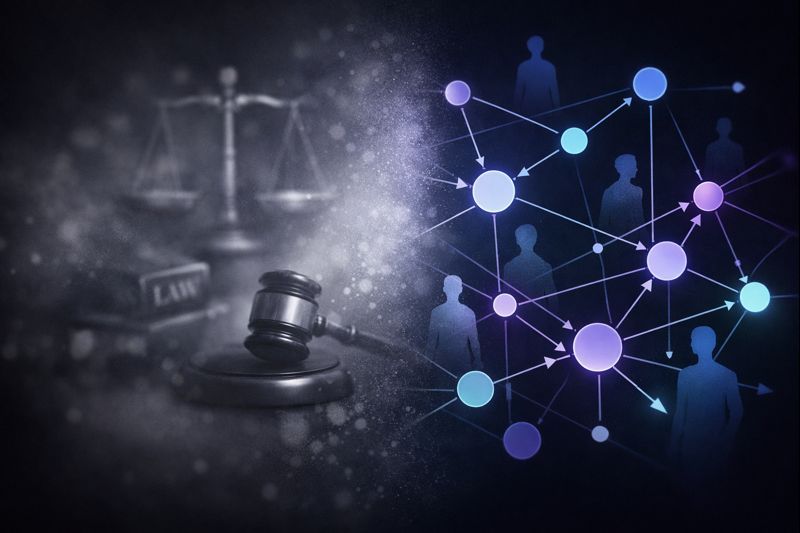
Law has always claimed to be rational. In practice, it often runs on intuition, precedent, and authority. Experimental jurisprudence exists because of this gap. It asks a simple question: how do people actually reason about law?
Not how judges say they reason. Not how textbooks describe it. How real humans assign blame, interpret intent, judge fairness, and decide punishment.
For decades, this field was constrained by the same three bottlenecks: small samples, weak experiments, and fuzzy causality. AI breaks all three. Here is how, step by step.
1. What experimental jurisprudence is really measuring
Strip away the philosophy and the jargon. Experimental jurisprudence studies mental models.
When someone reads a legal case, they run an internal simulation:
- Who caused the harm?
- Did they intend it?
- Could they have avoided it?
- Does punishment feel deserved?
These judgements are not random. They follow patterns. The problem was never the theory. The problem was measurement.
Traditional methods relied on:
- A few hundred students.
- A handful of hypothetical cases.
- Crude statistical averages.
That is not how complex reasoning systems are studied anywhere else.
2. Why scale matters more than clever arguments
If you only sample a narrow group, you mistake local norms for universal principles.
AI removes the scale constraint.
- Millions of respondents across jurisdictions can be analysed.
- Cultural, linguistic, and socio-economic variation becomes visible.
- Minority reasoning patterns stop disappearing into averages.
This matters because law governs populations, not seminar rooms.
Once you scale up, something uncomfortable happens: many “obvious” legal intuitions fracture. What looked like consensus turns out to be a coalition of incompatible mental models.
That is not a flaw. That is data.
3. The hidden problem: bad experiments
Most legal experiments fail before analysis begins. They change too many things at once.
AI improves the experiment itself.
- Language models generate tightly controlled vignette variations.
- Only one legal variable is altered at a time: intent, foreseeability, consent.
- Adaptive designs focus testing where reasoning becomes unstable.
This mirrors how physics isolates variables. You do not learn about gravity by changing mass, distance, and friction simultaneously.
The result is cleaner signals and fewer philosophical arguments about “interpretation”.
4. Correlation is not explanation. Law needs counterfactuals.
Legal reasoning is counterfactual by nature.
- Would the judgement change if intent were absent?
- What if harm occurred without negligence?
- What if the same act produced no damage?
Classical statistics struggles here. AI-enabled causal inference does not.
Structural causal models allow researchers to:
- Represent legal reasoning as causal graphs.
- Separate harm from intent instead of blending them.
- Simulate legally meaningful “what if” scenarios.
This moves jurisprudence from description to explanation. Courts do not care that two variables are correlated. They care why a judgement changes.
5. Disagreement is not noise. It is structure.
Legal theory often treats disagreement as a problem to be resolved. Empirically, disagreement is the phenomenon.
AI makes disagreement measurable.
- Clustering reveals stable reasoning types.
- Bayesian models show how confidence shifts when facts change.
- Competing intuitions can be mapped rather than averaged away.
This matters because pluralism is real. Pretending otherwise just hides power behind neutrality.
6. Testing law before it harms people
In engineering, you test systems before deployment. Law rarely does.
AI enables pre-deployment jurisprudence.
- Draft laws can be stress-tested against simulated populations.
- Doctrines can be exposed to adversarial fact patterns.
- Bias and instability surface early, not after years of litigation.
This does not make law mechanical. It makes failure visible sooner.
7. The normative gap remains, but it becomes honest
AI does not tell us what the law should be. That would be a category error.
What it does do is clarify the trade-offs.
- Where public intuition aligns with doctrine.
- Where it diverges sharply.
- How much divergence lawmakers are choosing to tolerate.
Normative decisions remain political and moral. AI simply removes plausible deniability.
The core insight
AI does not replace judges, philosophers, or lawmakers.
It does something more basic and more dangerous: it makes legal reasoning observable, testable, and falsifiable at scale.
Experimental jurisprudence stops being a thought experiment and becomes a measurement discipline. Law begins to look less like inherited wisdom and more like a system that can be interrogated, stressed, and improved.
That shift changes everything.





