Start From First Principles: What Do Agencies Actually Do?
Strip away the jargon and the glitter of Cannes, and advertising boils down to a simple invariant:
Agencies connect brands to consumers in ways that drive growth.
Everything else, media buying, CRM, influencer campaigns, production, is just a different lever to pull. The real problem is an optimisation puzzle:
- Where should brands invest?
- What content should flow through those channels?
- How do we know what works?
AI thrives on exactly this type of ecosystem problem: multiple competing choices, large data flows, and constant feedback.
Why Old Workflows Broke Down
Traditionally, marketing was a relay race:
- Research team → delivers a report
- Creative team → makes a concept
- Production → shoots the ad
- CRM team → adapts it
- Media team → runs it
Every handover added cost, time, and information loss.
Causal lever: The sequential pipeline fragmented decision-making. No one could optimise the whole system, only their slice.
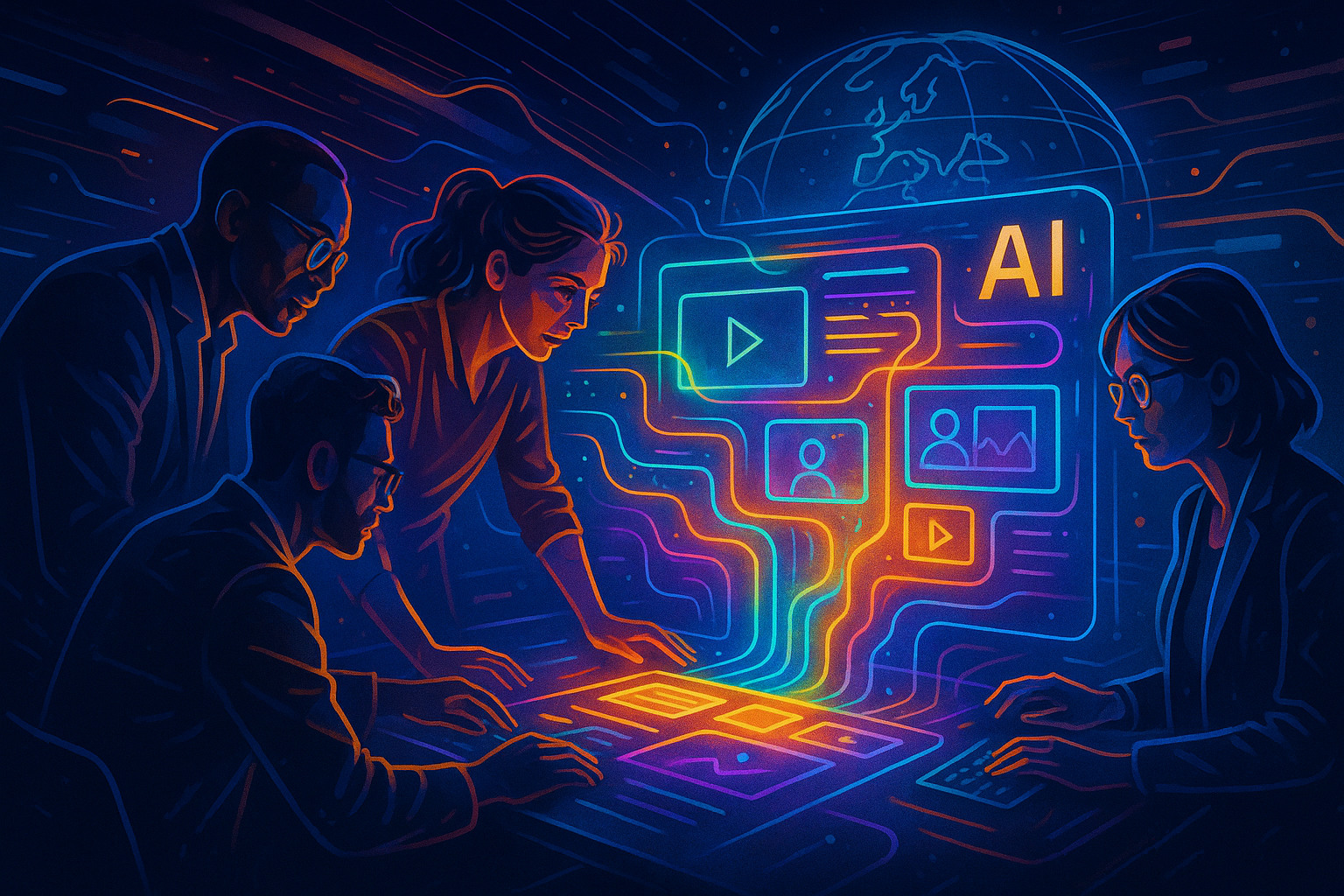
AI Collapses the Pipeline Into One Loop
With AI platforms like WPP Open, the workflow compresses into a single loop:
- Define the business problem
- Encode consumer knowledge into AI agents
- Generate and test ideas
- Adapt for channels
- Launch and get feedback
Effect: The work isn’t just faster; it’s systemically different. What used to be six agencies in series is now one multidisciplinary team, using the same tools, working in parallel.
Smaller Teams, M-Shaped People
Pretorius describes the future workforce as M-shaped:
- Breadth across marketing disciplines
- Depth in multiple specialisations (media, AI, creative, product)
Why M and not T? Because one deep skill is no longer enough, AI has amplified productivity so much that people can afford to go deep in several areas.
Causal lever: Productivity gains from AI let individuals span more domains → demand shifts to multi-specialists.
Creativity as Vector Embeddings
The wildest shift Pretorius highlights: creativity itself is becoming computational.
Take WPP’s Creative Ideation Canvas. It lets strategists throw in a persona, a sound file, an image, and a script. The system recombines them into a storyboard, interpreting style, tone, and context.
Under the hood? Just vector embeddings, mathematical representations of media.
First principle: If ideas can be embedded, then creativity is just the smart recombination of embeddings.
Implication: The boundary between “strategy” and “production” blurs. Creativity is now both human taste and algorithmic assembly.
Leadership Lessons From the Trenches
Pretorius likens transformation to warfare:
- Propaganda: Repeat a clear, simple message endlessly (until you bore yourself).
- Trench warfare: Block, tackle, and grind through daily adoption.
- Show, don’t tell: Demo tools live, don’t just theorise.
- Give hope: People create best when they feel safe and optimistic.
Causal levers here are psychological, not technical: clarity, repetition, and emotional safety.
The Big Picture: From 450 Agencies to 5 Platforms
WPP simplified from 415 fragmented agencies to 5 global platforms. Why? Because AI rewards integration, not silos.
- One platform
- One product organisation
- One technology stack
Effect: WPP can now charge not just for time spent (old T&M model) but for outputs and outcomes. When you control the whole pipeline, you can price on results.
What It Means for Entrepreneurs
Here’s the causal chain every founder should internalise:
- Fragmented systems → inefficiency
- AI conflates workflows → faster, cheaper, higher quality outputs
- Smaller expert teams + M-shaped talent → competitive advantage
- Outcome-based pricing → agencies (and startups) can capture more value
- Creativity = embeddings → the frontier shifts from execution to taste and judgment
Takeaway
AI isn’t making advertising “push button, make ad.”
It’s collapsing silos, amplifying talent, and turning creativity into a recombination game.
For entrepreneurs, the real opportunity isn’t to replace humans, but to build AI-native workflows where strategy, creativity, and execution flow as one.
That’s how you move mountains with smaller, sharper teams.





