Executive Summary
The emergence of Grokipedia in October 2025 has sparked renewed debate about how humanity organises and shares knowledge. This document provides an objective analysis of both platforms, examining their distinct philosophies, methodologies, strengths, and limitations to help readers make informed choices about when and how to use each resource.
Neither platform is perfect. Wikipedia offers 24 years of community-built knowledge with transparent editing processes but faces documented biases in coverage. Grokipedia provides rapid AI-generated content with real-time updates but raises concerns about algorithmic bias and accuracy. Understanding these trade-offs empowers users to leverage both tools appropriately.
Platform Overview
Wikipedia
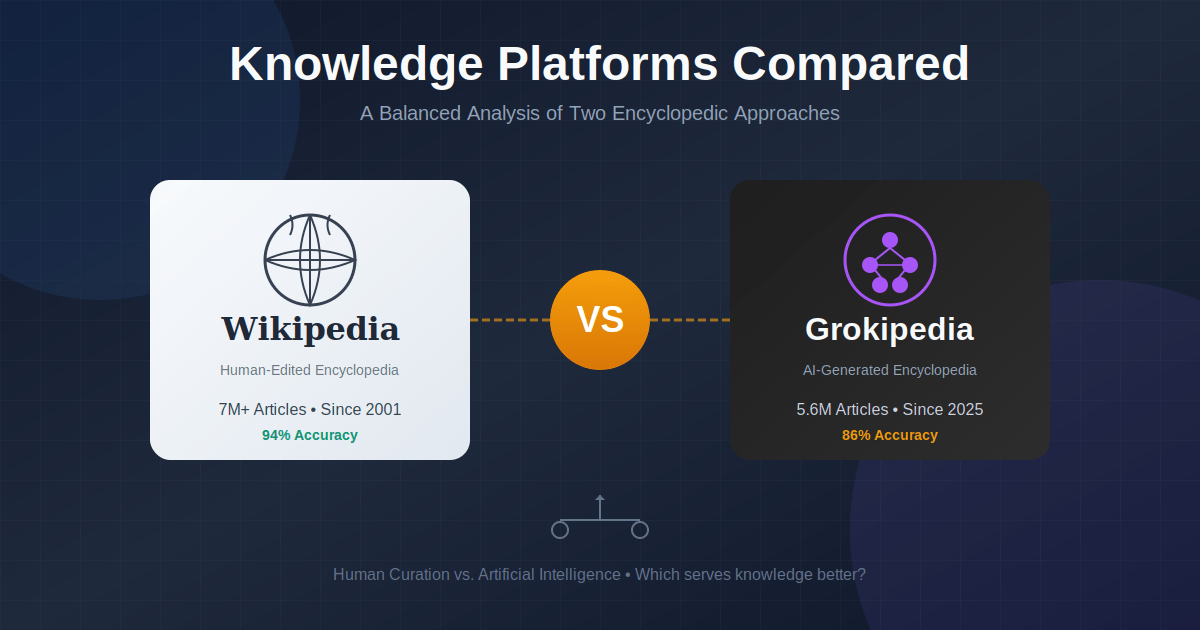
Founded in 2001 by Jimmy Wales and Larry Sanger, Wikipedia is a free, multilingual online encyclopedia written and maintained by a community of volunteer contributors. With over 7 million English articles, it operates on principles of neutral point of view (NPOV), verifiability through reliable sources, and open collaboration.
Grokipedia
Launched on October 27, 2025 by xAI, Grokipedia is an AI-generated encyclopedia powered by the Grok large language model. Positioned by Elon Musk as an alternative that addresses perceived biases in Wikipedia, it currently contains approximately 5.6 million articles. Users cannot directly edit articles but can suggest corrections through a feedback system.
Side-by-Side Comparison
| Aspect | Wikipedia | Grokipedia |
| Content Volume | ~7 million English articles | ~5.6 million articles |
| Editorial Model | Human volunteer editors with community oversight | AI-generated with user feedback system |
| Update Speed | Variable; depends on editor availability | Rapid; AI can process updates quickly |
| Accuracy (tested) | ~94% in independent testing | ~86% in independent testing |
| Transparency | Full edit history visible; open processes | Algorithmic; limited visibility into processes |
| Source Citations | Required; community-verified | Present but less densely referenced |
| Cost to Users | Free (donation-supported) | Free |
| Founded | 2001 | 2025 |
Wikipedia: Strengths
Proven Track Record and Scale
After 24 years of development, Wikipedia has established itself as a foundational reference resource. Its reliability has been tested in multiple academic studies, with a landmark 2005 Nature study finding it comparable to Encyclopaedia Britannica. More recent testing shows approximately 94% accuracy on factual claims.
Transparent Editorial Process
Every edit is logged with timestamps and contributor information. Discussion pages document debates about content. This transparency allows users to assess how contested topics have evolved and understand the reasoning behind editorial decisions.
Robust Citation Requirements
Wikipedia's reliable sources policy mandates that claims be supported by verifiable references. This creates accountability and allows readers to trace information back to primary sources. Research indicates articles with more editorial oversight tend to be higher quality.
Community Error Correction
Multiple layers of fact-checking exist: individual editors, WikiProjects focused on specific topics, and administrative oversight. Studies show vandalism is typically corrected within minutes, and the community structure provides continuous improvement over time.
Wikipedia: Documented Limitations
Systemic Coverage Bias
Wikipedia acknowledges it underrepresents perspectives from the Global South, women, and non-Western subject matter. Only about 18-20% of biographies feature women. The reliance on English-language sources creates an Anglo-American perspective on many topics. African, Asian, and Latin American subjects receive less comprehensive coverage.
Editor Demographics
The editing community skews heavily male (estimates suggest 80-90% male editors) and Western. This demographic concentration influences which topics receive attention and how they are framed. Efforts to diversify the contributor base have shown limited success.
Notability Barriers
Wikipedia's notability guidelines, while protecting quality, can exclude important topics that lack traditional media coverage. The case of physicist Donna Strickland—whose article was rejected before her Nobel Prize due to insufficient sources, illustrates how institutional biases in coverage propagate to Wikipedia.
Political and Ideological Disputes
Studies show Wikipedia articles may reflect slight left-of-center perspectives on some political topics, potentially because international editors hold views left of U.S. political norms on issues like healthcare and climate. Wikipedia co-founder Larry Sanger has criticised perceived ideological drift since leaving the project.
Grokipedia: Strengths
Rapid Content Generation and Updates
AI enables fast content creation and updating. Grokipedia grew from 800,000 articles at launch to 5.6 million within months. For fast-changing topics, current events, recent appointments, policy changes, AI can potentially reflect updates faster than volunteer editors can process them.
Confidence Scoring
Grokipedia displays confidence scores on claims, helping users gauge reliability. Testing shows moderate positive correlation (r = 0.62) between confidence scores and accuracy. This transparency about certainty levels, while imperfect, offers readers a signal that traditional encyclopedias lack.
Consistency in Presentation
AI-generated content applies consistent formatting and analytical frameworks across articles. This can provide more uniform treatment of subjects compared to Wikipedia articles, which vary significantly in style and depth depending on editor interest and expertise.
Strong Performance on Stable Facts
Independent testing shows Grokipedia performs well on established scientific and technical topics. Categories like Science/Technology and Sports showed strong accuracy. For general reference on non-controversial subjects, it can serve as a useful resource.
Grokipedia: Documented Limitations
AI Hallucination Risk
Large language models can generate confident, coherent text that is factually incorrect, a phenomenon called 'hallucination.' Unlike human errors caught through peer review, AI hallucinations can produce sophisticated falsehoods that appear authoritative. Independent testing found 86% overall accuracy compared to Wikipedia's 94%.
Documented Political Bias
Multiple external analyses have found Grokipedia articles frame contested political and social issues through right-leaning perspectives that echo Elon Musk's personal views. Academic analysis of coverage found systematic differences in framing compared to Wikipedia on politically contested topics. Some articles have been accused of downplaying extremism.
Source Quality Concerns
Research shows Grokipedia citations include sources Wikipedia considers unreliable. One study found 85.5% of controversial topic entries cite sources Wikipedia flags as 'generally unreliable,' and 21.7% cite 'blacklisted' sources. The platform has been found citing social media posts and low-credibility websites.
Limited Transparency and Correction Mechanisms
Unlike Wikipedia's visible edit history, Grokipedia's algorithmic processes are opaque. Users cannot directly edit articles, only suggest corrections. This closed system makes bias harder to identify and nearly impossible to correct without internal access. There's no public audit trail showing how content evolves.
Derivative Content
Investigations revealed large portions of Grokipedia content were adapted from Wikipedia, despite positioning itself as an independent alternative. Some articles are nearly verbatim copies with different citation formats. This raises questions about the platform's claimed independence.
Recommendations: When to Use Each Platform
Consider Wikipedia When:
- You need well-sourced information with traceable citations
- The topic is established with extensive secondary literature
- You want to understand how knowledge about a topic has evolved
- Transparency and accountability in sourcing matters
- You're researching academic, scientific, or technical subjects
Consider Grokipedia When:
- You need a quick overview of very recent events
- The topic is non-controversial and factually stable
- You want to see confidence-scored claims
- You're seeking an alternative perspective to cross-reference
- Speed of information matters more than depth of sourcing
Best Practice: Use Both Critically
For important research, neither platform should be your only source. Cross-reference information between both encyclopedias and trace claims back to primary sources. Be especially cautious with politically contested topics on either platform, and always verify critical information through authoritative original sources.
Conclusion
Both Wikipedia and Grokipedia represent different approaches to organizing human knowledge, each with distinct trade-offs. Wikipedia offers depth, transparency, and community oversight but struggles with coverage gaps and demographic bias among editors. Grokipedia provides speed and AI-powered synthesis but faces questions about accuracy, political bias, and algorithmic opacity.
The emergence of AI-generated encyclopedias adds a new dimension to information access, but does not eliminate the fundamental challenges of bias and accuracy, it transforms them. Rather than choosing sides, informed users can leverage both platforms' strengths while remaining aware of their limitations.
The best approach to knowledge in 2026 remains what it has always been: consult multiple sources, trace claims to their origins, think critically about biases (both human and algorithmic), and recognise that all knowledge systems reflect the values and limitations of their creators.
Sources: This analysis draws on independent accuracy testing (Skywork AI, October 2025), academic research (arXiv papers on Grokipedia bias analysis), Wikipedia's own documentation on systemic bias, reporting from The Business Standard, TechPolicy.Press, PolitiFact, The Atlantic, NBC News, and platform documentation from both Wikipedia and Grokipedia.


