AI Overviews, answer engines and generative search have changed how customers find brands. The old scoreboard measured rankings and clicks. The new one measures whether a model mentions you at all, and whether it does so accurately, when a buyer asks a question that never reaches your website.
A fresh crop of platforms is now competing to define what visibility even means in an AI-first world, and the practitioners building on top of them do not agree on much. So we put the leading voices in answer engine and generative engine optimisation up against each other on the questions every marketing team is wrestling with right now. What follows is the honest version of that debate, with the numbers attached.
First, a quick definition, because the acronyms are a mess.
Answer Engine Optimisation (AEO) is about getting selected for direct answers: featured snippets, People Also Ask, voice assistants and the AI-generated answer box. Generative Engine Optimisation (GEO) is the broader practice of being cited and recommended inside answers from ChatGPT, Gemini, Perplexity, Claude and Google's AI features. In day-to-day work the two blur together, and you will also see the same idea sold as LLMO, GSO, AIO and "AI SEO". As of early 2026 there was still no agreed academic line separating the terms. Google, for its part, published documentation in 2026 arguing that optimising for generative AI search is still just optimising for search, and therefore still SEO. Hold that thought, because it sits at the centre of the first argument.
What this actually means for brand visibility
The headline numbers are doing a lot of work in sales decks, so treat them with a bit of suspicion, but the direction of travel is hard to argue with. Gartner has projected that traditional search volume drops by roughly 25% by 2026, with a steeper fall of around 50% by 2028 as queries migrate to conversational interfaces. More than 60% of Google searches now surface some kind of AI answer, and depending on whose study you read, somewhere between 93% and 95% of AI search sessions end without a click to anyone's site.
That last figure is the one that should reorganise your thinking. In a zero-click answer there is no blue link to win and no traffic to count. The competition is for a sentence inside a synthesised response, and that sentence may name one brand, several, or none at all. McKinsey has gone as far as calling AI search the new front door to the internet, and on the B2B side the behaviour is already entrenched: surveys put the share of buyers using generative AI for vendor research at close to 89%.
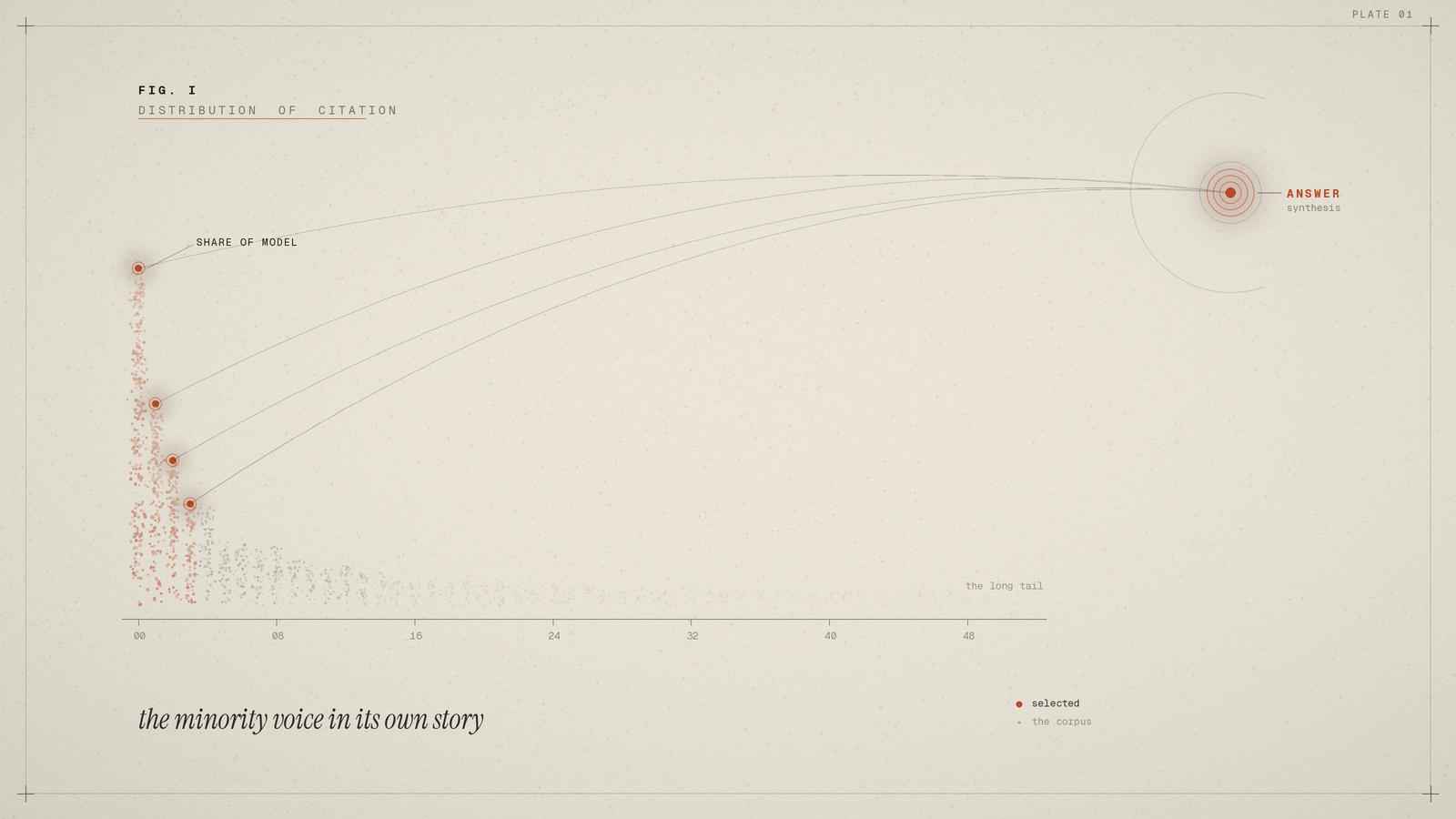
Here is the uncomfortable part for most brands. Profound analysed tens of millions of citations and found that on category-level prompts, the kind a buyer types when they have a problem but no preferred vendor, owned content made up only about 4.3% of citations. Roughly 95% of what an AI says about you is sourced from somewhere other than your own website. You are, in the words of one analyst, the minority voice in your own story. Visibility in this world is far less about your homepage and far more about the corpus of third-party material the model leans on to describe you.
Measuring influence inside AI answers
This is where the debate gets genuinely heated, because the metrics are new, the data is noisy, and several vendors have a commercial interest in whichever number makes their dashboard look essential.
The metric most people anchor on goes by a few names. Share of Model, Share of Citation or Citation Share all describe the same basic idea: out of a frozen set of buyer-relevant prompts, what percentage of the available citation slots does your brand earn versus competitors. One founder's monitor, to give a sense of scale, logged 77 owned citation slots out of 560 tracked across 32 queries, a 14% share. That is the honest texture of this work. Presence is possible, but it is sparse, and every slot is contested.
A few distinctions matter more than the marketing suggests:
- A mention names your brand. A citation links to it. These are not the same thing and you must track them separately, because a brand can be named constantly and linked rarely.
- Sentiment matters as much as frequency. Being described inaccurately or negatively is worse than being left out, and it is invisible if you only count appearances.
- Source distribution tells you which of your pages get pulled. It is usually a handful of deep pages rather than the homepage, which is useful when you decide what to refresh.
- Recommendation rank and prompt coverage tell you whether you show up early in the answer and across how many buyer-intent queries.
Now the caution that the more thoughtful practitioners keep raising, and that the dashboards quietly bury. These numbers are sample estimates, not a census, and the variance is brutal. Backlinko's research found that the mix of sources large language models cite shifted by around 80% in just two months. An academic paper in early 2026 showed that citation distributions follow a power law and that a great deal of what marketers report as a "win" sits entirely inside the measurement noise. The discipline that separates a real signal from a vanity tile is simple but rarely followed: freeze your prompt set, name your denominator, measure weekly, and only believe a movement you can tie to a specific piece of work you actually did.
Then, on 7 May 2026, the measurement ground moved. ChatGPT began hyperlinking brand names directly to their homepages. Profound's analysis found referral traffic to monitored brands roughly doubled overnight, the share of answers carrying a clickable brand URL jumped from around 4-5% to 22%, and the homepage share of OpenAI referrals went from 3.5% to about 24%. After years of telling everyone the homepage was dead, it became an AEO surface again in a single afternoon. The lesson is not "optimise your homepage". The lesson is that a single product decision at one lab can rewrite your metrics, so any trend line that spans that date is comparing two different things.
Tactics that move the needle, and tactics that do not
If there is one fight worth having, it is this one, because a fair amount of money is being spent on tactics with no evidence behind them.
Start with what the research supports. The foundational GEO study out of Princeton, Georgia Tech and the Allen Institute tested a set of content interventions and found that "fact density", which means adding authoritative citations, statistics and quotable statements, could lift the visibility of lower-ranked pages by up to 40%. That is a genuinely democratising finding for a challenger brand, because it rewards substance rather than budget. The same line of work found that brand mentions correlate far more strongly with getting cited (around 0.66) than backlinks do (around 0.22), and that a promotional tone actively hurts you, with a negative correlation of roughly 26%. Write like a salesperson and the model leaves you out.
Keyword stuffing, the reflex of two decades of SEO, performed about 10% worse than doing nothing, because models work on meaning rather than exact-match strings. Topic-descriptive URLs earned roughly twice the citations of keyword-stuffed ones for the same reason.
Now the awkward part, the tactics being sold hard that the data does not back:
- llms.txt has repeatedly failed to show a measurable lift in independent tests. One vendor found that removing it from their predictive model actually improved accuracy. It may yet matter for the agentic web, and it costs little to add, but it is not the lever it is marketed as.
- FAQ schema showed a slightly negative association with citations in at least one study, with schema-laden pages averaging fewer citations than pages without. Google itself moved in 2026 to debunk the idea that models need your schema to understand you.
- The broader category some now call "technical GEO", the bundle of schema overuse, mechanical chunking, AI-specific page rewrites and manufactured mentions, looks largely like a myth. None of it is required, and some of it backfires.
There is a sensible middle position worth defending. Clean heading structure and clear writing genuinely help in retrieval-heavy pipelines, not because the model worships your markup but because clarity makes you easier to extract. Structure multiplies the effect of good content. It does not replace it.
And there is a deeper point that the tactic-chasers miss. Generic content that ticks every box still loses, because the synthesis layer collapses interchangeable sources into a single composite answer and credits no one in particular. You do not just need to be authoritative and well cited. You need to be distinctively so. A real proprietary statistic, a contrarian and defensible point of view, a piece of original research: these survive synthesis precisely because they cannot be averaged away.
The new tool and platform landscape, and how to pick a partner
The vendor map is crowded and changing monthly, so treat any ranking, including the ones the vendors publish about themselves, as a starting point rather than gospel. Broadly, the field sorts into a few camps.
At the enterprise end sit platforms like Profound, with its detailed citation taxonomy and consumer-panel data, and Scrunch, which leans on security and governance credentials such as SOC 2. Adobe's LLM Optimizer pulls in the weight of its wider cloud. In the mid-market and agency space you find Peec AI, AthenaHQ, Otterly, OtterlyAI, Bluefish and Omnia, each trading on some combination of multi-platform tracking, sentiment analysis and competitor benchmarking. The established SEO suites have entered too, with Semrush's AI Visibility Toolkit and Ahrefs' Brand Radar bolting AI mentions onto data stacks teams already use. Specialists round it out: Botify connecting crawl behaviour to visibility, Gumshoe with its "Share of LLM" framing, and others aimed at niches like affiliate or compliance-heavy work.
A few questions cut through the demos:
- How big is the prompt database? Most vendors will not publish a number. The real differentiator is not the dashboard, which everyone has, but how many genuine user prompts the platform can mine to tell you which prompts are worth tracking in the first place.
- Does it prescribe action or just describe a problem? A dashboard that tells you your share dropped is half a product. One that hands you an executable brief is the whole one.
- Which engines does it actually cover, and how does it handle the variance? A tool that reports a single confident score and hides the noise floor is selling you certainty it does not have.
- Will it let you try it on your own queries before you sign? On paper these platforms look identical. In practice the setup speed and data control differ enormously, and a vendor unwilling to show you the inside should make you ask why.
Be especially wary of overfitting your whole strategy to one platform's preferences. Studies running the same queries across ChatGPT, Perplexity, Claude, Gemini and Grok found that only around 7% of cited domains appeared on three or more platforms at once. There is no single algorithm to crack. There are five or six different ones, and they disagree.
Brand-building in a zero-click world
This is the part that should reassure the marketers who never fully believed search was only ever about clicks.
When 93% of AI sessions end without a visit and 95% of what a model says about you comes from third parties, the job description changes. You are no longer mainly building a website for a crawler. You are building a reputation in the wider corpus that models read: the review sites, the comparison lists, the analyst notes, the forum threads, the trade press. Research suggests AI-recommended products carry around 3.6 times more reviews than their category rivals, and that brands earning both mentions and citations are far more likely to keep resurfacing across repeated runs than brands earning citations alone. Presence compounds.
A short, real example makes the point. A real estate CRM called REsimpli climbed to the most-cited tool in ChatGPT for "best CRM for real estate investors" inside 90 days. It did so not by rewriting its homepage but by aligning its entity data across places like Crunchbase, generating a couple of dozen fresh third-party reviews, and earning a place on three independent "best of" lists. That is brand-building and digital PR with a citation-shaped goal, and it looks a great deal more like the work earned-media teams have always done than like classic SEO.
Two practical implications follow. Your entity has to be consistent everywhere. If your own site says "answer engine optimisation", your LinkedIn says "AI search optimisation" and a directory calls it something else again, you are adding ambiguity that makes you harder for a model to pin down. Pick a primary term and use the rest as deliberate synonyms. And measure brand impact the way you would measure PR or brand search, upstream of direct attribution, because the influence is real even when the click never happens. Adding a simple "How did you first hear about us?" field with an AI option to your forms will catch more of this than your analytics ever will.
Designing content and sites for agents, not only humans
The horizon here is agentic. OpenAI's Operator arrived in January 2026, and the general expectation, echoed in Harvard Business Review's coverage early in the year, is that agents will increasingly act as buyers in their own right: shortlisting vendors, comparing options and, eventually, transacting. Designing for that reader changes a few priorities.
Lead with the answer. An agent extracting your content rewards a concise, direct response at the top of the page, ideally two or three sentences or a tight list that can be lifted cleanly, with the supporting evidence beneath it. Make your claims verifiable, with dates, figures and named sources, because corroboration is what gets you selected over a vaguer competitor. Keep high-value pages current, since fresher pages are roughly twice as likely to earn citations, and staleness is one of the first things to cost you presence. Build content around the actual questions buyers ask rather than the head terms you wish they searched, mining real phrasing from sales calls, support tickets and People Also Ask, then mirroring it in your headings.
One timing detail is worth knowing. In multi-turn conversations the first exchange is far more likely to produce a citation than the tenth, by a factor of around 2.5. The battle to be co-cited alongside the obvious incumbent is largely won or lost in that opening turn, which puts a premium on owning the clearest, most quotable answer to the defining question in your category.
None of this means abandoning the human reader. The consistent thread across every credible study is that content built to genuinely serve a person, clear, specific, evidence-backed and honestly written, is the same content that machines select. The two audiences have converged more than the "optimise for robots" crowd would like to admit. Which loops back to where we started, and to Google's claim that this is all still just SEO.
That claim is half right, and the half it gets wrong is the half that matters. The fundamentals of useful, trustworthy, well-structured content have not changed, and anyone treating GEO as a brand-new dark art is mostly rediscovering old discipline under a new label. But the goal has moved, from a ranked list of clickable links to a synthesised answer that may never link to anyone, and the place the competition happens has moved with it, out of your website and into a third-party corpus you influence rather than control. You can call that SEO if you like. Just do not let the label talk you out of changing what you measure, where you compete, and what you build.
The brands that win the 2026 to 2028 transition will be the ones publishing the most distinctive, verifiable and consistently referenced material, and measuring honestly enough to tell the difference between a real gain and a rounding error.





