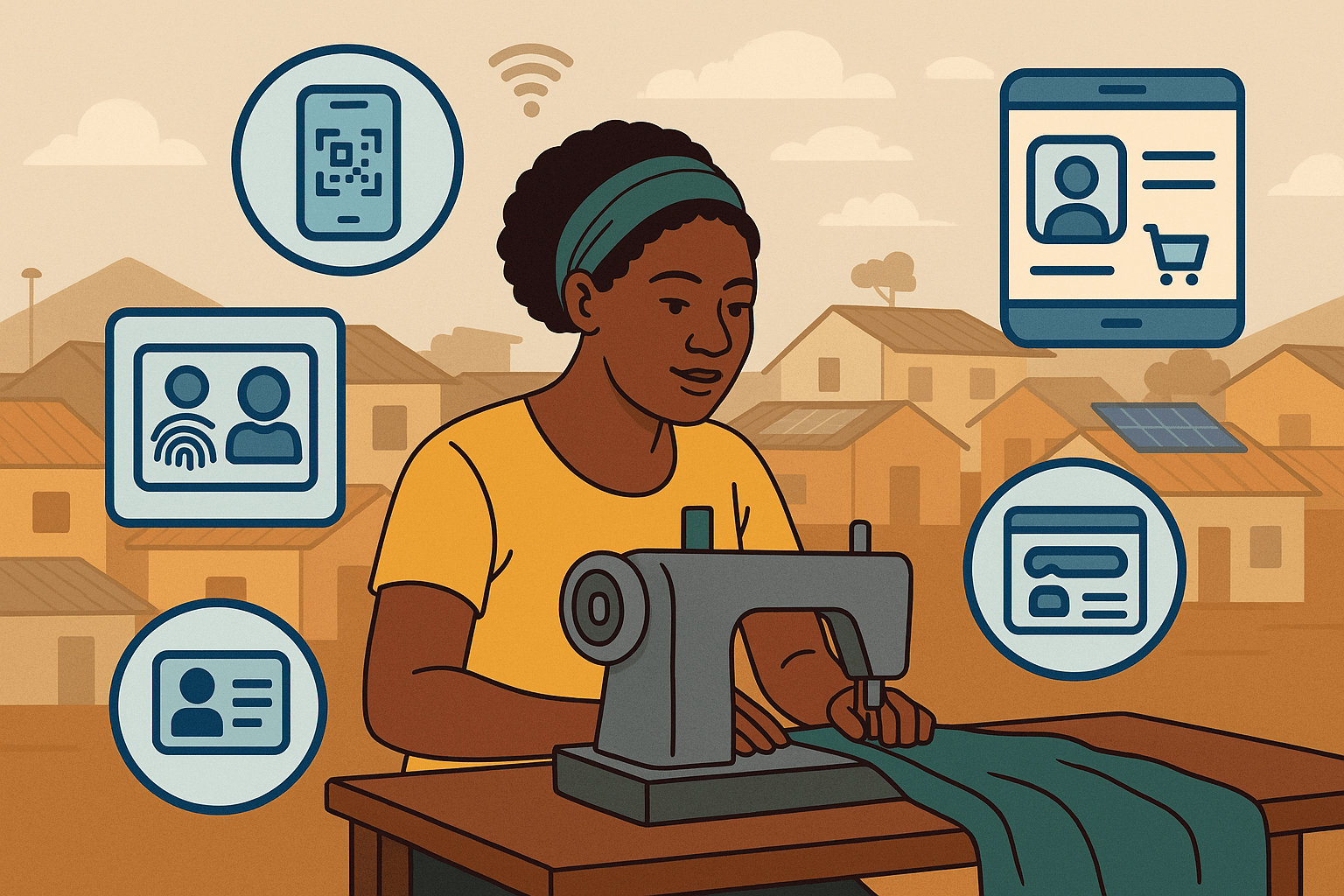
🧵 Meet Nandi: A Seamstress with Digital Ambition
Nandi runs a small tailoring business from her home in Katlehong. Her loyal customers come via word of mouth, and she takes cash payments only. She has no website, no business registration, and no way to track sales data for future financing or partnerships.
Here’s how her journey could change with DPI-enabled systems:
| Digital ID | Nandi gets a verifiable business identity through a DPI-linked platform (like a mobile app or SEDA kiosk) using biometrics and local address proof. |
| Payments Layer | She links her ID to a DPI-enabled wallet that supports QR payments via PayShap, allowing her to accept digital payments—even from customers without bank accounts. |
| Data Exchange | Her transactions sync with an open data ledger that allows her to generate revenue records. She uses this to apply for a CHIETA-accredited training grant. |
| Marketplace Access | Through an integrated platform like Acalytica, Nandi builds a mobile-friendly storefront and begins taking custom orders online. |
DPI turns Nandi into a registered, digital-ready microenterprise—without forcing her to hire an accountant or web developer.
🛠️ Platform Builders: What’s Already in Motion?
Several platforms and programmes are laying the groundwork for DPI use in artisan ecosystems:
✅ Acalytica
Provides artisans with free digital storefronts, analytics, QR code tools, and split-payment features. Works even for unregistered businesses and supports cashless transactions through Stripe and local integrations.
✅ PayShap
South Africa’s rapid payment system enables low-cost, real-time payments using phone numbers or aliases. Perfect for artisans without EFT setup.
✅ CHIETA
The Chemical Industries SETA is expanding digital skills for artisans, with partnerships in townships for mobile training labs and funding pathways.
✅ DSBD/SEDA
Explores integrating DPI elements in its support for informal traders—especially in rural and peri-urban hubs—by digitizing business registration and access to microgrants.
🚀 Scaling the Use Cases: A DPI Flywheel for Artisan Growth
Once an artisan enters the DPI ecosystem, opportunities compound:
- Registered ID → Payment Access
- → Receives more customer trust and formal contracts.
- Payment Access → Revenue Data
- → Builds a credit score for microloans or equipment financing.
- Revenue Data → Formal Training Eligibility
- → Upskills through SETAs like CHIETA or mobile e-learning.
- Training + Digital Tools → Business Expansion
- → Hires others, increases income, and contributes to job creation.
This DPI flywheel turns the artisan economy into a national engine of resilience.
🧭 Enabling Infrastructure Still Needed
To make these use cases the norm, not the exception, we must:
- Localize digital tools to work on feature phones and in low-connectivity environments.
- Train community-based agents to onboard and support artisans.
- Integrate DPI with trusted intermediaries—like cooperatives, churches, or trade associations.
- Provide zero-rated access to key platforms like Acalytica and CHIETA portals.
🔚 Conclusion: DPI Is Not a Silver Bullet—It’s a Catalyst
DPI won't solve every challenge artisans face. But it can lower the floor and raise the ceiling. It can remove friction, boost visibility, and turn informal skills into formal opportunity.
📚 References
- PayShap Launch Report – BankservAfrica (2023)
- CHIETA Digital Skills Strategy (2024)
- Acalytica.com – Tools for Artisans & Creators
- DSBD Informal Sector Strategy (2023)





