You have been thinking about it for months. Maybe longer. The ebook you keep meaning to write, the template people keep asking you for, the meal plan your DMs request every January. It lives on a mental shelf labelled "one day."
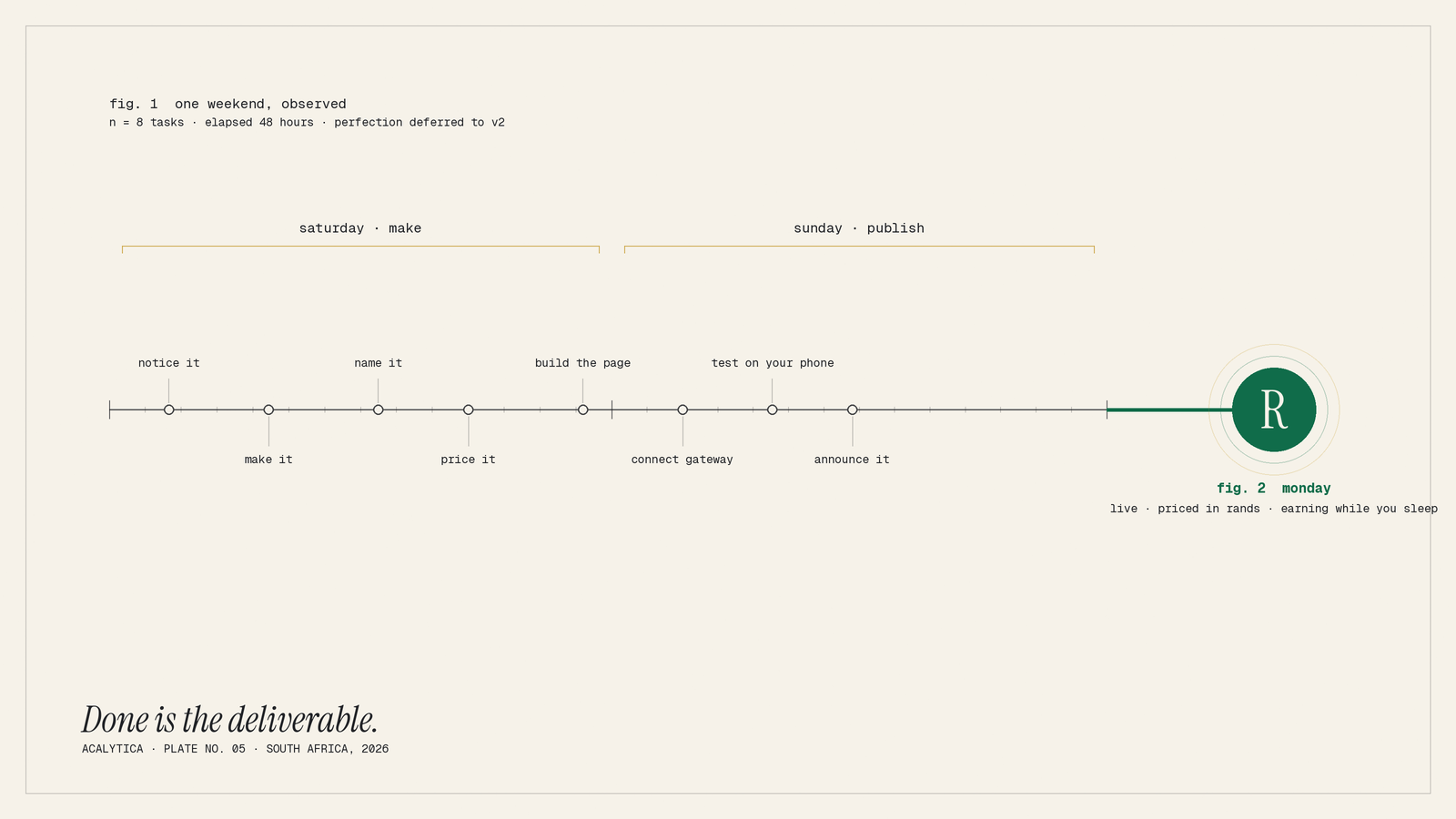
Here is the uncomfortable truth about "one day": digital products do not fail because they were built badly. They fail because they were never built at all. So this guide has one job, to get you from idea to a live, buyable product between Saturday morning and Sunday night. Not a perfect product. A published one. You can polish version two with the money from version one.
Before Saturday: pick the thing you already get asked about
Do not brainstorm a product. Notice one. The best first product answers a question people already bring to you. What do friends, followers or colleagues ask your help with? What do people say "you should charge for this" about? What did you figure out the hard way that others are still struggling with?
Some patterns that work again and again in the local market: the fitness person's 4-week meal plan, the tutor's exam pack with worked solutions, the designer's CV template, the admin whiz's business document bundle, the photographer's editing presets, the freelancer's "how I got my first clients" guide. Notice what these have in common. None of them required new knowledge. They required packaging knowledge that already existed.
Pick one. Just one. The bundle empire can come later.
Saturday morning: make the thing
Block out three to four focused hours. That is genuinely enough for a first version, because your product needs to be useful, not long. A tight 12-page guide that solves one problem beats a padded 60-page ebook every time, and buyers agree.
For written products (guides, plans, notes): open Canva and pick an ebook or document template so the design is handled for you. Write like you talk. Structure it as: the problem, the steps, the examples, the checklist. Export as PDF.
For templates and presets: you likely already have the asset, you have just never packaged it. Duplicate your best CV design or preset, strip out personal details, and write a one-page "how to use this" PDF to include with it.
For anything with numbers or plans: a simple, clean spreadsheet or table often is the product. A budget tracker, a meal schedule, a content calendar. Do not overdecorate it.
The rule for Saturday: when you catch yourself fiddling with fonts for the third time, stop. Done is the deliverable.
Saturday afternoon: name it and price it
Give the product an outcome name, not a clever one. "The 4-Week Kickstart Meal Plan" outsells "Fuel & Flourish." "Matric Physics Paper 1 Exam Pack" outsells "Physics Made Fun." Buyers should know exactly what they are getting from the name alone.
Then pick a price from the realistic local ranges: guides and ebooks R99 to R199, meal plans R149 to R249, study notes R49 to R99, template packs R99 to R199. When stuck between two numbers, take the higher one, because underpricing is the far more common mistake. And remember that your first price is an experiment, not a commitment. You can change it in seconds later.
Sunday morning: build your page
This is the part people expect to be technical, and it is not. On Acalytica, the whole setup takes about half an hour.
Create your account and claim your link, ideally your name or brand, something clean like acalytica.com/yourname. Pick a template. Add a short bio line that says who you help and with what. Upload your product file, write two or three sentences describing who it is for and what it delivers, and set your price in Rands.
Then connect a payment gateway. If you already have a Paystack, Payfast or Yoco account, plug it in. If not, sign up for one now; the entry-level options are free and do not require a registered company, though allow for a verification wait of a day or two with some providers, which is exactly why we do this on Sunday morning rather than Sunday night.
Before lunch, do one test: open your page on your phone, exactly the way a buyer will see it. Check the description reads clearly, the price is right and the buy button works. If you can, ask one honest friend to try the full purchase and refund them the money. You now have a shop.
Sunday evening: announce it
Do not overthink the launch post. A simple, honest formula works better than hype:
The problem: "Every week people ask me how I plan my meals on a budget." The product: "So I finally put my whole system into a 4-week plan, with the grocery lists included." The proof: one screenshot, one page preview, or one result. The path: "It is R149, link in bio."
Post it where your people already are, whether that is TikTok, Instagram, X or your WhatsApp status. The status is criminally underrated: the people who watch it already know and trust you, which makes them the most likely first buyers you have. If you are on TikTok, film a 30-second version of the same formula talking to camera. Do not post once and vanish; mention it again during the week, because most followers will not see the first post.
What to expect in week one
Let us be honest, because hype helps nobody. A creator with a small, engaged audience typically sees somewhere between two and fifteen sales in the first week. At R149, ten sales is R1,490, earned from something that now exists forever and sells while you sleep. Some launches do far better, especially close to payday or exam season. Some start slower and build as the link circulates.
Whatever the number, you have something priceless that the "one day" version of you never had: real data. Your page analytics show you how many people visited and where they came from, so you can see whether your problem is traffic (nobody is clicking the link, so post more) or conversion (people visit but do not buy, so sharpen the description or rethink the price). From here, everything is iteration rather than guesswork.
The only step that matters
Everything in this guide is simple. None of it is easy, because the hard part is deciding that this weekend is the weekend. But consider the maths of waiting: every month your product stays unpublished costs you every sale it would have made, and the product you launch this weekend will still be earning next year.
Saturday: make it. Sunday: publish it. Monday: you are a person who sells digital products.
Create your free page on Acalytica and have your link ready before the weekend starts.





