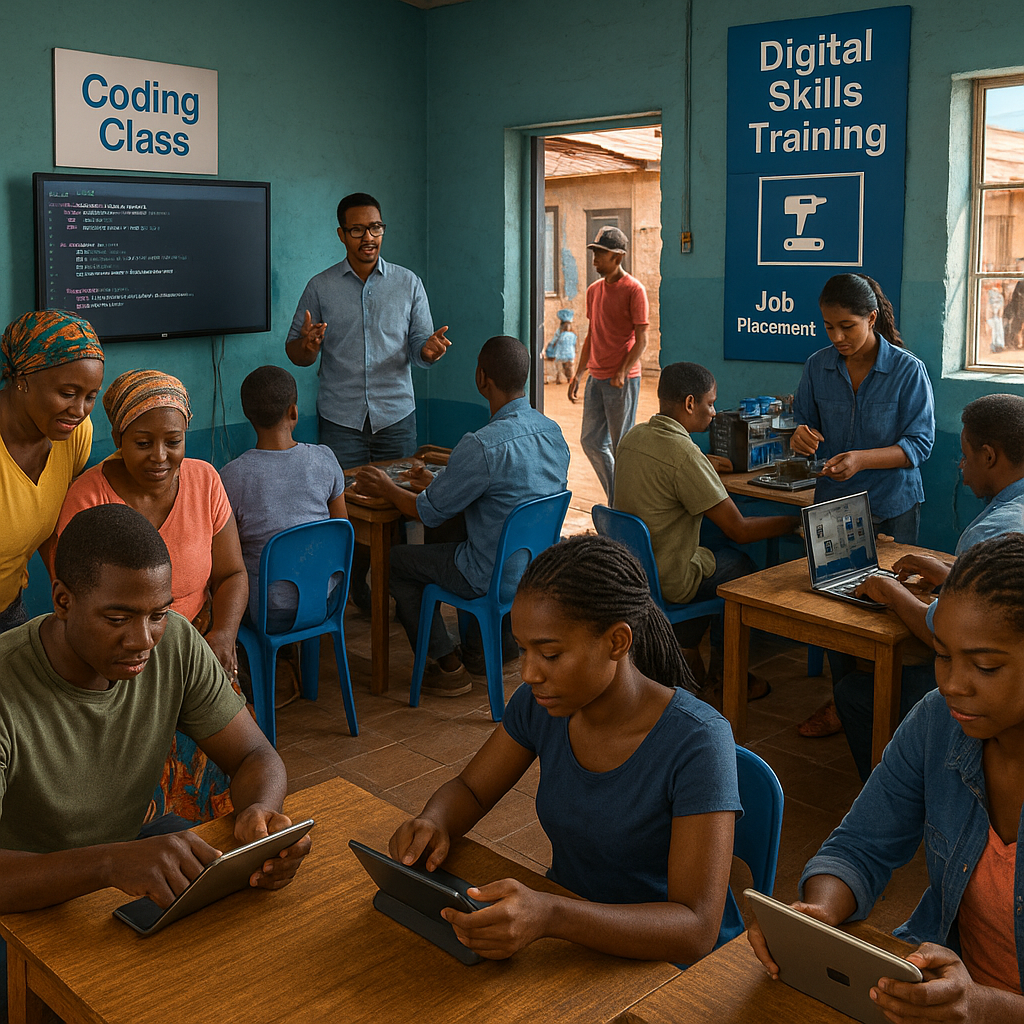
Smart cities promise innovation, but without deliberate investment in human capacity, they risk becoming exclusionary digital enclaves. To thrive, cities like Lanseria must not only deploy technology—but equip residents to use, build, and benefit from it. This article explores how digital skilling is not a support activity, but the foundation of smart city success in Africa.
The Digital Opportunity Gap
While smart infrastructure (IoT, AI, mobility platforms) is expanding across African cities, a skills mismatch persists:
- Youth unemployment remains high despite growing digital sectors.
- Township entrepreneurs are often excluded from tech procurement and delivery ecosystems.
- Public services are digitized, but residents lack the skills or trust to access them.
The result is a two-speed city—one hyperconnected, the other digitally invisible.
Skilling for the Smart City Economy
A modern smart city must cultivate a digitally capable population that can:
- Engage with public tech platforms (e.g., digital IDs, utility portals, civic dashboards).
- Monetize digital tools (e.g., using biolinks, QR codes, or no-code websites to run businesses).
- Fill new job roles in areas like AI support, urban data analysis, drone logistics, or IoT device maintenance.
These aren’t futuristic skills—they are here-and-now competencies essential for smart city participation.
Models for Digital Skilling in Lanseria
1. Community-Based Training Hubs
Retrofit community centers into smart learning hubs offering:
- Wi-Fi access and mobile learning stations.
- Short courses in digital literacy, cybersecurity, mobile money, and platform use.
- Peer-to-peer mentorship for upskilling informal entrepreneurs.
2. Public–Private Training Collaboratives
Involve tech firms, startups, and civic organizations in delivering:
- Micro-credential programs aligned with city services.
- Sponsored apprenticeships tied to smart city deployments.
- Job-matching platforms for newly skilled workers.
3. Digital Pathways for Youth
Integrate skilling into schools via:
- Gamified coding platforms.
- Environmental monitoring using sensors and citizen science.
- Smart school dashboards to teach data interpretation.
Equipping the Informal Economy
Smart cities can’t just target formal jobs—they must also uplift informal workers and micro-enterprises, who make up most of Africa’s workforce.
Solutions include:
- Training spaza shop owners to accept mobile payments.
- Teaching barbers and tailors to manage appointments via messaging apps.
- Helping food vendors create digital menus or social proof platforms.
When tech meets hustle, productivity, visibility, and income all rise.
What Policymakers and City Builders Must Do
- Include digital skilling in every infrastructure project—from roads to energy to mobility.
- Fund skilling programs via procurement offsets or ESG-linked municipal bonds.
- Open city datasets for use in training simulations and local startups.
- Track digital inclusion KPIs as core to urban performance reporting.
Conclusion
Smart cities must be built with smart citizens. Digital skilling is not charity—it’s infrastructure. It enables participation, boosts competitiveness, and fosters innovation from the bottom up. In Lanseria and beyond, the smartest cities will be those that train first, then transform.





