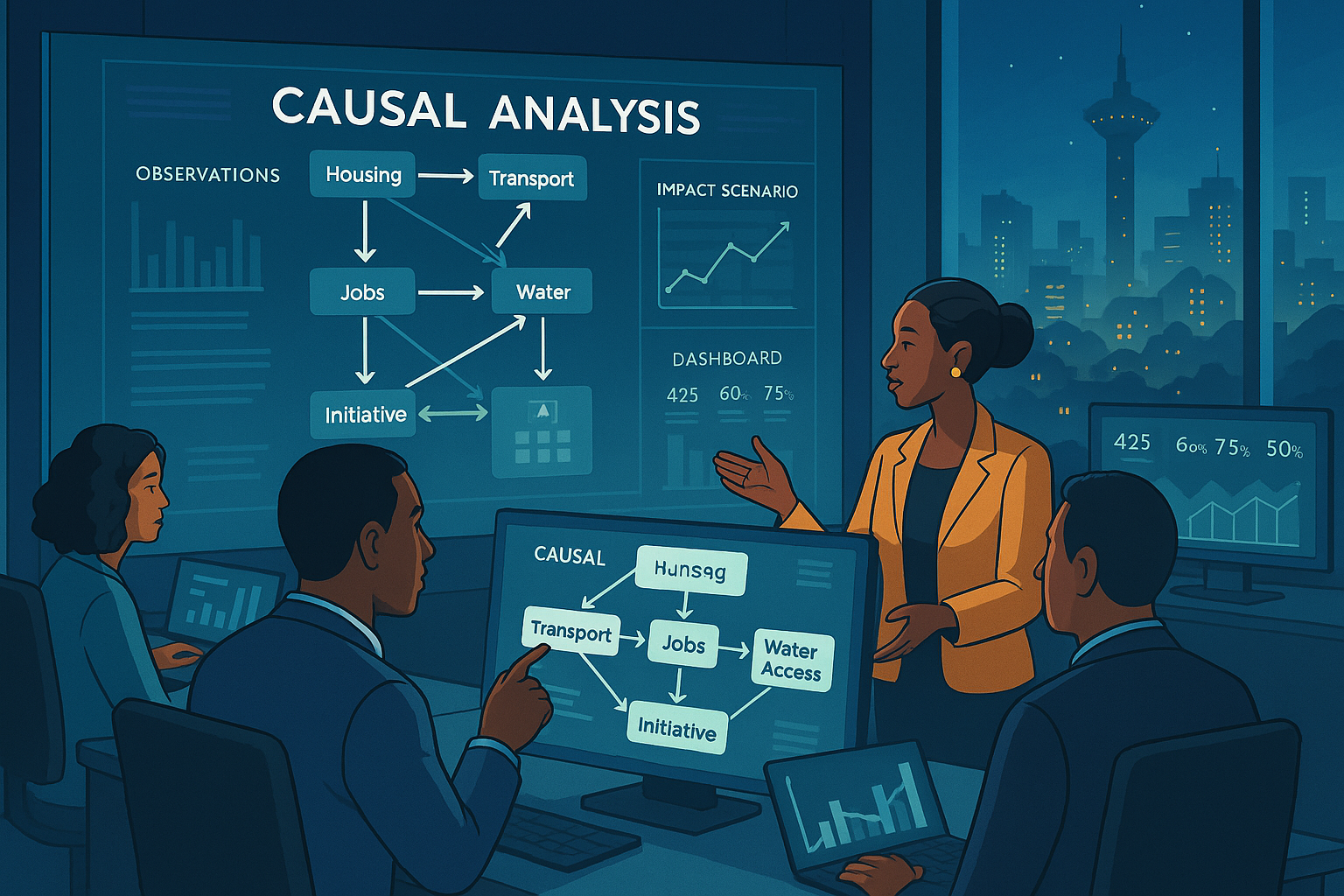
As African cities pursue digital transformation, a critical question emerges: Are we merely collecting data, or are we learning what truly works? Causal AI offers a paradigm shift—from passive data aggregation to active decision-making based on cause-and-effect relationships. For smart cities like Lanseria, adopting causal AI can unlock more precise urban planning, targeted interventions, and accountable governance.
The Limits of Predictive Analytics
Most smart cities today rely on predictive AI—algorithms that forecast traffic, energy use, or water demand. However, prediction alone cannot answer questions like:
- “Did our job training program reduce unemployment?”
- “What caused the spike in energy use in Ward 6?”
- “Would another intervention have worked better?”
These require causal inference—understanding not just what happened, but why it happened and what would have happened otherwise.
What Is Causal AI?
Causal AI uses mathematical models to simulate interventions, analyze counterfactuals, and uncover relationships between variables in complex systems.
In a smart city context, Causal AI can:
- Evaluate policy outcomes using causal diagrams and DAGs (Directed Acyclic Graphs).
- Simulate alternative actions (“what if we had built bike lanes before bus routes?”).
- Detect unintended consequences in large systems (e.g., subsidy leakages or gentrification).
Use Cases for Smart African Cities
1. Urban Mobility Planning
Using mobility data and DAGs to estimate the true impact of transit changes, congestion pricing, or ride-hailing policies.
2. Housing & Zoning
Assessing whether housing subsidies cause displacement or foster equitable growth.
3. Water & Energy Management
Distinguishing correlation from causation in usage patterns, pricing, and access.
4. Health & Emergency Services
Quantifying the impact of interventions such as AI triage systems or vaccine campaigns on public health metrics.
5. Education & Workforce Initiatives
Evaluating which skill-building programs drive employment vs. those that simply enroll participants.
From Data Collection to Causal Impact Loops
Smart cities must transition from descriptive and predictive loops to causal impact loops:
- Observe: Collect data via sensors, apps, and feedback forms.
- Model: Use DAGs and Structural Causal Models (SCMs) to encode hypotheses.
- Infer: Apply techniques like propensity score matching or instrumental variables.
- Act: Make policy choices based on evidence of what works.
Platforms like Acalytica are building user-facing interfaces that integrate causal inference tools—enabling decision-makers, analysts, and community stakeholders to move from data to action.
What This Means for City Leaders and Technologists
- Invest in talent and tools for causal analytics—not just big data pipelines.
- Mandate evaluation frameworks for all major urban interventions.
- Build open causal models for transparency and collective learning.
- Empower local universities and startups to co-develop sector-specific causal engines.
Conclusion
Causal AI is not just a technological upgrade—it is a governance revolution. It empowers African smart cities to stop guessing, start testing, and scale only what works. If Lanseria embraces this approach, it could become Africa’s first truly evidence-based city—a model for urban accountability in the digital age.





