For most of the last decade, "brand safety" lived in a narrow box. It meant keyword blocklists, post-bid verification scores, and the occasional crisis when a marquee advertiser found its logo next to extremist content on a social platform. Guardrails, in turn, were what platform safety teams talked about, model-side filters, RLHF refusals, the unglamorous plumbing of trust and safety.
In 2026, those two worlds have collapsed into one. The same CMO who used to ask whether her display ads were appearing on misinformation sites now has to ask whether her own AI-generated email copy will hallucinate a product claim, leak customer PII, or drift off-brand at 3am with no human in the loop. Brand safety is no longer something you buy from a verification vendor and forget. It is a runtime property of every system that touches the brand, and the maturity curve for the technology that enforces it has steepened dramatically.
This post is an attempt to map that curve honestly: where the technology actually is, where vendors are overpromising, and what a defensible 2026 brand safety and guardrails posture looks like.
Two heritages, one problem
It helps to be precise about where today's stack came from, because the seams still show.
The media-side heritage runs through GARM, the IAB Tech Lab, the 4As Advertiser Protection Bureau, and the MRC. Its central artefacts are the GARM Brand Safety Floor and Suitability Framework (originally published in September 2020, later expanded to include misinformation) and IAB Tech Lab's Content Taxonomy 2.2, which gave verification vendors and publishers a shared vocabulary for the eleven sensitive content categories advertisers wanted control over. That heritage is fundamentally about adjacency, making sure an ad for a family SUV doesn't render next to a beheading video, and the maturity model behind it is well-understood: pre-bid contextual classification, post-bid verification, inclusion and exclusion lists, and a slow drift away from the blunt keyword blocking that used to defund legitimate news coverage of difficult topics.
The model-side heritage is younger and messier. It runs through OWASP's Top 10 for LLM Applications, AWS's Guardrails for Bedrock (GA in April 2024), Azure Content Safety, NVIDIA NeMo Guardrails, open-source projects like Guardrails AI and LlamaGuard, and a fast-growing tier of gateway products. Its central concern is what the model says and does, toxicity, prompt injection, PII leakage, jailbreaks, hallucination, tool-use abuse, rather than where an ad shows up.
The reason these two heritages now have to be discussed together is simple: generative AI has made the brand itself a generator of content at scale. When a marketing org runs hundreds of agentic workflows producing landing pages, ad creative, support replies, and personalised emails, the question "is this output safe and on-brand?" is structurally the same question whether the asset is a paid placement or an autonomous agent's output. A 2025 MarTech analysis put it well by reframing brand standards as a "constitutional layer", machine-readable rules that must be enforced before an AI acts, not reviewed after.
A practical maturity model
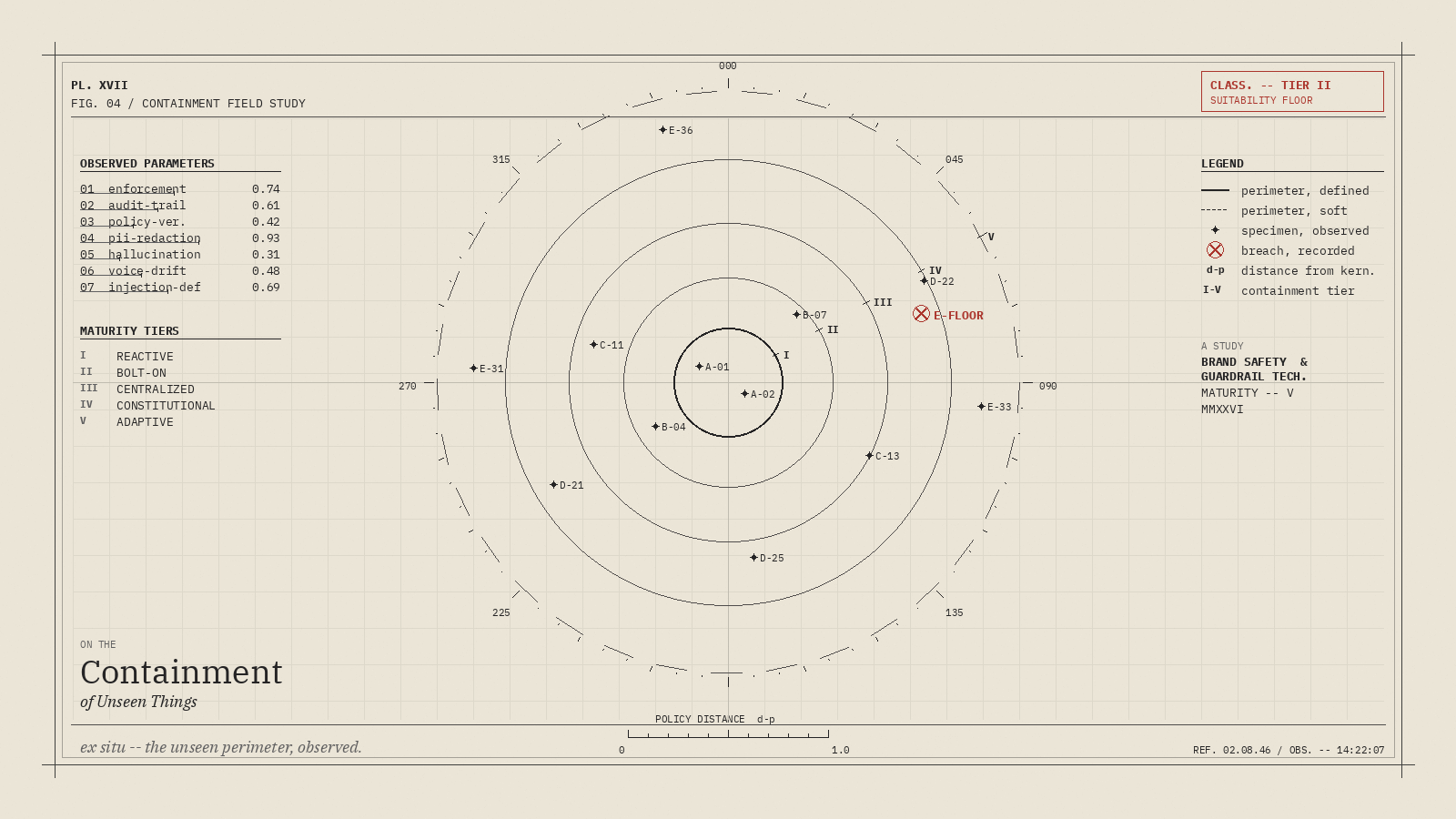
Vendor-published maturity models in this space tend to be self-serving (level 5 always happens to look like the vendor's roadmap). A more honest five-stage view, drawn from what enterprises are actually doing in 2026, looks like this.
Stage 1: Reactive. Brand safety is handled by post-hoc human review and a verification scorecard once a quarter. AI usage is governed by a PDF policy in a shared drive. There are no runtime controls; incidents are discovered when somebody screenshots them on LinkedIn. Most mid-market organisations are still here, and the IBM 2025 Cost of a Data Breach Report's finding that almost every AI-related breach happens in environments without adequate access controls is essentially a description of this stage.
Stage 2: Bolt-on. The organisation has adopted pre-bid brand safety verification (IAS, DoubleVerify, Zefr or similar) on the media side, and individual application teams have added per-app guardrails on the AI side, usually whatever ships with their primary model provider. Coverage is uneven. Each team interprets policy slightly differently, and one missed implementation becomes the next audit finding. This is where the bulk of large enterprises sit today.
Stage 3: Centralised enforcement. Brand safety and AI guardrails are pulled out of individual applications and onto shared infrastructure. On the media side, this looks like consistent application of the GARM Floor across all DSPs and verification partners with a single suitability tier per brand. On the AI side, it looks like a gateway pattern: every model call across every team routes through a single policy enforcement point that handles content safety, PII redaction, prompt injection defense, and audit logging. This is the architecture that vendors like Maxim AI's Bifrost, Portkey, and the major cloud-native gateways are pushing, and it has become the de facto target state for organisations serious about scaling AI in 2026.
Stage 4: Constitutional. The brand's voice, red lines, factual claims, regulatory constraints, and tone are encoded as machine-readable assets that the enforcement layer can consult in real time. This is more than a system prompt. It is a versioned, testable artifact that fires before any AI output leaves the system, generates an audit receipt, and allows the organisation to prove, to regulators, agencies, and itself, that a given output was checked against a specific version of policy at a specific time. Jasper's "brand memory" layer and the BXAI-OS framing of "constitutional enforcement" are early examples; most organisations attempting this are stitching it together themselves.
Stage 5: Adaptive and federated. Policies update continuously based on incident data, red-team findings, regulatory change, and brand strategy shifts. Different business units, geographies, and partner agencies operate under federated policy with shared minimums (the floor) and local suitability layers above it. Very few organisations are credibly here. The ones who are tend to be the largest CPG and financial services advertisers who already had mature governance functions before generative AI showed up.
The honest assessment: most organisations that think they are at Stage 4 are actually at Stage 2 with a good narrative.
What the technology can and can't do in 2026
Several capabilities have genuinely matured to the point where they are reliable production infrastructure. Multimodal contextual classification, analysing text, image, audio, and video together to determine the topic and sentiment of a page or piece of content, is now a commodity, sold by every serious verification vendor and increasingly available as an API rather than as a pre-bid integration. PII detection and redaction at the gateway layer is solved well enough that there is no good excuse for a customer-facing chatbot to leak a phone number. Prompt injection defences, while not bulletproof, have improved considerably as gateway vendors have layered detection models in front of the LLM rather than relying on the LLM to defend itself. And dual-stage validation, checking both the input prompt and the output response, has become the default architectural pattern rather than an advanced feature.
Other capabilities are still genuinely hard. Hallucination control remains the most overstated capability in the market; retrieval-augmented generation reduces fabrication when the retrieval corpus is good, but does not eliminate it, and "grounded" outputs still routinely include claims that are not in the retrieved sources. Brand voice consistency at scale is harder than vendors admit, a fine-tuned or system-prompted model will hold voice for a few hundred tokens and then drift, especially under adversarial or unusual user input. Cross-cultural and cross-linguistic policy enforcement is uneven; most guardrail providers were trained primarily on English and perform measurably worse on the long tail of languages that global brands actually need to cover. And the collapse of GARM in 2024, after the well-publicised X lawsuit, has left the industry without the convening body that previously coordinated cross-platform definitions, even as the underlying frameworks it produced remain in widespread use.
The gap between marketing claims and operational reality is where most program failures happen. A team that buys a guardrails platform expecting hallucination-free output will be disappointed; a team that buys the same platform expecting consistent PII redaction and policy-versioned audit trails will be well-served.
What a defensible 2026 posture actually looks like
A few principles seem to separate organisations whose programs work from those whose programs collapse the first time something goes wrong.
The first is that enforcement belongs at the gateway, not in the application. Per-application guardrails produce inconsistent enforcement, provider lock-in, and audit gaps because evidence is scattered across application logs. A single policy enforcement point that every model call passes through is the only architecture that makes "this request was blocked because of this policy at this time" a provable statement across a fleet of services.
The second is that the floor and the ceiling are different problems. The GARM Floor, content categories no advertiser should monetise, full stop, is a relatively settled question, even after GARM's institutional collapse, because the underlying frameworks are still embedded in MRC guidance and Tech Lab taxonomies. Suitability, what this brand wants to avoid beyond the floor, is genuinely a per-brand judgment and should not be outsourced to a vendor's default settings. The same logic applies to AI guardrails: there is a baseline of toxicity, CSAM, and clear policy violations that should be blocked unconditionally, and a much larger surface of brand-specific suitability that requires actual brand-side input.
The third is that governance is the human side of the same system. The MarTech recommendation of a cross-functional AI Council, legal, data, marketing, ethics, and technology, is not bureaucratic theatre. The technology stack changes monthly and the policy documents have to keep up; an organisation that cannot make policy decisions in days rather than quarters will find its enforcement layer running on outdated rules that block legitimate work and miss new risks.
The fourth is that regulatory pressure is now a forcing function, not a future concern. The EU AI Act's high-risk obligations apply from August 2, 2026, and the audit-trail requirements alone will be hard to satisfy without centralised enforcement and policy versioning. Organisations treating compliance as a separate workstream from brand safety are duplicating effort and will end up with two systems that disagree under stress.
Where this is going
The trajectory through the rest of 2026 and into 2027 looks reasonably clear. Gateway-and-guardrails will continue to consolidate as the dominant architecture, with the open question being whether the winning gateways are vendor-neutral (Bifrost, Portkey, Kong) or cloud-provider-native (Bedrock Guardrails, Azure AI Content Safety, Vertex AI safeguards). Brand suitability and AI output safety will continue to merge into a single discipline with a single tooling stack. Audit-receipt and policy-version-tracking features will become table stakes rather than differentiators, driven primarily by the EU AI Act and the patchwork of US state-level AI laws now coming online. And the "constitutional layer" concept, machine-readable brand and policy rules consulted at runtime, will probably emerge as the next genuine architectural shift, in the same way that the gateway pattern emerged in 2024 and 2025.
What will not change is the underlying truth that brand safety and guardrails technology is not a product category you can buy your way out of. It is an operating discipline, and the organisations that treat it as such, investing in centralised enforcement, codified policy, cross-functional governance, and honest measurement, will continue to pull ahead of the ones still treating it as a verification line item.
The maturity gap is not about having the technology. By 2026, almost everyone has access to the technology. The gap is about whether the organisation has built the muscle to use it.
Have a different read on where the maturity curve actually sits, or a war story from your own program? The interesting conversations in this space are happening between practitioners, not in vendor whitepapers.





