Everyone wants a brand that "lands heavy." A brand that carries influence, draws attention, and leaves an imprint long after it’s been experienced.
But here's the question most founders, creators, and marketers don't ask:
“Is my brand actually heavy, or just loud?”
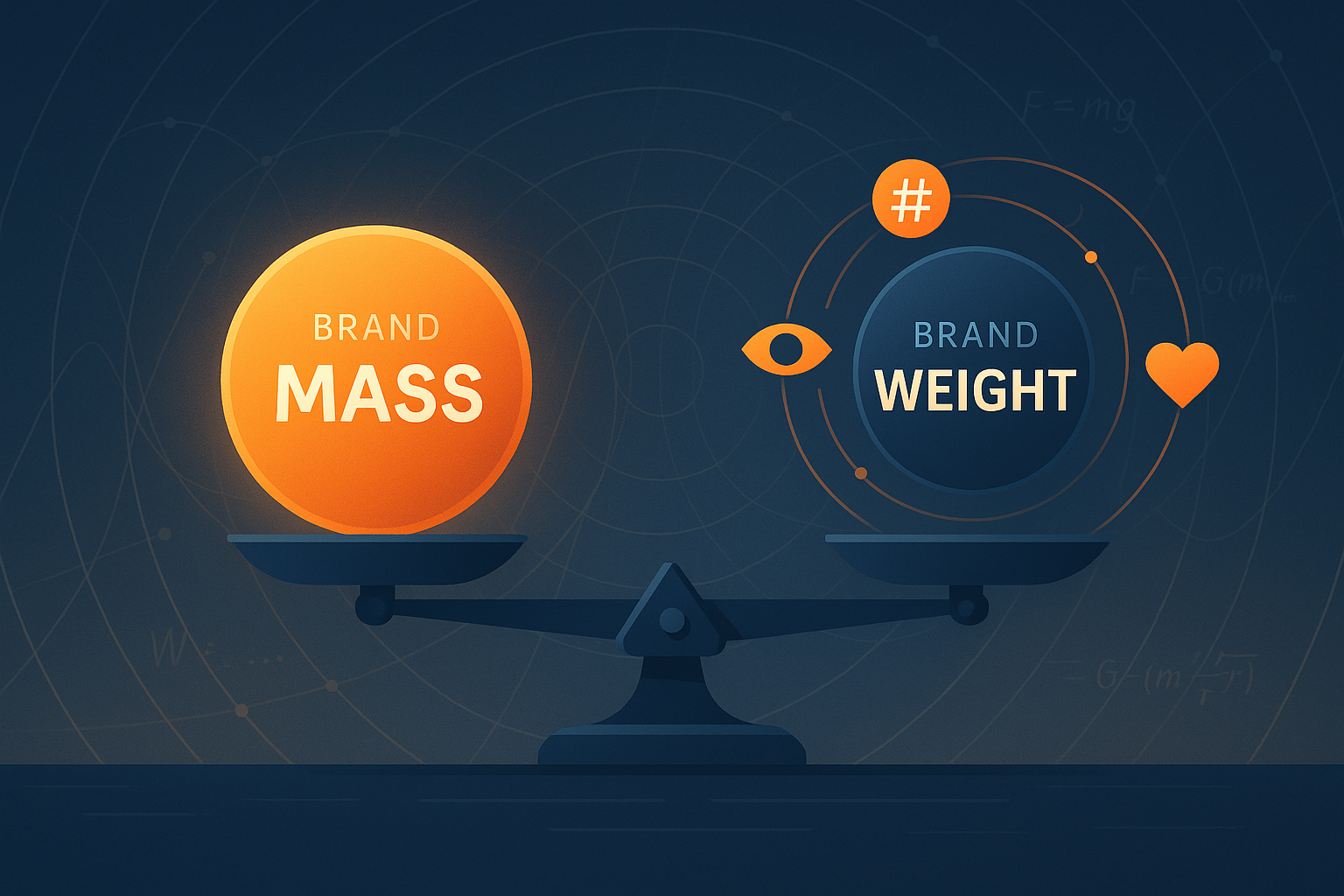
Welcome to the concept of Brand Mass vs. Brand Weight, a physics-inspired mental model to help you build not just visible brands, but gravitational ones.
What Physics Teaches Us About Branding
In physics:
- Mass is the amount of matter in an object. It’s intrinsic.
- Weight is the force of gravity acting on that mass. It changes depending on where you are.
Mathematically:
Weight (W) = Mass (m) × Gravity (g)
This is true in branding too.
Brand Mass = Substance
Your brand mass is the intrinsic value and depth your brand holds. It's built from:
- Your founding purpose
- A clear and compelling brand story
- Deeply held values
- Consistent customer experience
- Strong product–promise alignment
- Time-proven trust and credibility
Mass is what remains when the campaigns stop, the spotlight fades, and the hype dies down. It’s what you are when no one is watching.
Apple has mass. Patagonia has mass. So does Nando’s. Their marketing doesn’t define them, their purpose does.
Brand Weight = Perceived Influence
But having mass isn’t enough.
Weight is what your brand feels like in the market. It’s how much attention, trust, and influence your brand exerts on others. And that depends on the gravitational field, your market context.
That includes:
- Cultural relevance
- Topical alignment
- Timing
- Visibility
- Competitive space
"A high-mass brand in the wrong market feels invisible. A low-mass brand in a hot niche can feel huge, but it’s fleeting." - Acalytica
The Branding Equation
Let’s borrow the physics formula and tweak it for brand strategy:
Brand Weight = Brand Mass x Market Gravity
This explains a lot:
- Why some well-crafted brands flop (low gravity)
- Why some viral brands burn out (low mass)
- And why the most iconic brands last decades, they have both.
Real World Examples
High Mass, High Gravity
Nando’s – Deep cultural roots, humour, purpose-driven, consistently relevant.
Low Mass, High Gravity
Viral TikTok skincare brand – Trending today, gone next quarter.
High Mass, Low Gravity
Legacy corporate brand with outdated marketing, still has purpose and values, but no market connection.
Low Mass, Low Gravity
Generic drop-shipping store with no story, values, or unique voice.
How to Increase Brand Mass
- Codify your brand purpose and values, make them visible.
- Align your product or service with that promise.
- Create a narrative that people can belong to.
- Reinforce your voice, tone, visuals, and identity everywhere.
- Build trust through consistency, not novelty.
Mass doesn’t trend. It compounds.
🌠 How to Increase Market Gravity
- Enter relevant cultural conversations.
- Position into whitespace (where others aren’t).
- Collaborate with brands that increase your pull.
- Leverage formats where your audience lives.
- Ride timely moments, launches, events, movements.
Gravity doesn’t ask for permission. It pulls.
Final Thought: Mass Attracts
If your brand isn’t getting the traction you want, don’t ask for more followers.
Ask: Do I have real mass?
Then ask: Am I applying it in the right gravitational field?
Because in branding, just like in space — mass attracts.
TL;DR
- Brand Mass = Your substance. Built slowly. Lasts long.
- Brand Weight = Your market impact. Feels big or small depending on the context.
- Big brands aren’t always heavy. The heavy ones pull everything around them.
Want help measuring your brand’s mass and weight?
Acalytica is working on a diagnostic tool to help creators and businesses track their brand energy and impact across time and platforms.
Stay tuned.
Or better yet, start building gravitational pull today.





