Start with the problem Bayes solves
Teams argue because they are answering different questions. One person asks: “What do we think is true?” Another asks: “What did the dashboard show this week?”
Bayes’ Theorem is the bridge between those two. It tells you how to take what you already believe and update it when new evidence arrives. Not replace it. Update it.
Your next belief should be your old belief, adjusted by how well the new data fits. Weak evidence should not whip you around. Strong evidence should move you decisively.
Bayes in one sentence
Posterior = Prior × Evidence strength (normalised).
If that feels abstract, good. We will make it concrete using product and marketing examples.
The formula, stripped of intimidation
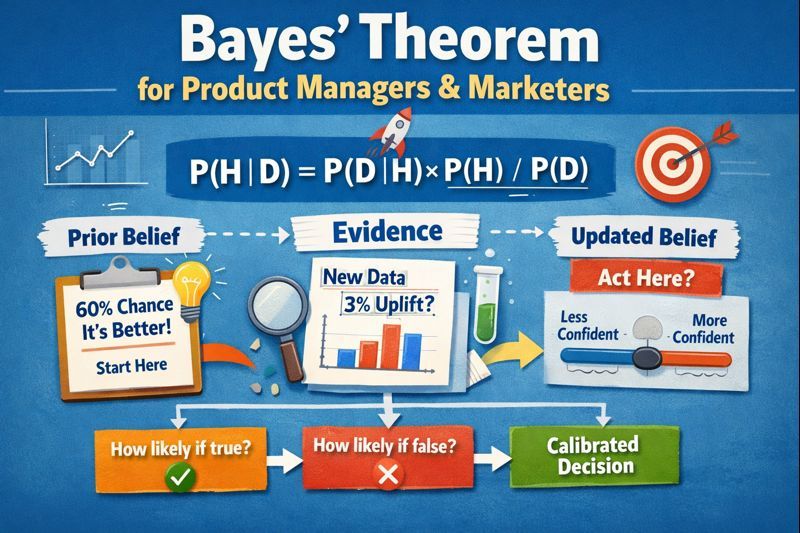
P(H | D) = P(D | H) × P(H) / P(D)- H = hypothesis (a claim you might act on)
- D = data (what you observed)
- P(H) = prior (your belief before this data)
- P(D | H) = likelihood (how expected this data is if H is true)
- P(H | D) = posterior (your updated belief after seeing the data)
- P(D) = baseline frequency (how common this data is overall)
The only part people obsess over is the maths. The real work is defining H properly and being honest about what counts as evidence.
A mental model that actually sticks
Imagine a dimmer switch, not a light switch. Your belief is a knob from 0% to 100%.
- New evidence turns the knob.
- Noisy evidence barely nudges it.
- Clean evidence moves it a lot.
If you treat every weekly swing in metrics like a verdict, you are using a light switch. That is how teams chase noise.
Example 1: A/B testing a landing page
Step 1: State the hypothesis like a decision
Hypothesis H: “The new landing page increases paid sign-ups.”
Step 2: Admit you already have a prior
Prior P(H): Based on past redesigns, you think there is a 60% chance it is better. This is not bias. It is information from history.
Step 3: Collect the data
Data D: The experiment shows a 3% uplift, but the confidence interval is wide. In plain terms: you saw an improvement, but the system is noisy.
Step 4: Ask the only two likelihood questions that matter
Likelihood if H is true: If the new page really helps, how likely is a 3% uplift?
Likelihood if H is false: If it does not help, how likely is it to still show a 3% uplift just from randomness?
Step 5: Update your belief and act accordingly
The posterior P(H | D) will rise a bit, not jump to certainty. The update is proportional to evidence quality. If the test is underpowered, Bayes tells you: stop pretending you learned more than you did.
The point is not computing a perfect number. The point is making the update rule explicit so decisions are consistent.
Example 2: Lead quality from a new channel
A new ad channel brings leads that look “high intent” based on click behaviour. Sales complains they are junk.
Bayesian framing
- H: Leads from Channel X are high quality.
- Prior: Historically, new channels are good 30% of the time.
- Data: Early cohort shows 2 deals from 100 leads.
- Likelihood: If the channel is good, would you expect only 2% close rate?
This prevents a classic mistake: judging a channel on tiny sample sizes. Bayes forces you to combine history with fresh evidence.
Example 3: Personalisation and segmentation
Most segmentation is frozen in time: “These users convert, those users churn.” Reality shifts, but the segments do not.
A Bayesian segment is a probability per user: “This user has a 72% chance of converting in the next 14 days.” Every new action updates that probability.
Personalisation becomes a live prediction system, not a static label.
Why p-values are not the same thing
A p-value asks: “If there is no real effect, how surprising is this result?” It does not directly answer: “How likely is it that this is a real effect?”
Bayes answers the decision question: “Given the result, what should I believe now?” That is why it fits product and marketing work, which is mostly decisions under uncertainty.
The one trap Bayes does not save you from
You can still lie to yourself by choosing a sloppy hypothesis or cherry-picking evidence. Bayes updates beliefs. It does not choose your integrity.
- Define the hypothesis in a way that changes an action.
- Separate signal from noise with adequate sample sizes.
- Use priors grounded in history, not vibes.
- Update continuously, not only when you like the result.
A practical shortcut for teams
If you do not want the algebra, use this meeting script internally:
1) What did we believe before (and why)?
2) If we are right, how likely is this data?
3) If we are wrong, how likely is this data anyway?
4) What belief update follows?
5) What decision changes because of the update?
That is Bayes in operational form: a belief update tied to a decision.
Bottom line
Bayes’ Theorem is a rule for sane learning: start with what you know, weigh new evidence by its quality, and update your confidence without overreacting.
If your team argues about “what the data says”, you likely have a Bayes problem: no explicit priors, no explicit likelihoods, and therefore no consistent updates.





