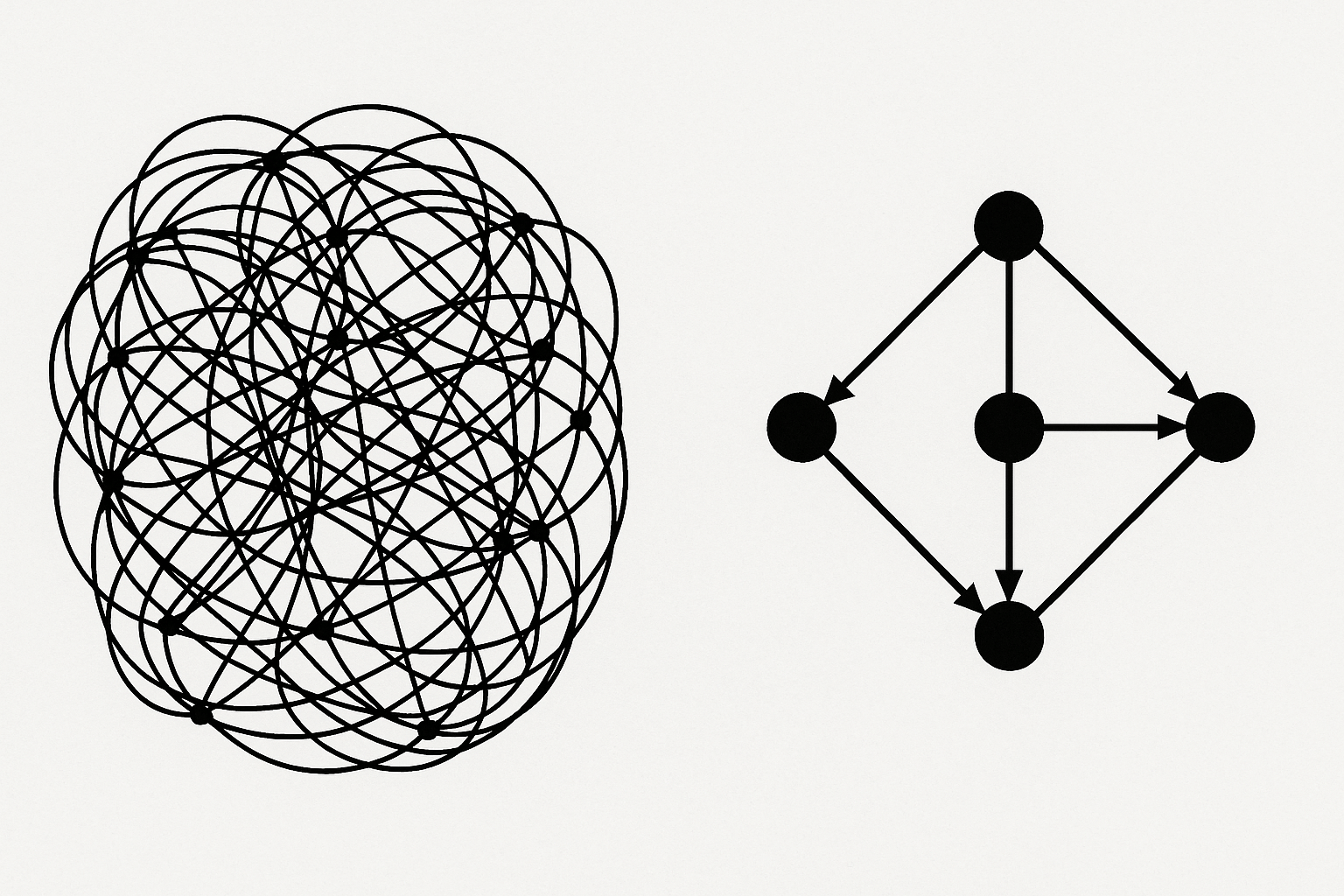
A world model looks like causality at first glance. It predicts the next thing that ought to happen. It compresses experience into a neat internal picture. It behaves as if it “understands” the rules behind the world. That illusion is strong because prediction often masquerades as explanation. But the illusion breaks the moment you try to poke the system and watch what changes.
A world model learns the patterns of the world. Causality is about the levers of the world. Those are not the same category of thing. A pattern tells you what usually follows what. A lever tells you what would happen if you forced something to be different. You can learn a million patterns without ever learning a single lever.
Think about how children learn physics. They don’t memorise every ball trajectory they’ve ever seen. They drop things, push things, throw things, and watch what breaks their expectations. The important information is not the pattern of past falls. It is the principle that predicts how things would fall even if they’ve never seen those conditions before. That principle is causal. A world model built only on past experience can only replay the archive.
A world model does something impressive: it reduces the world to a compressed internal movie. It guesses the next frame. But no matter how sharp the prediction becomes, it is still a statistical shadow. The same observational stream can come from many different underlying mechanisms. A world model has no way to tell which mechanism is real because it never performs the one act that identifies mechanisms: intervention.
Causality is a different kind of knowledge. It says that the world is built from components that work the same way even when you disturb them. It describes what is invariant under pressure. You can only discover that by asking counterfactual questions: what would happen if I changed X? What if I held everything else fixed? These questions don’t exist inside a world model unless you explicitly build them in.
If you train a giant predictive model on everything humans have ever written, it will learn to imitate the way people talk about causes. It might look like it is reasoning causally. But push it off the scripted path and it snaps back to correlations. It is repeating the music without knowing the instrument.
To turn a world model into a causal model, you must force it to separate mechanisms instead of mixing them. You must give it operators that change variables on purpose. You must test which parts of the model stay stable when you disturb inputs. In other words, you need to bolt causality onto the predictive machinery. The predictive machinery alone will never get you there.
Causality is the structure. A world model is the surface. The surface can get better and better, crisper and more coherent, but it will never reveal the structure by itself. Prediction is not explanation. Patterns are not levers. Understanding begins only when you can say what would happen if things were different.





