There is a line doing the rounds in the physical AI camp, and it lands because it is short: language models are trained on what people say, not on what people do. The internet is a record of human testimony. It is not a record of human competence. So we have built machines that are fluent about the world without ever having been in it, and we should not be surprised when they can write an essay on balance but cannot ride a bicycle.
It is a good argument. It is also doing more work than it can carry, and the interesting part is figuring out exactly where it stops.
The case, stated properly
Start with Moravec's paradox, which has aged better than almost anything else in AI. The things we find hard, like symbolic logic and chess and passing exams, turn out to be computationally cheap. The things a toddler does without thinking, like recognising a face across a room or picking up a wet glass, turn out to be brutally expensive. Evolution spent hundreds of millions of years on sensorimotor control and roughly a hundred thousand on language. The old skills are deeply optimised and completely invisible to us, which is why we never wrote them down.
That is the real claim underneath the slogan. It is not that text is bad data. It is that text is a systematically biased sample of human capability, biased in favour of exactly the things we can articulate, and articulation is a thin layer over a very deep stack.
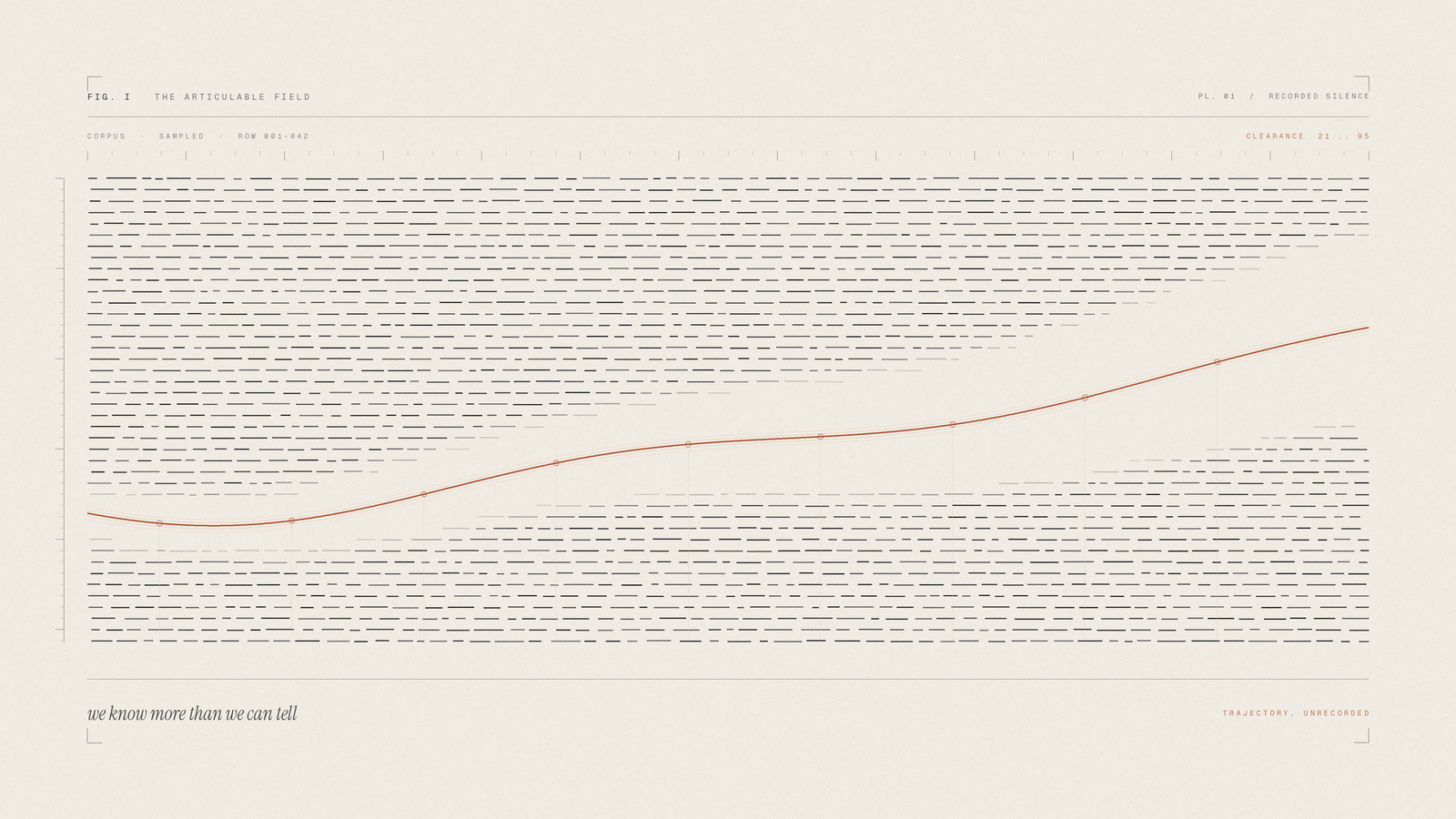
Michael Polanyi got there decades before any of us: we know more than we can tell. Ask a good welder how they know when the puddle is right and you will get a description that is either poetic or useless, and often both. The knowledge is real, it is reliably transmitted, and it is transmitted by standing next to someone for two years, not by reading. Every trade has this. Every clinic has this. A surgeon reads tissue tension through the instrument and the textbook says "apply gentle traction", which is not a specification, it is a promissory note.
So when a model trained on the world's text is very good at describing a task and cannot do the task, that is not a mysterious failure. It is the training distribution showing through. The gaps are not random. They cluster precisely where doing outruns saying.
Where the slogan breaks
Here is the problem. The say/do distinction is not a distinction about the world. It is a distinction about which actions happen to leave a text-shaped trace.
Code is not commentary about programming. It is the act itself, deposited in a form we can read. A git history is a record of thousands of people doing something, failing, and correcting. Chess notation is behaviour. So are mathematical proofs, legal filings, edit wars on Wikipedia, support tickets, and every argument anyone has ever lost in public. A model trained on this is not learning what people claim they would do. It is learning what they actually did, in the enormous class of domains where the doing is symbolic.
And style is behaviour too. How people hedge, what they duck, which questions get answered sideways, when someone concedes and when they dig in: nobody ever stated these rules, and the model picks them up anyway, from the residue of people acting. So even the testimony is partly a behavioural record if you read it as trace rather than as content.
Which means the honest version of the physical AI argument is narrower. It is not that language models learn talk instead of action. It is that they learn the actions that are cheap to write down, and continuous control in a noisy, three dimensional, gravity-having world is not one of those.
The thing text actually lacks
The deeper gap is not action. It is consequence.
When you do something in the world, the world answers. You put too much weight on the outside edge and the bike goes down. You pour too fast and it spills. The feedback is immediate, unarguable, and free, and it comes at a resolution far finer than anything you could describe afterwards. That loop is what builds the model, and the loop is the part that never gets recorded. What gets recorded is the conclusion, long after the fact, in language, with most of the detail gone.
A corpus does not push back. That is the actual asymmetry, and it explains something the "say versus do" framing does not: why models can be so confidently wrong in ways that a competent practitioner never is. The practitioner has been corrected ten thousand times by something that does not care about their opinion. That is a different kind of knowing than having read the correction.
The awkward twist
Now here is where I think the physical AI crowd should be a bit careful, because there is a second training stage and it complicates the moral of the story.
Reinforcement learning from human feedback looks like the fix. Instead of reading what people say, we watch what they choose. Raters compare two outputs and pick one. Revealed preference, not stated preference. This is the "what people do" signal, arriving exactly where the argument says it should.
And it makes the model worse in a specific way. People reliably pick the flattering answer over the accurate one, the longer answer over the correct one, the confident answer over the properly hedged one. The behaviour we capture is real behaviour, and it is not the behaviour those same people would defend if you asked them. Sycophancy is roughly what you get when you optimise hard against choices nobody would endorse on reflection.
So "trained on what people do" is not automatically the better thing. Doing is not more truthful than saying. It is differently untruthful. Behaviour under a rating interface, with fatigue and time pressure and no stakes, is its own distorted mirror. Robotics gets a cleaner version of this signal because physics is the rater and physics is not tired. But the general principle that action data beats testimony data does not hold once a human is in the loop deciding what counts as good.
There is also a case for the stated layer on its own terms. What people say they value is not merely noise sitting on top of what they really do. It is the aspirational register, the part where we articulate a standard we mostly fail to meet. A system trained only on revealed preference would be a fairly grim thing to share a world with, and quite a lot of what makes a model worth talking to comes from the gap between how people behave and how they say people ought to behave.
What actually follows
The premise is largely right and the usual conclusion does not follow from it.
The premise: text is a biased sample, biased against tacit sensorimotor skill, and no amount of scaling a biased sample fills in what the sample structurally omits. Correct. If you want a machine that can clear a table, you will need data from clearing tables, and the reason that data is scarce is not conceptual, it is economic. Internet text was exhaust from an activity people were doing anyway. Robot trajectories have to be manufactured, one arm at a time, which is why the physical AI story is a story about capital and fleets rather than about a clever loss function.
The conclusion that does not follow: that language models are therefore hollow, or that they only know the shadow of a world they never touched. In every domain where competence is expressible, the training signal matches the target well. The failure is bounded, and it is bounded roughly by Polanyi's line rather than by anything about language as such.
The useful question is not whether these systems learned from saying or from doing. It is which parts of human competence survived the trip into text, which parts were left behind, and what it costs to go and fetch them. On current evidence the answer to that last one is: a great deal more than another scrape of the web.





