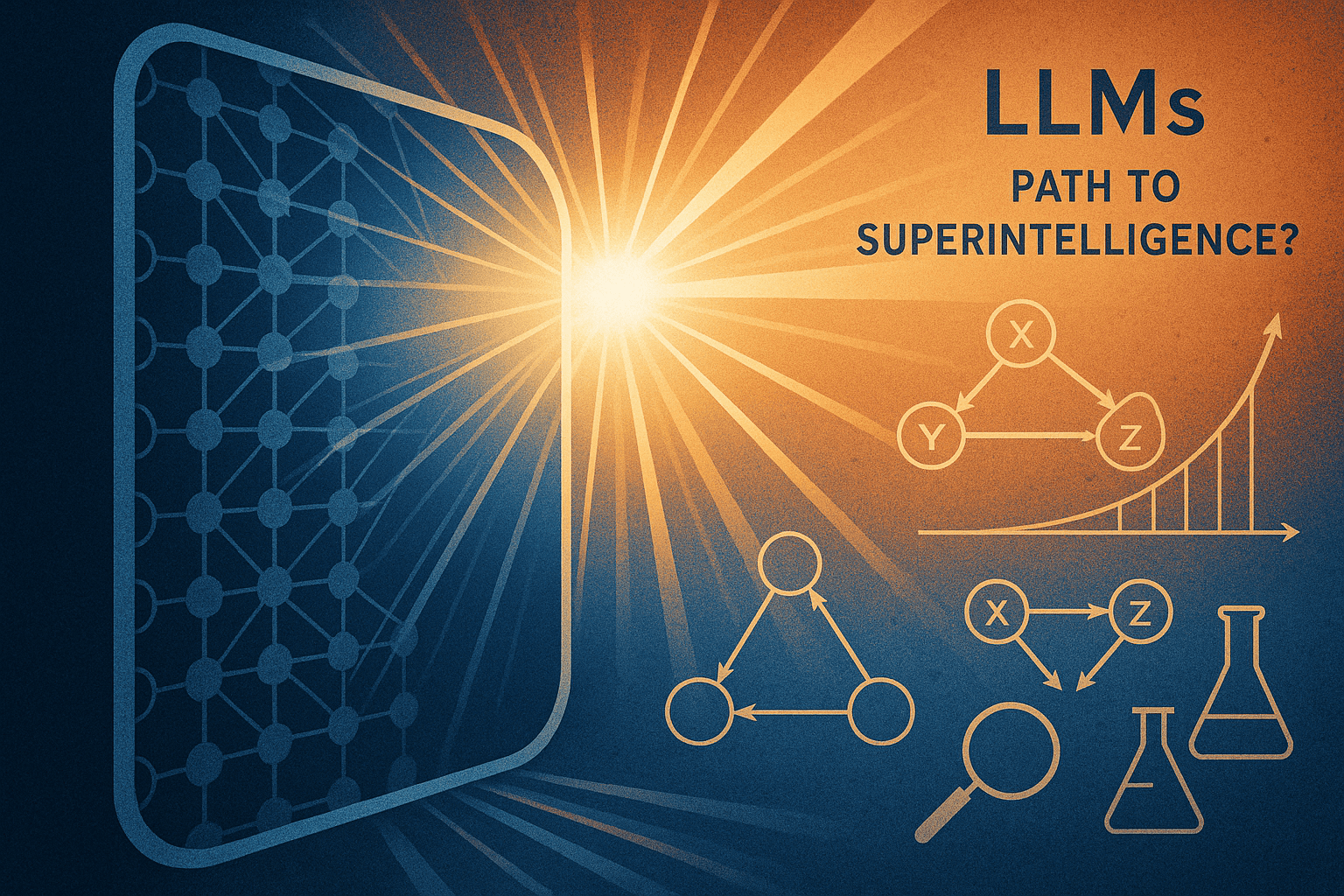
Large Language Models (LLMs) have become the most powerful mirrors of human thought we’ve ever built. Yet a mirror, no matter how clear, does not see. The question is not whether scaling them leads to superintelligence, but whether prediction alone can yield understanding.
The Illusion of Understanding
LLMs do something astonishing: they predict the next word in a sequence, given billions of examples. From this simple rule, we get conversation, code, poetry, and plans. But beneath the surface, no one’s home. The model doesn’t know why its words make sense. It only knows that they often do.
That distinction, between pattern and principle, is critical. Physics didn’t advance by memorising falling objects; it advanced by discovering invariants: force, mass, acceleration. LLMs, in contrast, internalise correlations, not causes. They are linguistic calculators of likelihood, not engines of explanation.
Why Scale Isn’t Intelligence
Scaling a model increases its memory and coherence, but not its epistemic grounding. Feed it all of Wikipedia, every research paper, every tweet, it will still lack a causal model of the world.
A child learns the concept of gravity by dropping a toy and watching it fall. The LLM “knows” about gravity because it has seen the sentence “things fall down due to gravity” millions of times. One grounds understanding in experiment; the other in frequency.
This is the central limitation: correlation learning does not produce comprehension. Superintelligence requires models that can reason why, not just predict what.
The Missing Ingredients
Superintelligence will not arise from text prediction alone. It will emerge from systems that integrate four missing ingredients:
- Causal Reasoning – The ability to model interventions, not just associations. Knowing that “fire causes smoke” allows prediction of both directions under manipulation, which no current LLM does.
- Embodied Grounding – Sensory and motor feedback loops that connect concepts to the physical world. Intelligence without grounding is unanchored simulation.
- Agentic Continuity – Persistence of goals and memory across contexts. Current LLMs reset after every prompt; a superintelligent agent must accumulate beliefs, update them, and pursue long-term objectives.
- Reflective Meta-Cognition – The ability to model its own uncertainty and revise strategies dynamically. True intelligence is not in answers, but in recognising when one doesn’t know.
How to Get There
To move beyond linguistic intelligence toward superintelligence, research and engineering must reframe their goals from scaling models to integrating modalities and motives.
Step 1: Couple LLMs with causal engines
Combine language models with structural causal models (SCMs) that can run interventions. The LLM provides hypotheses; the causal engine tests them through simulated or real-world feedback.
Step 2: Build persistent agent frameworks
Introduce architectures that store beliefs and goals across interactions, like CrewAI or other multi-agent frameworks, but grounded in causal state changes, not just prompt chaining.
Step 3: Merge simulation and embodiment
Integrate multimodal simulators (vision, action, sensor data) so that models experience counterfactuals. Let them “see” the consequences of actions, not just describe them.
Step 4: Reward understanding, not imitation
Current training objectives reward linguistic imitation. New objectives must reward causal inference, experiment design, and uncertainty calibration. A model should be penalised for confident nonsense and rewarded for adaptive curiosity.
The Path Forward
The road to superintelligence runs through causal integration, not linguistic inflation. We are currently building encyclopaedias that speak, not scientists that think.
Language models are necessary, but insufficient, components of a larger architecture. They give intelligence a voice, but not a mind. To cross that gap, machines must learn to do science: to experiment, observe, infer, and correct.
When a system can say not only “fire causes smoke” but also “if I extinguish the fire, the smoke stops”, and can test that claim, it will have taken its first step from imitation to insight.





