Every e-commerce team I talk to is chasing the same thing: conversion. More add-to-carts, more checkouts, more repeat buyers. And most of them are pouring money into AI to get there, smarter recommendation engines, personalised ad creative, chatbots that sound less like chatbots.
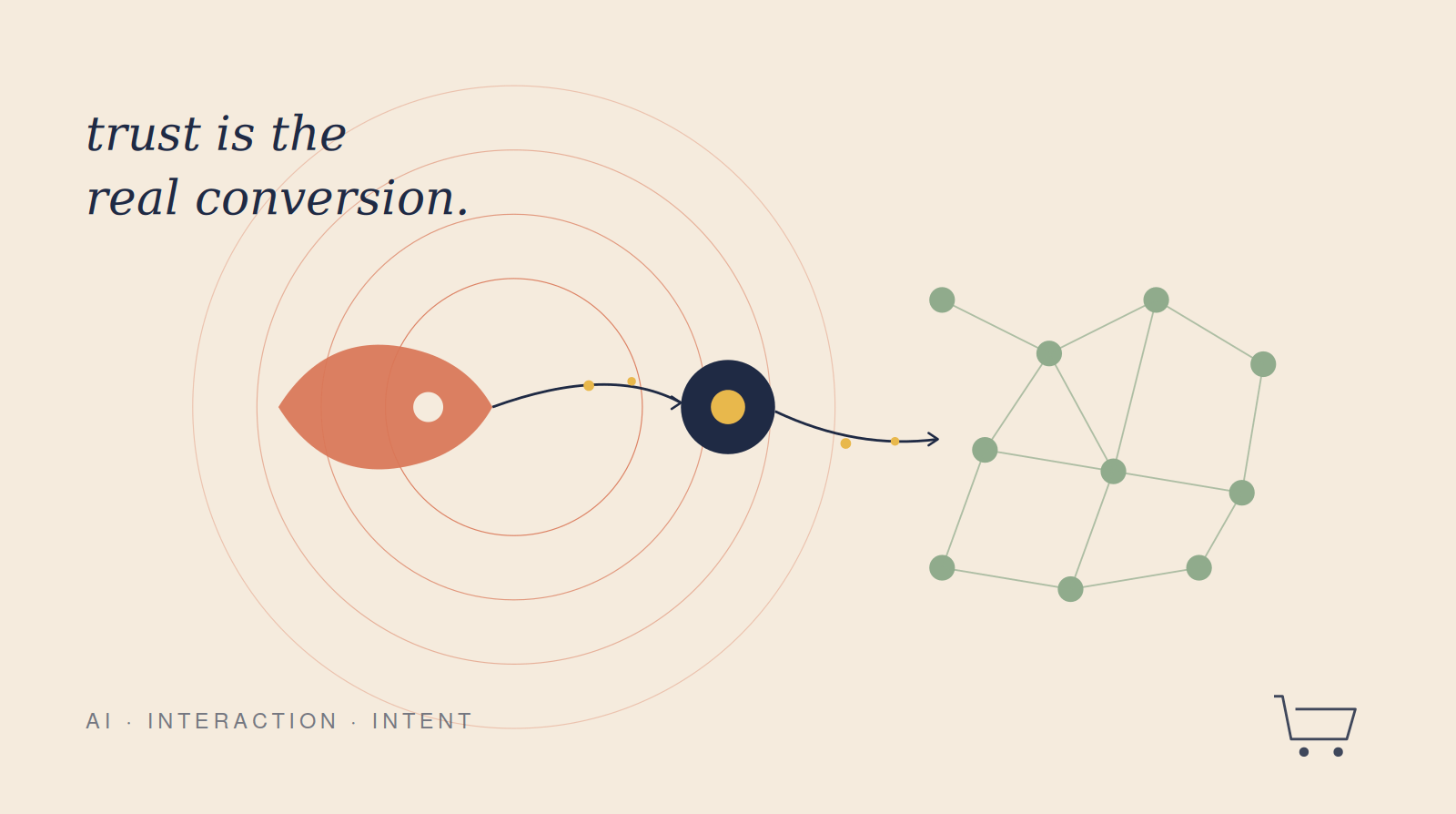
Here's what the research is quietly telling us: AI doesn't move buying decisions directly. It moves trust. Trust moves buying decisions. If you optimise for the first without understanding the second, you end up with a system that's technically impressive and commercially underwhelming.
The pathway that actually matters
A 2025 study using structural equation modelling on 600 online shoppers mapped the chain clearly: AI-based personalisation enhances perceived convenience and trust, which in turn lifts engagement and conversion likelihood by 42%. The direction matters. Personalisation doesn't sell, it builds the conditions under which people feel safe enough to buy.
A separate study on AI-powered advertising found the same structure: relevance and usefulness feed trust, and trust is what converts cognitive evaluation into actual purchase intent. Researchers have started calling this "algorithmic trust formation", users attributing human-like credibility to digital agents based on their perceived intelligence, empathy, and reliability.
So when your recommendation engine nails a suggestion, the customer isn't just thinking "good product." They're thinking "this system understands me," and that inference is what gets transferred onto the brand.
Four levers worth pulling
1. Accuracy beats sophistication
Consumers trust AI when they perceive it as reliable, full stop. A flashy interface with a recommendation that misses the mark damages trust faster than a plain interface with a recommendation that lands. This is especially true for Gen Z, who engage critically with technology and notice when an AI is performing intelligence rather than demonstrating it.
Practical implication: spend more on the quality of your underlying model and data than on the theatrics of the interaction.
2. Transparency is an indirect lever
Here's a counterintuitive finding from recent research on AI recommendations in the functional food space: personalisation directly drives purchase intention, but transparency does not. Transparency works by building trust, which enhances perceived value, which then drives purchase.
This means "explainable AI" isn't a sales pitch on its own. It's infrastructure. It removes the friction that would otherwise stall a sale, but you don't get credit for it the way you do for a great recommendation.
3. Humanisation has a ceiling
Making AI feel warmer, more conversational, more human-like increases trust, until it doesn't. The research confirms the uncanny valley effect in commerce: excessive anthropomorphism creates unease, and unease is the opposite of trust.
The practical guidance: aim for competent and considerate, not indistinguishable from a person. Customers want an assistant, not an impersonator.
4. Privacy is the hidden ceiling on everything
The same behaviour that builds trust, knowing the customer well enough to personalise, breaks trust the moment it feels like surveillance. Researchers describe this as a "privacy calculus": consumers run an implicit cost-benefit analysis every time they interact with a personalised experience. Over-automation and unclear data practices collapse the benefit side of that equation.
If your personalisation makes someone feel seen, you win. If it makes them feel watched, you lose.
What this changes about strategy
Most AI roadmaps in retail are organised around capabilities: "add a chatbot," "deploy a recommender," "test generative product descriptions." That's a features list, not a strategy.
A trust-first roadmap looks different. It asks:
- Where in the journey does the customer's trust get built, and where does it get depleted?
- Which AI touch-points are increasing perceived accuracy, and which are just increasing surface area?
- Are we explaining ourselves enough that customers understand why they're seeing what they're seeing?
- Have we crossed the line from helpful to intrusive anywhere?
The brands that win the next decade of digital commerce won't be the ones with the most AI. They'll be the ones whose AI earned the right to recommend anything at all.
The one-line version
AI shapes buying decisions by shaping trust. Treat trust as the outcome, and conversion follows. Treat conversion as the outcome, and trust, along with conversion, quietly erodes.
Further reading: studies referenced here include recent work in Advances in Consumer Research, Electronic Commerce Research (Springer), Frontiers in Artificial Intelligence, and ScienceDirect's 2025 research on AI-powered personalised advertising.