Every brand today is racing to bolt AI onto its customer experience. Personalised recommendations, conversational agents, predictive service, dynamic pricing, generative content. The pitch is seductive: smarter experiences drive engagement, engagement drives loyalty, loyalty drives lifetime value.
But the straight line from "AI experience" to "loyal customer" is a myth. There's a hidden link in the middle that most brands underinvest in, and it determines whether all that AI spending actually compounds into lasting customer relationships.
That link is trust.
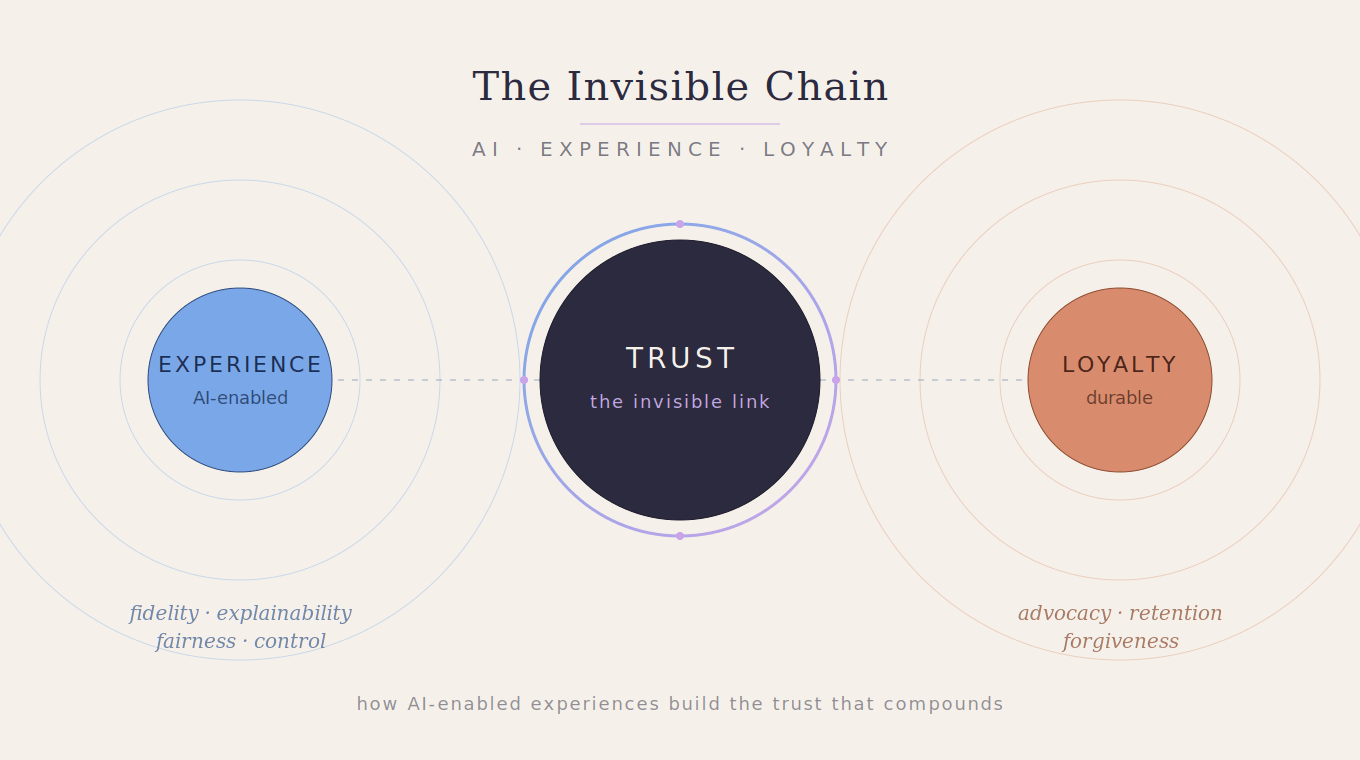
The Real Chain: Experience → Trust → Loyalty
When a customer interacts with an AI-mediated brand experience, a recommendation, a chatbot, a personalised email, an algorithmic credit decision, they are not just evaluating the output. They are forming inferences about the brand itself. Is this company competent? Does it have my interests at heart? Can I predict how it will behave next time?
Those inferences are trust. And trust is what converts a good experience into a loyal customer, rather than just a satisfied one. Without trust, great experiences produce transactional customers who leave the moment a competitor offers something marginally better. With trust, customers tolerate mistakes, forgive friction, advocate to others, and stay.
So the question becomes: which dimensions of an AI-enabled experience actually build that trust? And how do they differ in what kind of loyalty they produce?
Personalisation Fidelity: Competence You Can Feel
Personalisation fidelity is how accurately the AI matches a user's genuine preferences, context, and intent. High fidelity is Spotify surfacing a track you didn't know you needed. Low fidelity is being retargeted with baby products for six months after buying a single shower gift.
Fidelity is the workhorse of cognitive trust, the trust built on competence and reliability. Each accurate interaction is a small deposit: "this brand gets me." Over time, these deposits produce behavioural loyalty: repeat visits, repeat purchases, default-channel behaviour.
But fidelity has a sharp edge. Push it too far without transparency and it tips into the creepiness zone, the moment a user realises the system knows something it shouldn't obviously know. This is where competence-based trust collides with integrity-based trust, and the latter loses. Brands that optimise purely for personalisation accuracy, without matching investment in the other dimensions below, reliably hit this wall.
Explainability: The Trust Safety Net
Explainability is the degree to which a brand makes AI decisions legible. "Recommended because you watched X." "Your score reflects these three factors." "We suggested this route because traffic on your usual one increased."
Explainability does two things that fidelity alone cannot. First, it builds affective trust, the feeling that the brand isn't hiding something. Second, and more importantly, it serves as a trust repair mechanism when the AI inevitably makes a mistake. A wrong recommendation with no explanation feels like the brand doesn't understand you. The same wrong recommendation with a clear explanation ("we suggested this because of your recent purchase") lets the user attribute the error to a specific, fixable cause rather than to brand incompetence.
This is why explainability punches above its weight. It doesn't have to be perfect. It just has to be present.
The Supporting Cast
Beyond these two headline dimensions, several others shape trust in distinct ways:
Procedural transparency — disclosing that AI is being used at all, operates as a hygiene factor. Its absence destroys trust quickly; its presence produces diminishing returns once a baseline is met.
Perceived fairness — the sense that outcomes are unbiased across users, builds integrity-based trust. This matters most in high-stakes decisions (lending, insurance, hiring) but increasingly shapes everyday commerce too.
Data control and agency — the ability to correct, tune, or opt out, appears disproportionately powerful for trust. Research consistently shows that offering users control matters more than whether they actually use it. The option is the trust signal.
Human fallback — the ability to escalate to a real person, may be the single strongest predictor of trust in high-stakes AI interactions. Its absence signals that the brand is hiding behind its algorithms.
Why Trust Produces Different Kinds of Loyalty
Here is the part most brand strategies miss. Trust is not monolithic, and neither is loyalty.
Cognitive trust — built by fidelity, reliability, and consistency, produces behavioural loyalty. Customers keep coming back because the system works. This is valuable but fragile: it erodes the moment a competitor's system works better.
Affective trust — built by explainability, fairness, control, and warmth, produces attitudinal loyalty. Customers advocate, forgive mistakes, and stay even when a competitor offers a marginally better deal. This is the loyalty that compounds.
The highest-value outcome — the willingness to give a brand the benefit of the doubt when its AI slips up, is produced almost entirely by affective trust. And affective trust is produced almost entirely by the dimensions brands tend to underinvest in.
What This Means in Practice
A few patterns are worth internalising if you're building AI-enabled experiences:
Fidelity without explainability produces short-term engagement but fragile loyalty. Users feel surveilled rather than served. Explainability without fidelity feels like an alibi, the brand is transparent about mediocre recommendations. You need both, and they reinforce each other.
Invest in control mechanisms even if usage is low. A visible "tune your recommendations" option does trust work whether or not users click it. It is a signal, not just a feature.
Treat human fallback as a trust investment, not a cost centre. The moment a user hits a wall with your AI and cannot escape it, you are burning down trust that took months to build.
Plan for AI failure. Every AI system makes mistakes. The dimensions that matter most are not the ones that prevent mistakes, they are the ones that determine whether users forgive them.
The Quiet Competitive Advantage
Most brands will keep chasing personalisation accuracy as if it were the whole game. A smaller number will recognise that the experience → trust → loyalty chain is the real system, and that trust is built by a portfolio of dimensions working together — not by any single technical capability.
Those brands will end up with something more durable than engagement metrics. They will end up with customers who stay when things go wrong, advocate when asked, and give the brand room to keep evolving. In an environment where every competitor has access to the same AI, that is the only moat left worth building.