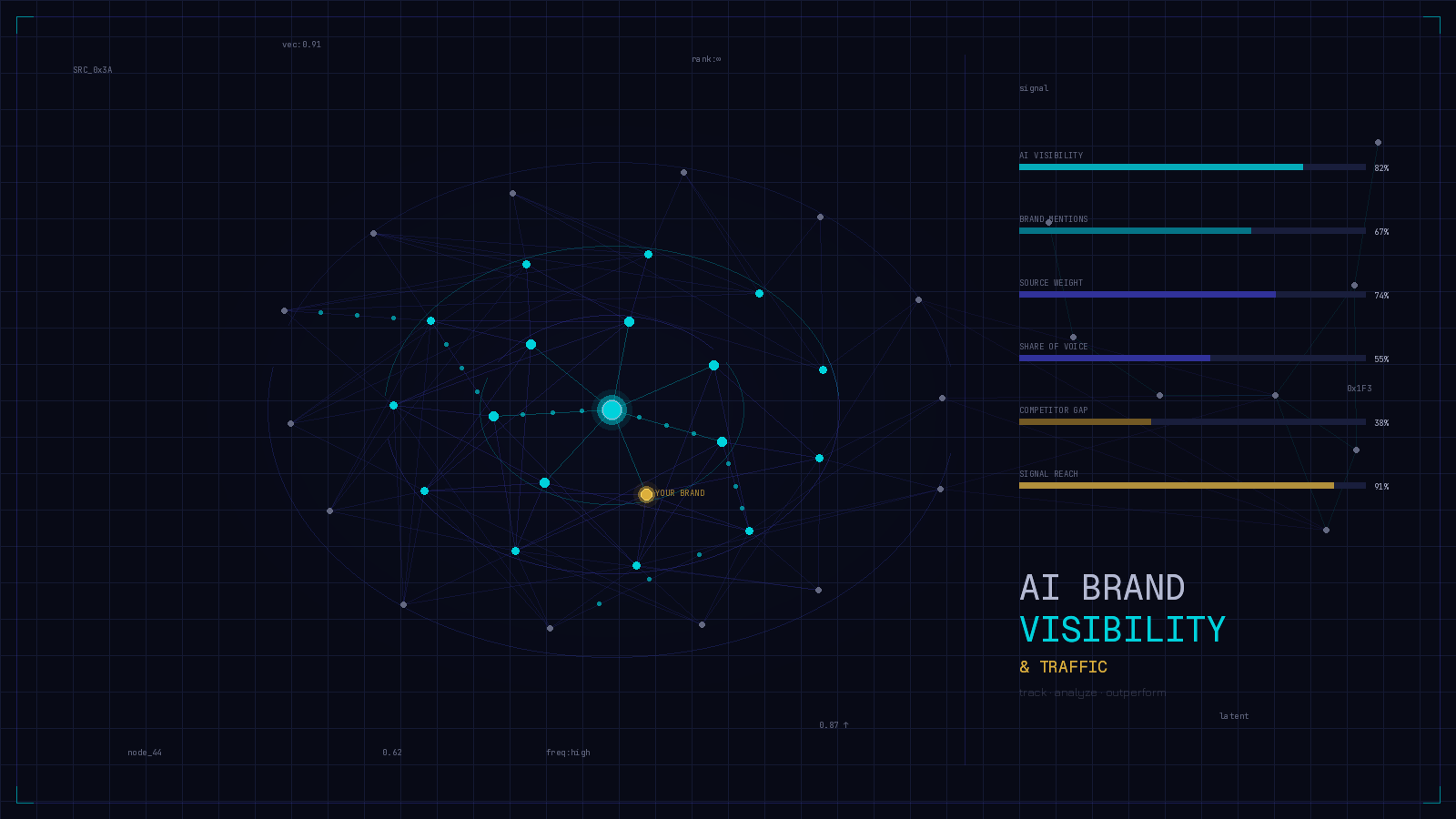
The rules of digital visibility are being rewritten. For the better part of two decades, brands competed for the top spots on a search engine results page, ten blue links, a few ads, and a featured snippet if you were lucky. But the emergence of AI-powered assistants and generative search engines has fundamentally changed the game. Today, when a potential customer asks an AI chatbot which software to use, which brand to trust, or which product best fits their needs, the answer they receive doesn't come with a list of links to explore. It comes as a confident, curated response, and your brand is either in it or it isn't.
This is the new battleground of brand visibility, and most companies are only just beginning to understand what it means for their traffic, authority, and growth.
What Is AI Brand Visibility?
AI brand visibility refers to how prominently and accurately your brand appears within responses generated by large language models (LLMs) and AI-powered search tools, platforms like ChatGPT, Google's AI Overviews, Perplexity, Microsoft Copilot, and others. Unlike traditional SEO, where visibility is measured in rankings and impressions, AI visibility is about whether your brand is mentioned, how it is characterised, and whether it is positioned as a credible, authoritative source within AI-generated answers.
The distinction matters enormously. A brand that ranks third on Google still gets seen. A brand that is absent from an AI-generated answer is effectively invisible to a growing segment of users who never scroll past the AI response at all. Research suggests that AI-generated answers are already intercepting a significant portion of queries that would previously have driven organic traffic, and that share is growing rapidly.
Why Traditional Analytics Are No Longer Enough
Most marketing teams are still measuring success with tools built for a different era. Organic traffic dashboards, keyword rank trackers, and backlink monitors are valuable, but they were designed to measure performance on search engines that return lists. They don't tell you whether your brand appears when someone asks ChatGPT for a recommendation in your category. They don't reveal how AI systems describe your products, your values, or your competitive positioning. And they certainly don't show you which of your competitors are being named in AI answers while your brand goes unmentioned.
This creates a dangerous blind spot. A company could maintain strong traditional SEO metrics while simultaneously losing mindshare in AI-generated conversations, the very conversations that are increasingly driving purchase intent and brand discovery among younger, AI-native audiences.
Tracking Your AI Visibility: What to Measure
Understanding your brand's presence in AI-generated answers requires a new set of metrics and a new monitoring mindset. The core areas to track include the following.
Mention frequency is the most fundamental signal, how often does your brand appear in AI-generated responses across relevant query categories? This should be measured across multiple platforms and query types, from product comparisons and category questions to problem-solution searches and brand-adjacent topics.
Sentiment and framing matters just as much as frequency. An AI that mentions your brand but characterises it as expensive, difficult to use, or best suited for a niche audience may actually be doing your positioning more harm than good. Tracking how AI describes your brand, the language used, the attributes emphasised, the comparisons drawn, reveals the narrative being built around you in the minds of AI systems.
Competitive share of voice in AI answers is perhaps the most strategically important metric. When a user asks "what's the best CRM for a mid-sized business" or "which accounting software is easiest to use," which brands are consistently named? Understanding where you stand relative to competitors within AI responses gives you a clear picture of the battle for mindshare you may not have realised was already underway.
Source attribution is the layer beneath all of this. AI systems don't generate answers from thin air, they draw on training data, web content, reviews, publications, and authoritative sources. Uncovering which sources AI relies on to form its understanding of your brand, your category, and your competitors is critical intelligence. It tells you where to invest, which publications to earn coverage in, and which content assets are actively shaping AI perception of your industry.
How AI Decides What to Say About Your Brand
To improve your AI visibility, it helps to understand how these systems form their answers in the first place. LLMs are trained on vast corpora of text from across the internet, news articles, review sites, forums, industry publications, product documentation, social media, and more. When a user asks a question, the model synthesises patterns from this training data to construct a response. Real-time retrieval-augmented generation (RAG) systems layer on top of this by pulling in live web content to supplement or ground those responses.
What this means practically is that your AI visibility is a function of your content footprint across trusted sources. Brands that are frequently written about in authoritative publications, that have strong review profiles on trusted platforms, that maintain well-structured and regularly updated owned content, and that have a consistent, clear value proposition across the web tend to enjoy stronger AI visibility. The AI is, in a sense, reflecting the weight of evidence it finds about you, and that evidence is something you can actively shape.
Strategic Insights to Boost Your AI Presence
Improving AI brand visibility is not a single tactic but a strategic discipline that spans content, PR, technical SEO, and brand communications. The following approaches are proving most effective.
Build topical authority through comprehensive owned content. AI systems reward depth and breadth of expertise. Brands that publish consistently on the topics central to their category, not just their products, are more likely to be recognised as authoritative sources. Think of this as the AI equivalent of domain authority: the more you are associated with a topic across multiple credible sources, the more likely AI is to reference you when that topic comes up.
Earn coverage in the sources AI trusts. Not all content carries equal weight in shaping AI responses. High-authority publications, industry-specific media, Wikipedia mentions, and structured data from credible directories tend to have an outsized influence on how LLMs perceive and describe brands. A strategic PR effort focused on landing coverage in these outlets is one of the highest-leverage investments a brand can make in its AI visibility.
Optimise your brand's factual accuracy across the web. AI hallucinations often stem from conflicting or incomplete information about a brand. Ensure that your founding story, product descriptions, leadership team, key differentiators, and company facts are consistent and accurate across all major platforms, your website, press releases, review sites, and industry directories. Consistency signals reliability to AI systems.
Leverage structured data and clear schema markup. Technical signals still matter. Properly implemented schema markup helps AI systems parse your content accurately and increases the likelihood that your information is pulled into AI-generated responses. This includes product schema, FAQ schema, organisation markup, and review aggregation data.
Monitor and respond to review ecosystems. AI systems frequently synthesise user reviews when forming opinions about brands. Platforms like G2, Trustpilot, Capterra, and Google Reviews feed directly into how AI characterises brand reputation. Actively managing your review presence, encouraging satisfied customers to share their experiences and responding constructively to criticism, has a direct impact on your AI brand perception.
Outperforming Competitors in AI-Generated Answers
The competitive dimension of AI visibility is where strategic thinking becomes most valuable. Because AI answers are often framed as comparisons, "Brand A is best for X, while Brand B is better suited for Y", the way your brand is positioned relative to competitors in AI responses can directly influence buyer decisions, often before a prospect has even visited your website.
Competitive AI visibility analysis means regularly auditing which brands are mentioned alongside yours, how the comparison is framed, and what attributes AI associates with each player. If a competitor is consistently described as the "market leader" or "most trusted" option in your category, that framing will influence real purchasing decisions. Understanding this dynamic is the first step to countering it.
The brands that will win the AI visibility race are those that take a proactive approach, building the content, relationships, and digital footprint that give AI systems compelling reasons to mention them first, describe them positively, and recommend them confidently.
The Bottom Line
AI brand visibility is not a future concern, it is a present-day competitive reality. The shift toward AI-mediated search and discovery is already redirecting traffic, shaping brand perception, and influencing purchase decisions at scale. Companies that treat AI visibility as a core part of their digital marketing strategy today will build a compounding advantage that becomes increasingly difficult for competitors to overcome.
The brands that understand where and how they are being mentioned in AI-generated answers, uncover the sources driving those answers, and invest strategically in improving their AI presence will not just survive the transition to AI-first discovery, they will lead it.
In an era where the first answer a customer receives may come from an AI rather than a search engine, visibility isn't just about being found. It's about being chosen, before the conversation with your brand has even begun.





