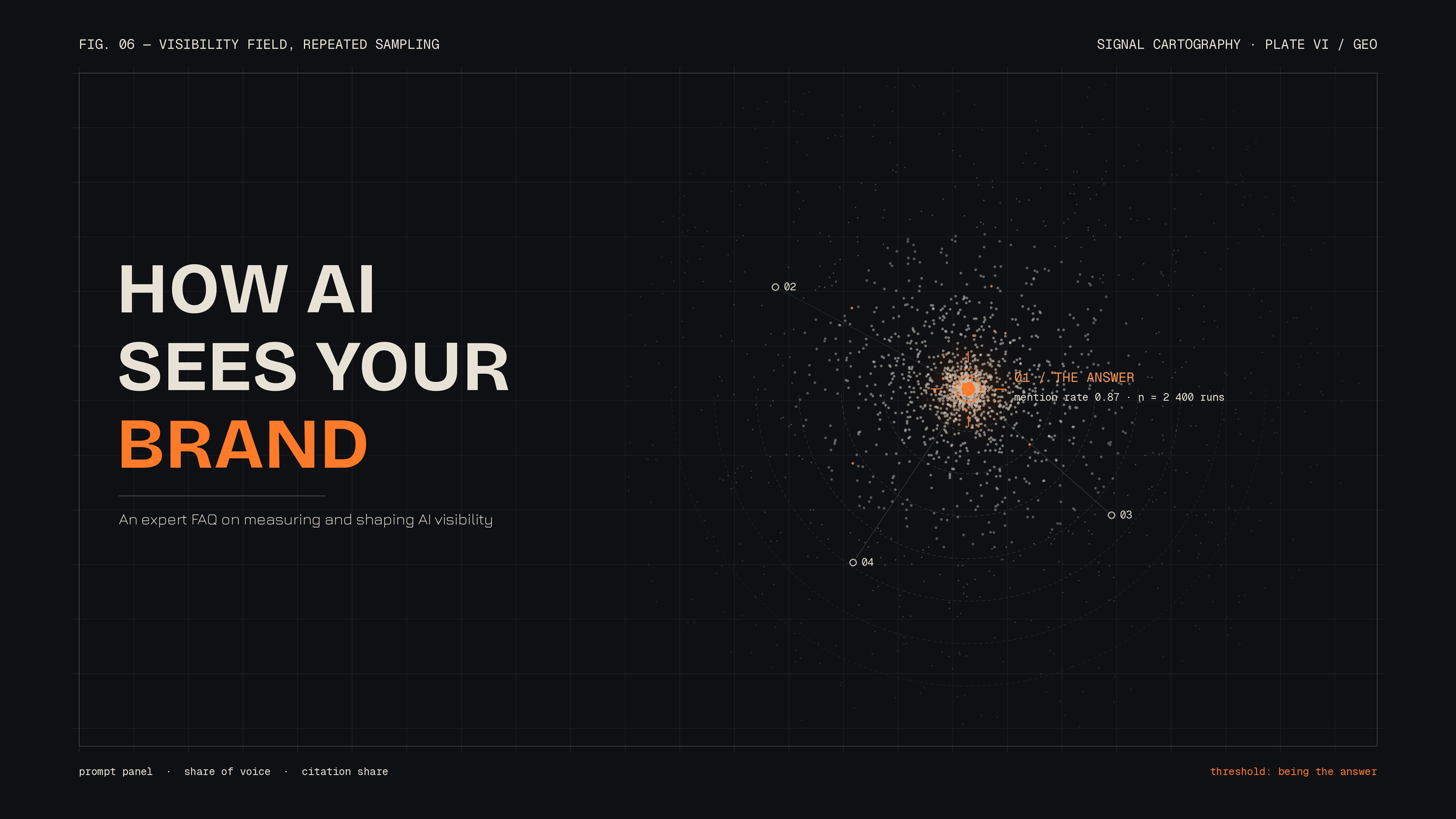
Generative AI has quietly become a new front door to your brand. When potential customers ask ChatGPT, Claude, Gemini or Perplexity for recommendations, comparisons or explanations, the answer they get is effectively a referral, or a dismissal. Generative Engine Optimisation (GEO) is the emerging discipline of understanding and influencing that answer. Below, we tackle the six questions that brand, SEO and comms leaders ask most often.
1. How visible is your brand in AI, and how do you measure it at scale?
Most brands have no idea how visible they are in AI answers, because AI visibility doesn't show up in any dashboard you already own. There is no "AI Search Console". Assistants don't send referrer data the way search engines do, and a user who acts on an AI recommendation often arrives at your site as direct traffic, or never arrives at all because the answer was enough on its own.
Measuring visibility at scale therefore requires a prompt-sampling approach. In practice, that means building a structured panel of the questions your buyers actually ask. These include category queries ("best project management tools for agencies"), comparison queries ("X vs Y"), problem queries ("how do I reduce churn in a subscription business") and brand queries ("is X trustworthy?"). You then run these repeatedly across the major models and modes, with and without web browsing switched on, and across the regions and languages where you operate.
From those runs, you track a handful of core metrics. Mention rate tells you how often your brand appears at all for a given prompt set. Share of voice tells you how often you appear relative to named competitors. Position and framing tell you whether you are the lead recommendation, one option among five, or a caveat. Sentiment and accuracy tell you whether what the model says about you is positive, correct and current. Citation share, for browsing-enabled answers, tells you how often your own content is the cited source rather than third-party coverage.
Two words of caution on method. First, AI outputs are probabilistic. The same prompt gives different answers on different runs, so single-shot testing is meaningless. You need repeated sampling and trend lines, not screenshots. Second, models update on their own release cycles, so your visibility can shift overnight without you doing anything. Treat AI visibility as a continuously monitored metric, like brand tracking, not a once-off audit.
2. Is AI helping or hurting your brand's reputation, and how do you know?
You know by auditing, not by assuming. AI systems can damage a brand in ways that are structurally different from bad press or bad reviews, because the harm is invisible to you by default. A journalist's negative article is public and findable. A model quietly telling thousands of users that your product "has known reliability issues", or that you discontinued a service you still offer, happens in private one-on-one conversations you can't see.
The main failure modes to audit for are these. Factual errors and staleness: old pricing, discontinued products presented as current, or the wrong leadership names. Conflation: being mixed up with a similarly named company, which is a common problem for brands with generic names. Inherited negativity: the model over-indexing on one bad news cycle or a hostile Reddit thread that featured heavily in its training data. And omission, which is the quietest form of harm. You're simply never mentioned when your category comes up, and a competitor absorbs the recommendation.
On the flip side, AI can help a brand disproportionately. Models tend to compress a category into a shortlist of two to four names. If you're on that shortlist, you capture consideration that in classic search would have been spread across ten blue links. Brands with strong, consistent, widely corroborated coverage often find that AI answers describe them more favourably and more coherently than their own homepage does.
The diagnostic is the same as in question one, a recurring prompt audit, but scored for reputation rather than presence. Flag hallucinations, outdated claims, negative framings and misattributions, and track them the way you would track media sentiment. A number of brands now include an "AI answer audit" in their quarterly reputation review alongside media monitoring and review-site tracking. That's the right mental model. AI is now a media channel about you, and it deserves the same monitoring rigour.
3. Should GEO live inside SEO, or is it a separate discipline?
The honest answer is that it overlaps heavily with SEO but isn't contained by it, and organisations that treat it as a pure SEO subtask tend to under-resource the parts that SEO teams don't own.
The case for housing GEO in SEO is strong on tactics. The inputs overlap substantially: crawlable, well-structured content, clear entity signals, schema markup, authoritative third-party coverage and digital PR. Retrieval-based AI answers (Perplexity, AI Overviews, browsing-enabled ChatGPT) draw heavily from pages that already rank, so classic search performance remains a leading indicator of AI citation. SEO teams also already have the auditing mindset. Rank tracking translates naturally into prompt tracking.
But GEO diverges from SEO in three important ways. First, the surface of influence is wider. A model's opinion of your brand is shaped by its training corpus, meaning Wikipedia, news archives, forums, review sites, and academic and industry publications, not just your rankable pages. Influencing that corpus is a PR and communications job as much as a technical one. Second, the success metric is different. SEO optimises for clicks, while GEO often optimises for being the answer in a zero-click environment, which changes how you write and structure content. Third, failure modes like hallucination and brand conflation are reputation problems that legal and comms teams care about, not ranking problems.
The organisational pattern that seems to work best is GEO as a cross-functional capability with SEO as its operational home. SEO owns the technical and content execution. Comms and PR own corpus-level reputation and third-party coverage. Product marketing owns the accuracy of claims. And someone, often a growth or digital lead, owns the measurement framework. What fails is either extreme: bolting "and AI" onto an SEO analyst's job description with no new mandate, or spinning up an isolated "AI visibility team" that duplicates SEO work and lacks its infrastructure.
4. Does your data structure determine your AI visibility?
It doesn't fully determine it, but it heavily conditions it, and it's the lever most completely within your control.
AI systems favour content they can parse, chunk and attribute cleanly. That has concrete implications. Semantic structure matters: clear heading hierarchies, question-shaped headings with direct answers in the first sentence or two beneath them, and self-contained sections that make sense when lifted out in isolation. Retrieval systems pull passages, not pages. A passage that answers a question completely, without depending on the surrounding context, is far more quotable than a beautiful narrative that only makes sense when read from start to finish.
Structured data and entity clarity matter too. Schema markup (Organisation, Product, FAQPage, HowTo), consistent naming of your company, products and people across your site, a well-maintained Wikipedia and Wikidata presence, and consistent facts across your site, LinkedIn, Crunchbase and review platforms all help models work out who you are and what's true about you. Inconsistent or conflicting facts across sources is one of the most common causes of hallucinated or muddled AI answers about a brand. Technical accessibility is the baseline underneath all of this. If AI crawlers (GPTBot, ClaudeBot, PerplexityBot, Google-Extended) are blocked, or your content is rendered in ways crawlers can't read, you've opted out of the channel. Some brands blocked these crawlers reflexively in 2023 and 2024 and are now discovering the visibility cost. That's a strategic decision worth revisiting deliberately rather than leaving on default.
The important caveat: structure is necessary but not sufficient. A perfectly structured site with weak authority signals will still lose to a messier brand that's cited everywhere. Think of data structure as removing friction. It makes sure that when models look at you, they understand you correctly, while authority and corroboration determine whether they look at you at all.
5. Can you actively shape how AI talks about you, and what's the evidence?
Yes, within limits, and the evidence base is growing although it's still young.
The foundational academic evidence is the 2023 GEO paper by Aggarwal and colleagues (Princeton, Georgia Tech and IIT Delhi), which coined the term and showed experimentally that specific content changes, such as adding citations, quotations and statistics to source pages, measurably increased how often those sources were surfaced in generative answers, with visibility gains in the region of 30 to 40 percent on their benchmark. That established the core premise: generative answers can be influenced through content, and are not fixed properties of the model.
Practitioner evidence has built up since then. Documented patterns include brands appearing in AI shortlists after earning coverage on the third-party sites models draw from (comparison articles, review platforms like G2, and community discussions on Reddit, which has become disproportionately influential since its data licensing deals with AI companies). They also include corrections to Wikipedia and structured data filtering through into model answers after later model or index updates, and FAQ-formatted content that answers questions directly earning citations in Perplexity and AI Overviews at higher rates than equivalent narrative content. Case studies from SEO and GEO vendors regularly show improvements in mention rate after coordinated content-plus-PR programmes, though vendor case studies deserve the usual scepticism about cherry-picking.
The limits matter as much as the possibilities. You can't dictate what a model says. You can only shift the probability of what it says. Changes to beliefs baked in during training are slow. They only land when models retrain, on timelines you don't control, while changes to retrieval-based answers can land in days or weeks. That's why most practical GEO effort concentrates on the retrieval layer. Influence also has to be earned in public. The mechanisms that work boil down to making true, consistent, well-evidenced information about your brand abundant and machine-readable. Attempts to game the system with fabricated signals carry real risk, both of platform countermeasures and of reputational blowback. The early history of SEO is the cautionary tale here.
A fair evidence-based summary: shaping AI answers is real and demonstrated, and it's mostly achieved through the unglamorous combination of accurate structured content, third-party corroboration and persistence, not through some secret prompt-whispering trick.
6. How do you actually measure the ROI of GEO, and what are you even measuring?
Start with the second half of the question, because the biggest ROI mistake in GEO is measuring the wrong thing. GEO produces value at three layers, and each layer can be measured to a different degree.
The first layer is visibility outcomes: mention rate, share of voice, sentiment, citation share and answer accuracy across your prompt panel. These are the metrics that GEO activity moves most directly, and they're best treated the way brand marketers treat awareness and consideration metrics. They are leading indicators with an established, if imperfect, link to revenue. They are not revenue itself.
The second layer is attributable traffic and conversion. This is partly measurable. Referral traffic from perplexity.ai, chatgpt.com, gemini.google.com and similar domains can be segmented in your analytics, and several published analyses have found that this traffic, while small in volume, converts at significantly higher rates than average. That makes sense, since a user arriving from an AI recommendation is already qualified and already persuaded. Track it, but understand that it's the visible tip. Much of AI's influence resolves as branded search, direct traffic or offline conversation.
The third layer is influence you can only measure by asking. Add "an AI assistant recommended you" to your how-did-you-hear-about-us field and to discovery questions on sales calls. Self-reported attribution is noisy, but its trend line is one of the few windows into zero-click influence, and B2B companies that have added it consistently report the number growing quarter on quarter.
On the cost side, GEO ROI calculations should be honest about marginal cost. Much GEO work, such as structured content, schema, digital PR and accurate third-party listings, is work you'd credibly be doing for SEO and brand anyway. The genuinely incremental costs are usually monitoring tools (prompt-tracking platforms), audit labour, and any content produced solely to be answerable by AI. Comparing that modest incremental cost against high-converting (if small) attributable traffic, plus movement in your visibility metrics, is how most teams currently justify the investment.
The pragmatic ROI framework then looks like this. One, define your prompt panel and baseline your visibility metrics. Two, instrument AI referral traffic and self-reported attribution now, so that you have a time series later. Three, run GEO initiatives as measurable interventions: change something, then watch the prompt panel and citation share respond over four to twelve weeks. Four, report GEO the way you report brand and PR, as a portfolio of leading indicators plus a growing sliver of hard attribution, rather than pretending to a last-click precision the channel simply can't provide. Teams that promise last-click ROI from GEO end up either disappointed or dishonest. Teams that frame it as reputation infrastructure for the next search paradigm tend to secure durable budgets.
The takeaway
AI assistants are already answering questions about your category and your brand, whether or not you're watching. The brands winning this channel share a pattern. They measure continuously rather than auditing once. They treat AI answers as a reputation surface owned jointly by SEO and comms. They make their facts abundant, consistent and machine-readable. And they report the results with the honesty of brand metrics rather than the false precision of performance marketing. The channel is young and the evidence is early, but the direction is unambiguous, and the cost of being invisible compounds with every model update.





