Why global brands and capital allocators mis-allocate billions in African consumer markets and what a Bloomberg-grade terminal for Africa actually looks like
In one sentence. Bloomberg sells decision-latency reduction to traders who already trust their data; AFRIQ Terminal sells decision-confidence elevation in the 54 African consumer markets where the absence of trustworthy information is currently costing global brands and capital allocators billions in mis-allocated capital every year.
AFRIQ Terminal is the African market-intelligence product built by Acalytica. This piece is for the people whose decisions cost something when they are wrong: Development Finance Institutions, Africa-focused private equity, global CPG strategy teams, QSR and retail expansion leads, and African telcos and fintechs going cross-border. Nine minutes.
Quick answers
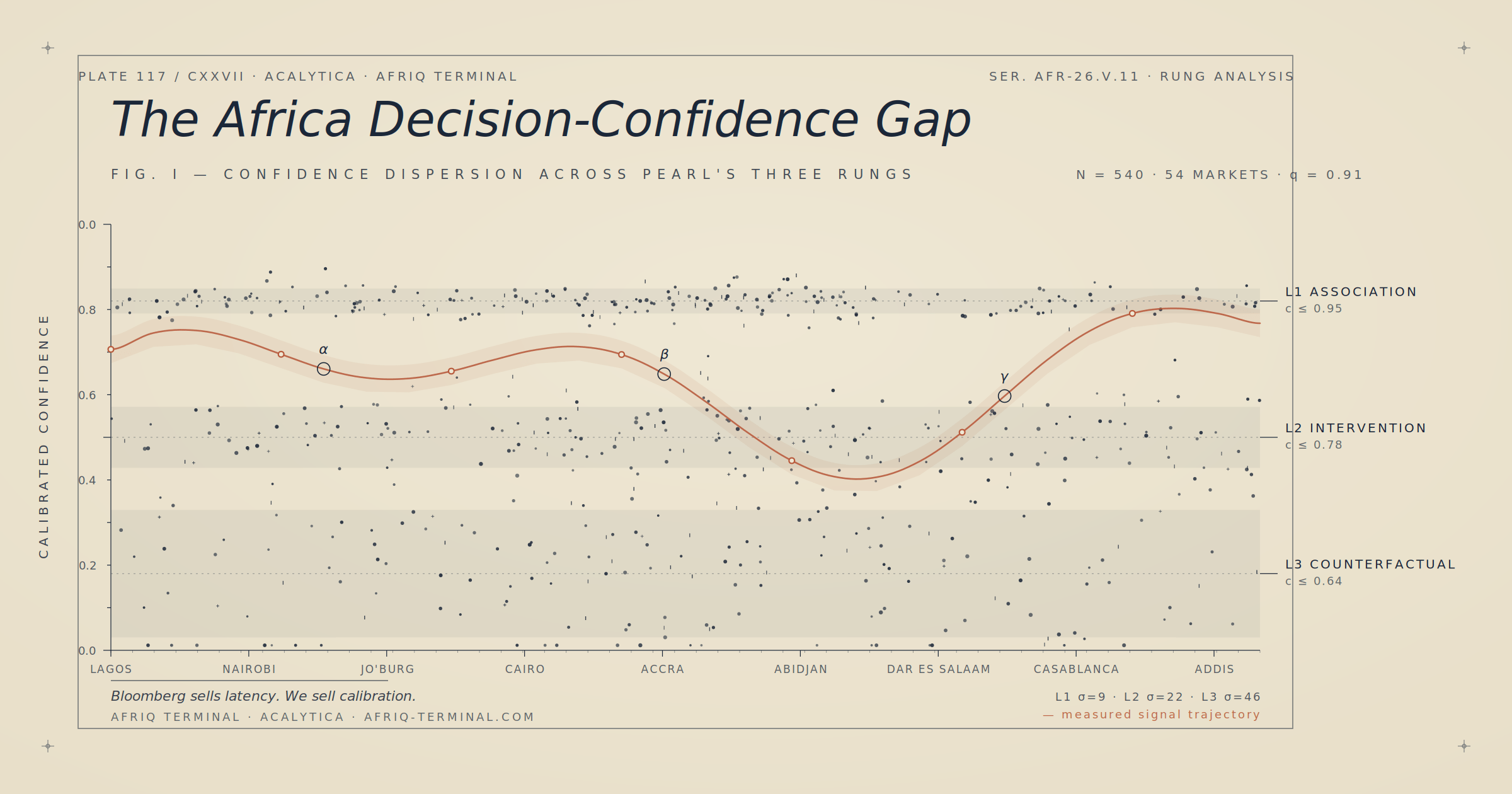
What is AFRIQ Terminal? A market-intelligence platform covering all 54 African consumer markets. Every brief generated carries claim-level confidence scoring, every claim is tagged on Pearl's ladder of causation (association, intervention, counterfactual), and every confidence score is calibrated against subsequent ground truth rather than self-reported by the model.
Who is it for? Five buyer cohorts: capital allocators (DFIs, Africa-focused PE and growth equity) and operating teams (global CPG, QSR/retail expansion, African telcos and fintechs going cross-border).
How is it different from Nielsen, Euromonitor, McKinsey scoping studies, or asking ChatGPT? Four differences, in increasing order of importance: city-and-category resolution rather than country aggregates; calibrated confidence anchored to subsequent ground truth rather than analyst self-report; per-claim Pearl-ladder tagging that distinguishes correlation from causation from counterfactual; and a learning loop where every query and claim resolution feeds the priors calibrating the next brief.
Where can I see the methodology? The methodology page at afriq-terminal.com/methodology documents the scoring framework, the cohort accuracy reporting cadence, and the ladder-confidence ceilings.
The problem nobody on a global insights desk wants to write down
Every Africa-facing investment-committee memo, market-entry deck and site-selection model carries the same unspoken footnote:
Confidence in inputs: medium-low. Source: management interviews, Euromonitor 2022, and a former colleague who used to live in Lagos.
That footnote is expensive. It compounds across the cohorts who actually have to act on it.
A Development Finance Institution commits an eight-figure cheque to a Nairobi consumer platform on the back of a $180,000 consultant scoping study whose primary-research sample is twenty-two interviews. A global CPG's Africa-strategy pod in Amsterdam cannot get below country-level resolution from its global Nielsen subscription, yet must defend a Lagos-versus-Accra prioritisation to the global CMO with budget on the line. A QSR expansion team underwrites a twenty-store Kenya rollout on a catchment model where the venue-density inputs are eight months stale and the purchasing-power proxy is national GDP per capita. A pan-African telco evaluates a cross-border corridor and learns, post-launch, that a regulatory gazette published three weeks before signing changed the unit economics, the kind of thing that happened to operators across West Africa during the Nigerian USSD fee fight of 2023.
None of these teams are bad at their jobs. They are operating without the equivalent of a Bloomberg terminal for the markets they are paid to underwrite. The cost of that absence does not show up as a single line item on anybody's P&L, which is precisely why it persists.
Decision-latency versus decision-confidence
Bloomberg's wedge is well understood. In mature financial markets, the data is broadly trustworthy and broadly available; the wedge is speed. A Bloomberg terminal does not make a trader smarter, it compresses the gap between what is knowable right now and what the trader knows right now to milliseconds. The economic value is the compression.
African consumer markets have a different physics. The data is not slow; it is structurally unreliable. Country-level Euromonitor numbers disagree with country-level Nielsen numbers; both disagree with what a stringer on Sandy Beach Road in Lagos actually saw last week; informal-trade volumes, which represent the majority of FMCG flow in most African markets, are systematically missed by formal retail audit; regulatory gazettes published in PDF form on national government websites move category economics overnight and never make it into a global subscription dataset.
The wedge here is not speed. It is confidence. Closing the gap between what is knowable and what is trusted requires a different design from the one Bloomberg got famous for.
Why this is not "just ask an LLM"
A reasonable buyer in 2026 might ask: if I want a market brief on Abidjan or Lusaka, why don't I just ask Claude or ChatGPT with web search enabled?
Fair question. Generic AI assistants with web search will produce a confident-sounding African market brief in thirty seconds. The output will read well, cite reasonable-sounding sources, and feel comprehensive. It will also, in our experience, be wrong in the specific ways that matter most to a capital allocation decision, usually because the model has cheerfully averaged across sources of wildly different quality, has confused correlation with causation, and cannot tell the user which parts of its answer are confident and which are guesses.
A generic LLM cannot, by construction, do four things that an Africa-rooted intelligence layer must do:
It cannot expose its identification assumptions. When a generic model tells you "shifting media spend from OOH to TikTok will increase reach in Lagos," it cannot tell you what causal model it implicitly assumed, what confounders it ignored, or what would change the conclusion. AFRIQ briefs surface these assumptions explicitly.
It cannot tell you which claims are association versus intervention versus counterfactual. "Boomplay engagement correlates with FMCG launch success" (association), "if you launch with francophone-first creative in Abidjan, reception will improve" (intervention), and "the Ghana launch would have succeeded with different pricing" (counterfactual) are three radically different epistemic claims that need radically different evidence to support them. Generic AI flattens them into one confident voice.
It cannot show you whether its past briefs have actually been right. A confidence score that is not anchored to subsequent ground truth is decorative. Saying "I'm 84% confident" means nothing unless you have a track record of being right 84% of the time when you said 84%. Calibration of this kind requires a system that ages, re-grades, and learns from its own historical claims, which is precisely what generic AI does not do for any specific vertical.
It cannot ingest the ground-truth that formal data sources structurally miss. The informal-economy layer, the talk-radio sentiment layer, the parallel-FX layer, the stakeholder-network layer, these are not failures of search coverage that better web crawling solves. They are categories of intelligence that require human infrastructure on the ground. A generic AI tool can summarise a webpage about informal retail in Kano. It cannot tell you what a stringer in Sabon Gari market saw on Tuesday morning.
These are not arguments against using AI for African market work. AFRIQ is itself an AI-native product. They are arguments for why a vertical, calibrated, ground-truth-anchored intelligence layer beats a generic horizontal one for decisions where being wrong costs eight figures.
Four design principles
Calibrated confidence, not model self-report
Every claim in every AFRIQ brief carries a confidence score. The scores are not arbitrary and not generated by the model rating its own work. They are anchored against subsequent ground truth: as briefs age, the claims in them are re-graded against what actually happened, and the cohort accuracy is published on the methodology page on a quarterly cadence.
The honest version of this discipline is what makes it valuable. The methodology page will, over time, show that some claim categories calibrate well and some calibrate poorly, and the confidence ceilings adjust accordingly. The Verified Intelligence threshold (75+ average confidence) is positioned to mean something specific: that the cohort of claims above it has demonstrated, in retrospect, the directional accuracy the score implied. A buyer who wants to see the table can see the table.
Pearl's ladder of causation, applied per claim
Every assertion in an AFRIQ brief is tagged on the three rungs of causal reasoning:
Association (L1). "X correlates with Y." This is the descriptive layer — market sizing, share comparisons, trend identification. Confidence here depends primarily on data quality.
Intervention (L2). "If you do X, Y will change." This is the decision layer — the layer that actually helps a buyer choose between actions. Surfaced in the Intervention Panel only when the underlying causal mechanism and identified confounders are documented. Confidence ceilings on intervention claims reflect a hard truth: claiming to know what will happen if you act requires more than data, it requires a model, and most market intelligence pretends it has one when it doesn't.
Counterfactual (L3). "What would have happened if X had not occurred." This is the highest-value and most demanding rung — the rung at which post-mortem analyses, attribution claims, and "would this exit have closed at a different multiple in a different macro" reasoning lives. Gated behind a dedicated Counterfactual tool, with confidence ceilings that decline further still without proprietary signal supporting the inference.
Pretending to certainty we do not have is the original sin of this category. Per-claim ladder-tagging is how we refuse to commit it.
Disagreement is a feature, not a bug
Every sophisticated buyer has private intelligence we do not see: an internal CRM, a transactional dataset, a private survey panel, an off-the-record stringer network. The temptation in market intelligence products is to ignore that private data and hope the public-facing brief reads as the authoritative voice in the room.
AFRIQ inverts this. Upload a private panel and the system will cross-check every brief against it, surfacing disagreements with severity tags and proposed reconciliations. If your Lagos retail audit says informal-channel volume is 45% and our operator-panel coverage says 68%, the brief will flag the gap on page one, name the methodological reason for the disagreement, and propose how to reconcile.
This is the page in the brief that earns the seat. Two contradictory worldviews coexisting silently in the same investment-committee deck is how bad decisions get made. Surfacing the contradiction is what sophisticated capital actually wants.
A compounding learning loop
Every query feeds the velocity signal, what the market of sophisticated buyers is asking about, where, when. Every claim a user confirms or refutes feeds the resolutions ledger that calibrates future confidence scoring. Hot-but-thin topics, questions that are being asked frequently but where data density is low, generate dispatch tickets that re-direct ingestion priorities and stringer effort. The next brief benefits from the priors built by every brief that came before it, including the ones that were wrong.
The learning panel that ships on every brief renders this calibration visible. A static report ages from the day it is delivered. A terminal that compounds its priors gets sharper.
Who AFRIQ Terminal is built for
Capital allocators
Development Finance Institutions. Representative cohort: IFC, AfDB, BII, FMO, Proparco, DEG, Norfund, Swedfund, US DFC, Finnfund. The pain is precise: eight- and nine-figure consumer-sector commitments where being wrong is career-ending, investment committees that demand calibrated confidence and full source provenance, and integrity-due-diligence requirements that tightened materially under FATF pressure in the last cycle. AFRIQ replaces the $80k–$250k consultant scoping study that currently sits at the front of every consumer-sector deal, with the added advantage that the calibration discipline survives a credit-committee memo in a way that consultant decks structurally cannot. Plan fit: Enterprise, audit log, SSO, named SLA.
Africa-focused private equity and growth equity. Representative cohort: Helios, DPI, Adenia, AfricInvest, Verod, TPG Rise, LeapFrog, Partech, Norrsken22. Same memo discipline as DFIs, faster procurement, higher deal cadence. The two highest-value workflows are pre-LOI scoping (single brief credit per deal) and quarterly portfolio monitoring across eight to twenty holdings (Brief-Delta as the artefact, an independent confidence trajectory that supplements management reporting rather than relying on it). Plan fit: Team or Enterprise.
Operating teams
Global CPG and consumer brands. Representative cohort: Unilever, Diageo, Heineken, AB InBev, Reckitt, Nestlé, Danone, L'Oréal, PepsiCo, Coca-Cola Africa. The pain is structural: Africa-strategy pods in London, Amsterdam, Johannesburg or Lagos cannot get below country-level resolution from Nielsen or Kantar global subscriptions, yet are responsible for city-by-city and SKU-by-SKU decisions. AFRIQ produces city-level venue density, competitor mapping and composite demand signal at a per-brief cost that compares favourably to a four-week internal scoping cycle. Plan fit: Team, regional strategy pods.
QSR, retail and consumer expansion. Representative cohort: Domino's MEA, Yum Africa, Carrefour MAF, Shoprite, Jumia, MaxAB, Wasoko, Game. Site-by-site, catchment-by-catchment decisions; every new store is a capex commitment underwritten on thin local data. AFRIQ's venue, catchment and purchasing-power briefs map directly to the site-selection workflow, and the Counterfactual tool stress-tests unit economics before lease signature. Plan fit: Team, expansion and property teams.
African telcos and fintechs going cross-border. Representative cohort: MTN, Airtel Africa, Safaricom, Moniepoint, Flutterwave, Wave, OPay, M-KOPA. Corridor-by-corridor expansion where regulatory risk shifts weekly, remittance flows mis-price chronically, and the difference between a profitable launch and a write-down is often a single ministerial decision. Regulatory gazette ingestion, remittance-flow signals and competitor density wire into watchlists that alert on regulatory deltas the day they publish. Plan fit: Team or Enterprise — regional operations.
The bigger bet
The companies and capital allocators who get African consumer markets right over the next decade will not be the ones with the loudest opinions or the largest decks. They will be the ones whose decisions are anchored to calibrated, source-traceable, causally-honest intelligence that compounds with every query run against it, and whose teams have the discipline to act on it.
That is the terminal we are building. If the cost of getting your next African-market decision wrong is meaningfully larger than the cost of a seat, we should talk.
How to start
The shortest path to a real evaluation is a fourteen-day, fixed-fee pilot scoped to one live capital-allocation question your team is actually working on. We co-define the question, scope the brief, and you keep every output regardless of what you decide afterwards. There is no long-form contract until the calibration has been tested against a real decision on a real deal.
For brand strategists, analysts and consultants who want to test the calibration discipline at lower commitment, the Solo plan ships the full L1/L2/L3 tagging and full source provenance for individual users. For regional strategy pods, expansion teams and operations leads, the Team plan adds collaborative watchlists and Verified Intelligence thresholding across five seats.
Book a pilot: sales@afriq-terminal.com Pricing: afriq-terminal.com/pricing Methodology: afriq-terminal.com/methodology Public brief Library: afriq-terminal.com/library
Frequently asked questions
Q: How is AFRIQ different from a McKinsey or Bain Africa scoping study? A: Scoping studies are point-in-time, six-figure, three-to-six-week deliverables, with no claim-level calibration and no compounding learning. AFRIQ is on-demand, credit-priced, freshness-monitored, and every claim carries a calibrated confidence score and a Pearl-ladder tag. The pricing comparison is roughly twenty AFRIQ briefs to one consultant deck.
Q: Why should I trust the confidence scores? A: Because they are anchored to subsequent ground truth, not to the model's self-assessment. Briefs age; claims in aged briefs are re-graded against what actually happened; the cohort accuracy is published quarterly. The methodology page documents the discipline and reports the numbers.
Q: Does AFRIQ cover all 54 African countries? A: Yes. Coverage is continental. Data density is structurally deeper in Nigeria, Kenya, South Africa, Egypt, Ghana, Morocco, Ethiopia, Tanzania, Uganda, Côte d'Ivoire and Senegal, and we disclose density transparently on the methodology page rather than implying uniform coverage we do not have.
Q: Can I bring my own data? A: Yes. Upload a private client panel — survey, transactional dataset, internal CRM — and AFRIQ will surface disagreements between your data and any brief, with severity tags and proposed reconciliations. The disagreement view is one of the most-used pages in enterprise deployments.
Q: Is there an enterprise audit log? A: Yes. Full audit log, SSO, configurable usage caps and named SLAs ship on the Enterprise plan, alongside confidential workflow segregation for deal teams working on sensitive transactions.
Q: Who builds AFRIQ Terminal? A: AFRIQ Terminal is built by Acalytica's team operating across African markets, with corporate registration under MathsGee Inc in Beaverton, Oregon, United States. The work is rooted on the continent; the legal entity is structured for international commercial operations.


