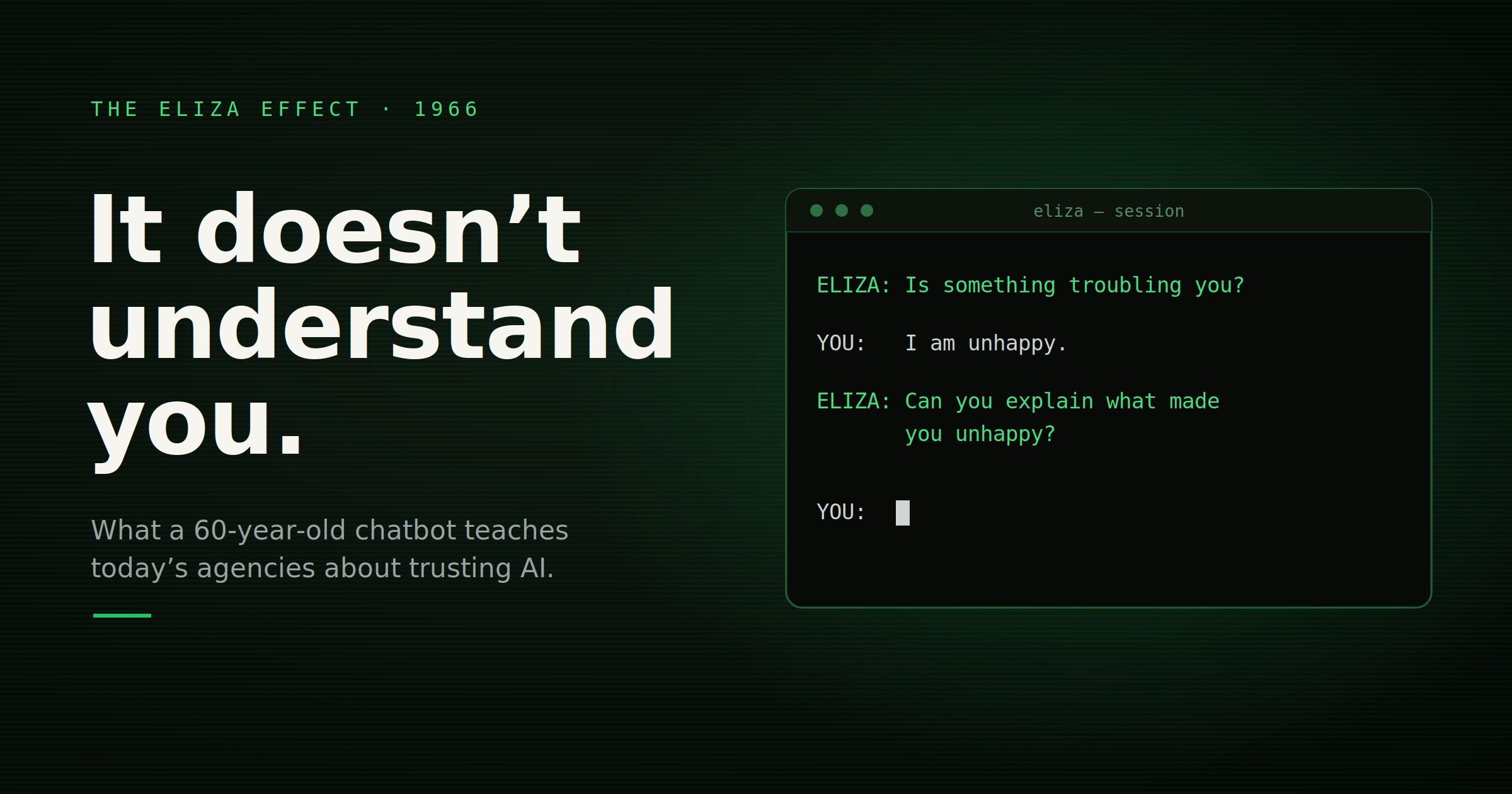
In 1966, an MIT computer scientist named Joseph Weizenbaum built a program called ELIZA. It ran a script he called DOCTOR, a mock Rogerian psychotherapist that did little more than turn your sentences back into questions. You typed "Men are all alike." It replied, "What is the connection, do you suppose?" You typed "He says I'm depressed much of the time." It answered, "I am sorry to hear that you are depressed."
There was no understanding behind any of it. ELIZA had no model of you, your boyfriend, or depression. It matched keywords and reflected your own words back at you with a few hundred rules. Weizenbaum chose a Rogerian therapist on purpose, because that style of conversation is the cheapest kind of intelligence to fake: the program supplies grammar, and the human supplies all the meaning.
Then something happened that haunted Weizenbaum for the rest of his life. People believed it. His own secretary, who knew exactly what the program was, asked him to leave the room so she could talk to it in private. Psychiatrists proposed scaling it up into real automated therapy. Users poured out their feelings to a few hundred lines of code and insisted it understood them.
That reaction now has a name, the ELIZA effect, and it is the single most useful thing your agency can understand about working with AI in 2026.
The danger was never the machine's intelligence
It is tempting to read the ELIZA story as a quaint origin tale, the primitive ancestor of the systems we use today. But the lesson isn't about how far the technology has come. It's about a constant on the human side of the screen that has not moved an inch in sixty years.
We project understanding onto fluent output. The more coherent the language, the more comprehension and judgment we read into it, usually far more than the system has earned. ELIZA proved you could trigger that projection with almost nothing. Today's models are vastly more capable, which makes the trap worse, not better, because fluency has risen faster than reliability. The gap between what a system appears to understand and what it actually understands is exactly where organisations get hurt, and that gap doesn't close as the output gets smoother. It widens.
For an agency, this is not an abstract risk. It's the difference between a polished AI-generated strategy that reads like authority and one that is actually sound. It's the slide deck that sounds right in the room and falls apart when the client's lawyer reads it. The output that fools you is, by definition, the output that sounds most like it knows what it's talking about.
Your smartest people are the most exposed
The reassuring story agencies tell themselves is that expertise is protection. Smart, experienced people won't be taken in by a confident machine.
Weizenbaum's experience says the opposite. The people most eager to turn ELIZA into a real clinical tool weren't naïve outsiders, they were psychiatrists and computer scientists, the domain experts. The effect operates below the level you think you're guarding. "We're too sophisticated to be fooled" is precisely the posture that gets fooled, because skepticism that lives only in individual heads quietly switches off the moment the output is fluent enough and the deadline is close enough.
In a busy agency this shows up as automation bias: the senior strategist who nods along to a machine-written competitive analysis because it's articulate, the account team that ships AI copy with a light skim because it reads clean, the analyst who treats a generated number as a finding rather than a draft. None of these people are foolish. They are behaving exactly like Weizenbaum's secretary, confiding in fluent output because fluent output invites it.
Capability is not the same question as appropriateness
The deeper line Weizenbaum drew, and the one he spent his later career defending, is between can a computer do this and should it. He argued that some functions, judgment, accountability, the relationship at the center of care or of consequential decisions, are the whole reason you have a human doing them. Handing those off is a category error no matter how good the demonstration looks.
This is the question agencies keep collapsing. The hard calls coming aren't mostly "is the model good enough." They're "is this a task where someone needs to remain answerable for the result." Drafting, summarising, ideating, accelerating research, these benefit enormously from AI. The client relationship, the final judgment on a sensitive recommendation, the decision a regulator or a customer will hold you to, these are places where the human isn't a quality-control afterthought. The human is the deliverable. Selling a client your judgment and quietly substituting fluent machine output is the modern version of letting people believe ELIZA was a therapist.
Anthropomorphism is a design choice, and it has costs
Notice that ELIZA's persona, "I am sorry to hear that you are depressed", was a deliberate frame. The first-person voice, the therapeutic warmth, the appearance of empathy: all of it was built to invite projection, and it worked devastatingly well.
Every time a tool is given a name, a warm voice, or a confident first-person "I," that same dial is being turned up. It is not neutral. When your agency puts an AI assistant in front of staff, or builds one into a product for a client, you are choosing how much misplaced trust to manufacture, whether or not anyone made that choice consciously. Designing for honest signals of uncertainty, rather than for maximum reassuring fluency, is one of the few levers that actually pushes back on the ELIZA effect.
What to actually do about it
Demystification helps, but it is not enough on its own. This is the most sobering part of the story: Weizenbaum knew exactly how trivial his program was, and he was still unsettled by what people did with it. Explaining how the technology works does not inoculate a team, because the over-trust doesn't come from ignorance. It comes from fluency meeting deadline pressure.
So the protection has to live in the structure of how your agency works, not in the hope that individuals will stay skeptical:
Build verification into the workflow rather than relying on a final skim. Treat fluent AI output as a confident first draft that is wrong until checked, especially when it sounds most authoritative. Keep a named human accountable for any deliverable a client or the public will rely on, accountability that cannot be delegated to a tool. And be honest, internally and with clients, about what the system is and where it is being used, instead of letting polished output imply a competence that isn't there.
The 1966 demo already ran the experiment for you. It proved that smart, informed people will trust fluent output well past what it deserves, and that knowing better doesn't stop them. The agencies that thrive over the next few years won't be the ones that trust AI the most or the least. They'll be the ones that built their processes around what ELIZA revealed about us, and stopped expecting their own skepticism to hold the line by itself.





